
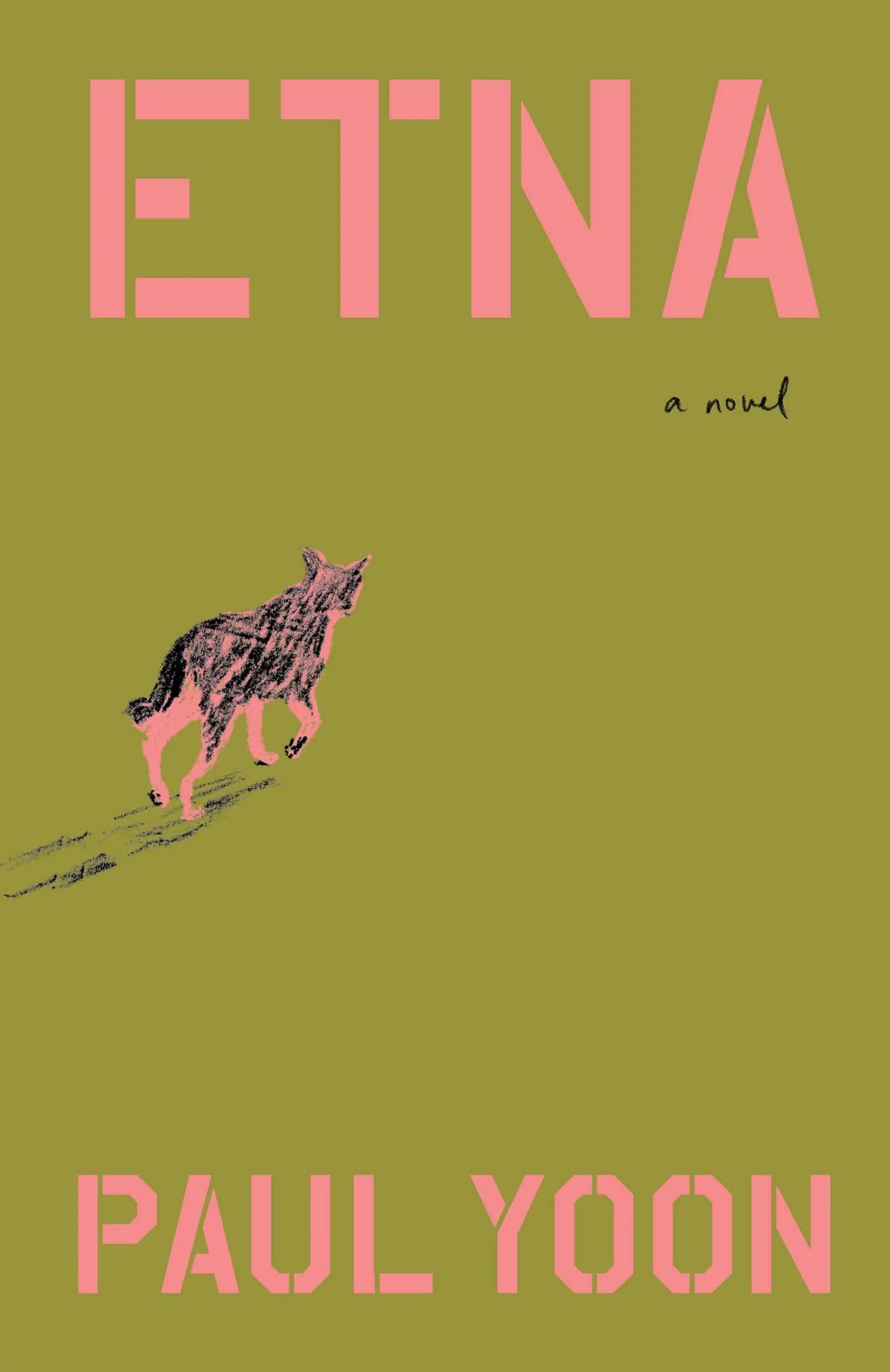
Published August 2026, Scribner | Review By Drew Foster
You’d be forgiven for overlooking the Honorback section at Nāʻālehu Public Library. Occupying the lowest shelf on the rack closest to the front door, it’s populated mostly by advanced readers’ editions sent to the library ahead of official release, as well as the occasional self-published work from a local writer. The books are not officially checked in and out; they’re borrowed on the honor system, hence the shelf’s name.
I’ve found a few gems in this small collection and make a point of regularly inspecting the shelf, which is always changing as books come and go. The Pulitzer Prize-winning novel “Angel Down,” which I wrote about in these pages in April, first appeared at the library as an honorback.
It was on this shelf I found “Etna” by Paul Yoon. I’d been kicking the novel’s tires for a couple of months — picking it up, putting it down; taking it home, returning it unread. Finally, in October, I committed. Good thing, too.
“Etna” is a slim, brisk novel that follows a military dog as it tries to find its way home after the war in which it served has ended. The protagonist, Etna, is a good boy, a smart dog. Maybe too smart, but more on that later. He’s named after the Sicilian volcano Mount Etna and embodies the geologic feature’s traits — Etna is docile and patient, but he can explode in fits of violence. He is a war dog, after all. Yoon tells the story from Etna’s perspective, a crafty device that’s both endearing and vexing.
We meet Etna when he still lives on a farm. He’s soon conscripted into the military of an unnamed country that’s at war with its neighbor. The army needs dogs — to sniff out unexploded ordnance, to find hidden enemies, to fight in close quarters. Quickly, we follow Etna through training, battle and the war’s conclusion. Then the bulk of the novel unfolds — Etna wants to return home. It will be a trying journey.
Who’s at war? We don’t know. A few hints point to North and South Korea. Ultimately, it doesn’t matter. The war is devastating, as wars are, and the land, society and people are left in shambles. But, also, dogs don’t know one country from another, so Etna can’t tell us. Which seems odd because Etna knows a lot that most dogs don’t — he recognizes music and can distinguish one country’s flag from another, he counts, he’s familiar with a vehicle’s gas pedal, steering wheel and air conditioning. My dog recognizes the word “car” — she loathes it; I think she associates it with the kennel — but I doubt she understands how the thing works. Also, Etna seems to be telepathic with a human character named Soojin.
Yoon has a tendency to anthropomorphize his canine characters, which is understandable — writing a novel from a dog’s perspective is not an easy feat. But the tendency wore on me and became hard to ignore. Etna also has fully formed conversations with other dogs. Even a few birds.
Attributing human language ability to animals doesn’t bother me in children’s literature — I absolutely love “Charlotte’s Web,” and those critters talk up a storm. But “Etna” is literary fiction, ostensibly for adults. I thought Yoon could have tried harder to navigate the language issue. After all, it’s been done before — the spectacular sci-fi novel “Children of Time” comes to mind, where intelligent spiders develop a language unique to arachnids.
Still, “Etna” is a good book. It’s a well-paced, fast read. And Etna is easy to love. We care about him. He’s earnest, good, loyal and true. At one particularly hairy point, I remember thinking: If Etna dies, I won’t be able to read another page.
Beneath the novel’s simplicity, Yoon prods heavier existential questions. What constitutes home? How do our futures unfold? Etna shows us that both are up to us — we make our homes, we shape our futures. By our choices, our actions and our principles. Etna’s more than just a good dog — he’s an example of righteous action leading to positive results. That’s a lesson we can all continue to learn.
