
Bookmarks: “The Polynesian Family System in Kaʻū, Hawaiʻi”
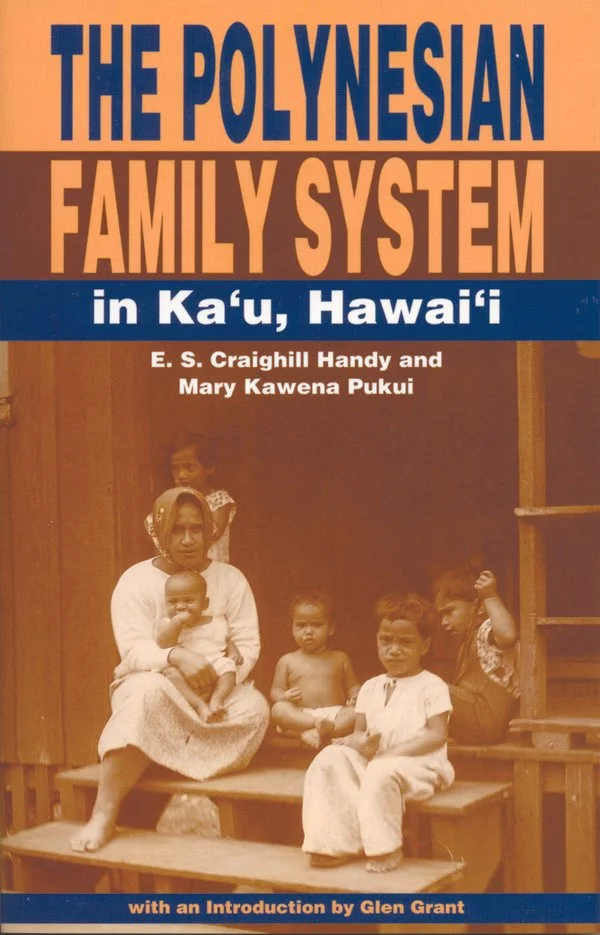
The Polynesian Family System in Kaʻū, Hawaiʻi"
By Drew Foster
Page 146: “The spirit left the body not with the breath, but out of the corners of the eyes (eua ‘uhane), whence tears flow.”
Page 94: Subincision.
Page 186: “It was bad manners … to take bananas or hala to a fishing place.”
This is me randomly flipping through “The Polynesian Family System in Kaʻū, Hawaiʻi” and finding something illuminating, astonishing, or outright jaw-dropping on whichever page I land. Written by E.S. Craighill and the venerable Mary Kawena Pukui, “The Polynesian Family System” is much more than a book, it’s a window into a disappearing world.
Anyone hoping to better understand Kaʻū, its people, its traditions, its history, and the many societal threads that make up the fabric of the district’s character should race to one of our local libraries and request a copy posthaste. Better yet, purchase the book and add it to your shelves at home. I scored my copy years ago at the OKK Farmers Market in Nāʻālehu, but it can also be found through Mutual Publishing’s website.
"The Polynesian Family System in Kaʻū, Hawaiʻi" was first published in 1958, the fruits of Ms. Pukui’s research in the 1930s, working with relatives to establish a record of Hawaiian life prior to Westernization. As Glen Grant writes in the introduction, it “(weaves) a psychic and cultural tapestry of (a) Hawaiian worldview which few studies before or since have been able to match.” And it’s held up – the book continues to be used in Hawaiian Studies classrooms at the University of Hawaiʻi-Hilo.
Though in places dense and academic, “Family Systems” is wide-ranging in breadth and stunning in detail. Standouts include chapters five (The Life Cycle) and seven (Traditional Manners and Customs and the Social Order), which provide a deep-dive into daily living with sections on everything from an infant’s diet, sickness and death, affection, wailing, bad manners and inhospitality, lending a hand, and dining etiquette. The section on subincision is staggeringly fascinating and completely unfit for print in this family-friendly newspaper. In Beauty-modeling, we learn that “The ends of (infants') fingers were gently rolled between the thumb and index finger to make them taper.” In a subsection titled The Fontanel: “It was believed that a baby under four months old could be nourished by a small mound of raw, grated sweet potato on the fontanel.”
Chapter Two (The Physical Environment) details this region’s terrain and seasons, while Chapter Three (The Legendary Setting) explores the gods most important to Kaʻū, Pele being chief among them. “If Pele is not real to you, you cannot comprehend the quality of the relationship that exists between persons related to and through Pele, and of these persons to the land and phenomena, not ‘created by’ but which are, Pele and her clan.”
Let me acknowledge that I am not kamaʻāina. I am not Kānaka Maoli. My family has only been in Kaʻū since 1997. Too often, in conversations with other mainland transplants, I hear people disparage Hawaiʻi as a place that would languish without Westernization. “The Polynesian Family System in Kaʻū, Hawaiʻi” thrashes that perspective. It presents, instead, a comprehensive, multilayered culture rich in customs, traditions, and kinship.
This book details and celebrates a people completely in tune with their surroundings, tying natural resources to deities and divinities. Land stewardship was not only an environmentally sound practice, but an act of worship and righteousness. It offers a near-complete picture of life and living in old Hawaiʻi. It is an astonishing volume you’ll want to read with the book in one hand and a highlighter in the other, to easily find the most interesting tidbits when you pull it off the shelf months and years after having read it the first time. Treat yourself to this book.
