Kaʻū Coffee Festival Celebrates Local Flavors & Resilience
By Jessica Andrews | Photos By Tim DeLozier
Of the myriad ways he and his fellow coffee growers prepare their cherries for roasting, Brandon Damitz gave honey processing the chef’s kiss.
Manning a French press at the Kaʻū Coffee Experience inside the Pāhala Community Center on June 20, Damitz, his wife Kelleigh Stewart, and their staff at Big Island Coffee Roasters explained the difference between washed, semi-washed, and honey-processed methods, as well as drying cherries with the fruit layer intact.
“It’s like you got a fruit rollup surrounding the coffee seed itself. Those tend to be very fruit forward,” Damitz said. “They’re hard to execute because mold during the drying process is very common.”
Though based in Puna, Damitz has worked with local farmers for 15 years and noted that Kaʻū and Puna coffees share similar flavor profiles. “Our coffee was mostly growing in pāhoehoe — it always had this slightly savory, or umami character,” he said. “We found that something grown at 1,800 to 2,000 feet in Kaʻū is matching the same amount of acidity for a Puna coffee at 1,000 feet.”
Damitz and Stewart were among more than 11 growers at the hoʻolauleʻa that capped off the weeklong festival. While participant numbers were down by five, Kaʻū Coffee Growers Association representative Brenda Iokepa-Moses called it a win: “The reason we don’t have those five is because they’re doing so well, they didn’t have product ... They sold out.”
Iokepa-Moses, a former C. Brewer Sugar Company HR employee, recalled how sugar workers received 5-acre land parcels for five years after the plantation closed. While some tried vegetables, others turned to coffee.
“Those coffee farmers went through their struggles, but they’re here today,” she said. “They have persevered and now they’re award-winning coffee farmers.”
She noted that Kaʻū’s deep volcanic soil produces a sweeter bean than Kona’s shallow, rocky soil, though she gave credit to their neighbors: “We give kudos to the Kona coffee farmers because they got the coffee out there.”
Luke Kanahele, who operates Kāʻlae Coffee in Nāʻālehu with his wife Chauntelle, drank his first cup at age 6. “I was a little kid running around the booths at Nāʻālehu, and I think one of the first coffees I tried was Rusty’s Hawaiian,” he said. “I remember begging, ‘Can I try it?’ And I was like, ‘This is amazing!’”
To Kanahele, though, coffees around the island are so similar that distinguishing Kaʻū varieties from others is difficult. A lot depends on who is growing the cherries, how it’s being processed, and how it’s roasted, he said. The growing conditions in Kaʻū, the abundant rain, and the more nutritious soil make for a robust flavor, Kanahele said.
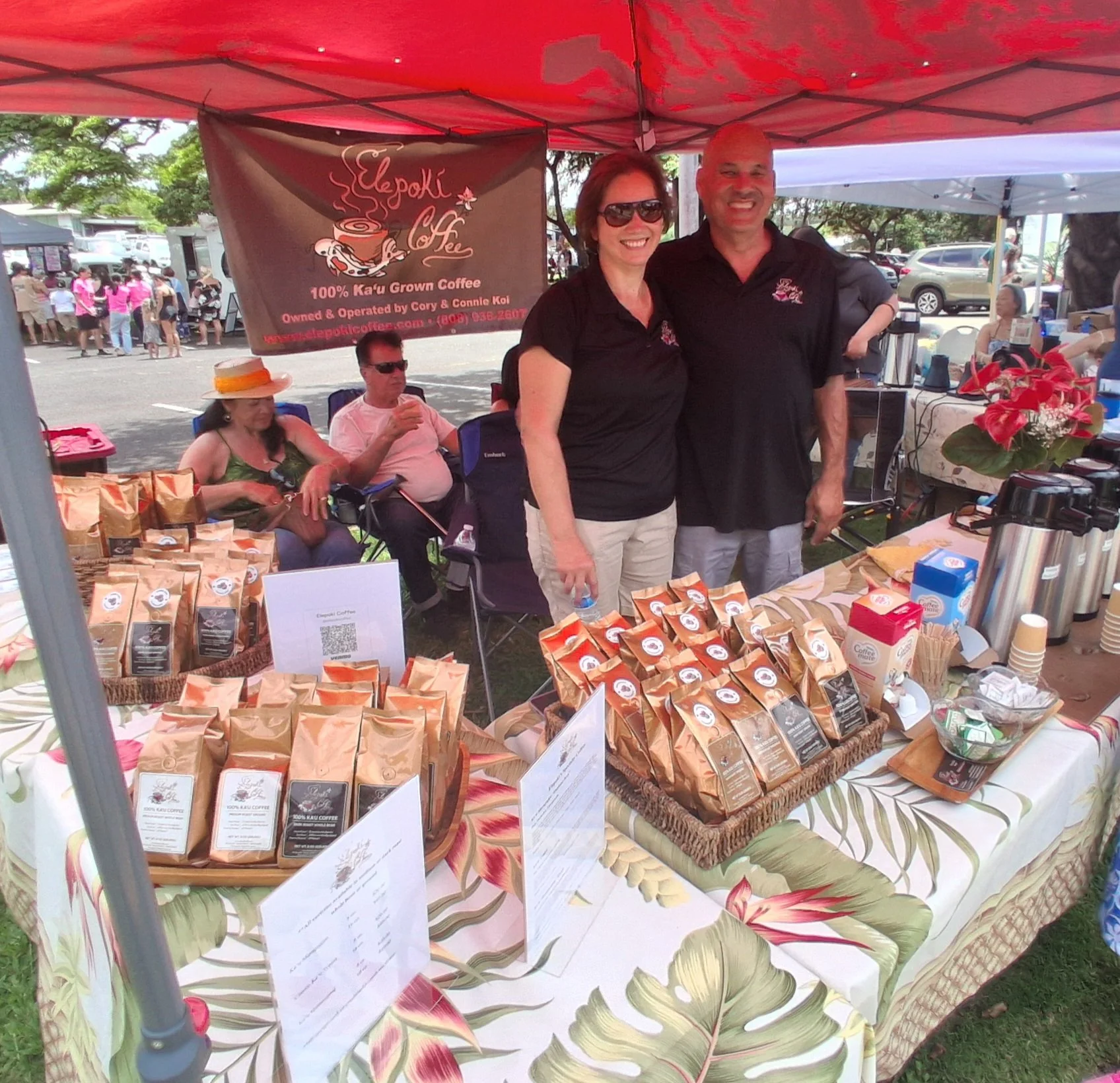
Connie and Cory Koi have been operating Elepoki Coffee since 2018, farming in the Cloud Rest and Wood Valley areas above Pāhala. Because she competes with other growers, Connie Koi said the Kaʻū Coffee Festival is important because of the exposure.
“Once people try our coffee, they can appreciate the quality,” she said. “We have different varieties of coffee and we take pride in separating our crops so we can showcase them separately.”
Elepoki Coffee features four different varieties of coffee, including red and yellow bourbon as well as the classic caturra.
“As far as processing, we process all-washed varieties,” Connie Koi said. “Preparing it, I like a medium roast — you can just drink it straight.”
Jackie Castaneda and her husband were among the plantation workers who went on to farm coffee.
“We started this thing,” she said, adding that her family has been attending the Kaʻū Coffee Festival since it started. “Really, we try to come and support everybody.”