
The Kaʻū Coffee Trail Run returns for Its 10th year
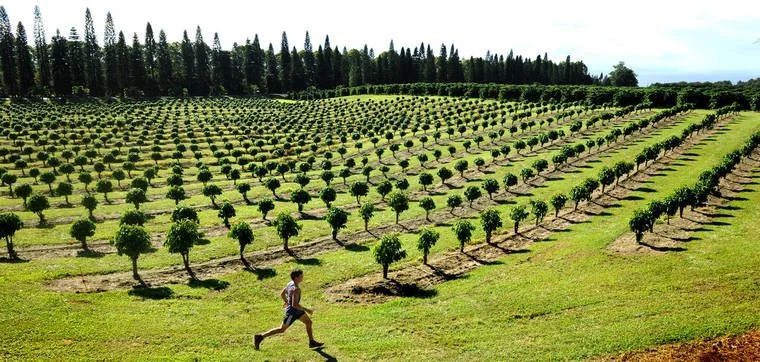
Epic scenery and caffeinated camaraderie: The Kaʻū Coffee Trail Run returns for its 10th year
By Sara Stover
The southernmost running race in the U.S. returns to Pahala this September, offering participants the rare opportunity to run through the vibrant coffee fields of the Kaʻū Coffee Mill in Wood Valley. With 2025 marking the Kaʻū Coffee Trail Run’s 10th edition, the trail race will once again be spearheaded by race director Nick Muragin.
“There’s no other race with a venue like this. It’s invigorating and peaceful at the same time. You’ll wish you could run here every day,” Muragin said. On Saturday, September 20th, the trail run will begin at the Kaʻū Coffee Mill with a family-friendly 5K for runners (and dogs) of all ages. Participants in the 10k can expect a moderate, uphill challenge, while the half-marathon offers 180-degree ocean views to elevation-seekers as they cross the slopes of rural Kaʻū.
The highly challenging 50K race, which was added in 2021, typically attracts an average of 23 participants. Twenty runners had already registered for this year's race by the end of July, and Murigan anticipates that more will sign up as the race date approaches.
When ‘O Kaʻū Kākou (OKK) debuted the first annual Kaʻū Coffee Trail Run in 2014 with a 5K, 10K, and half-marathon option, the event was one of several projects that the community service non-profit organized for the improvement and well-being of Kaʻū and its residents. Today, the run continues to support OKK’s community efforts. According to the race website, OKK uses the proceeds to fund local scholarships, the purchase of life-saving equipment for Kaʻū Hospital, restoration and maintenance of three historical cemeteries, and sponsorship of the 4th of July Parade, among other events.
“We used to see 400 runners register, then the pandemic hit. There was no race in 2020, and since 2021, registration has been hovering around 200,” said Murigan, who took over for OKK as the race director in 2022. “Kaʻū is like its own island on an island. I wanted to help out because my Dad was born here. As a kid, I hung out here a lot, hunting and fishing. The highlight was camping down at South Point.”
“For those coming from out of town or even further away, the trail run is a window to the small towns, old plantations, beautiful farms, and working ranches of Kaʻū,” said Murigan, adding that participants have come from as far away as Illinois, Texas, Colorado, and even Japan and Germany to race. “It brings awareness to the farming community here and to Kaʻū coffee. There’s so much to be proud of. This is old Hawaiʻi. This is the way it should be.”
In addition to being the southernmost trail race in the U.S. and one of the only races staged entirely on a coffee farm, the Kaʻū Coffee Trail Run’s dog-friendly reputation makes it stand out. As long as a registered walker or runner’s dog is on a leash, it can participate in the race and attend the post-run activities with its human.
“We try to make it better and better every year. We’ve lowered the price to make it more accessible and made adjustments so the course flows better. Two years ago, we took out some of the out-and-back in the 10k. Since then, we’ve changed the 5k course, so you don’t go across into the mac nut orchard anymore. Now it’s mauka side like the rest of the distances,” Murigan explained. “With elevation gains of nearly 450 feet in the 5k, over 800 feet in the 10k, more than 2,400 feet in the half marathon, and a two-loop 50k that rings in at 5,315 feet of elevation, the race is literally breathtaking. “The course speaks for itself. The views are priceless.”
“It’s rural, it’s challenging. My favorite part is the downhill, but you have to watch your footing,” said Patrick Stover, cross-country coach at Makua Lani Christian Academy. After participating in the first half-marathon in 2014, he won it in 2015 and went on to become the overall winner of the race’s first 50k in 2019. “If you’re planning on doing the half, don’t go out too fast on the first 5k. Take it easy and save your energy for the hill. It’s tough to get up it, but you get a panoramic view of Kaʻū at the stop. You see nothing but the ʻāina all the way to the ocean. The scenery makes it all worth the climb.”
Stover adds that while hydration is provided at aid stations along the course, many runners choose to carry their own water or sports drinks, as well as energy gels for fuel.
“Be sure to fuel and stay hydrated because you’ll be out there longer. Expect that it will take you 15 to 30 minutes longer to run this than a road race. You’ll be going slower, but you’ll never get bored. If it gets hard, stop and walk, breathe, and look around at where you are. Let it soak in,” Stover advised. “If you’re doing the half-marathon or 50k, you’ve got to train for trail running because it involves more technical skills than road running. If you want to do the 5k or 10k, I suggest doing a few 30 to 45-minute walks or runs during the week and a three to five-mile run or hike off-road on the weekends. The Kahuku Unit of Hawaiʻi Volcanoes National Park would be great for that.”
“My advice for half marathoners is to wear trail running shoes that are broken in, but not too old that the soles are worn down. Wear them on some long runs before race day to make sure they have good traction,” says Yuko White of Ocean View, who ran it last year with her husband, Drew. The two stopped to take photos throughout the race, capturing the course’s epic views as the elevation changed.
All race distances will finish at the Kaʻū Coffee Mill, where each 2025 participant will receive a medal when they cross the finish line, as well as light snacks and hydration. As in years past, the mill’s coffee shop will open early on race day, and local vendors from the Kaʻū community will be selling snacks and beverages as part of the post-race festivities.
“The Kaʻū coffee and the food trucks after the race might be one of my favorite parts every year, especially the Filipino food truck. That and supporting OKK,” said race announcer Edgar “Eddie O” Ombac. “The race ends with a descent, and it’s really exciting to be at the finish line and watch everyone come running down that hill.”
“If you’re going to tour a coffee farm, this is the way to do it,” Murigan pointed out. “There are so many reasons to join us for this trail run, but health is at the top of the list. It’s a chance to be outdoors, breathe the fresh country air in the morning, get some exercise, and enjoy the unique camaraderie that trail running offers.”
“You get everyone out here, from serious competitors to families with their kids. And then there are the volunteers who haul everything up to the aid stations on ATVs. They’re hardcore,” adds Stover, who shares that one of his fondest memories of the race is of powering up the hill, being cheered on by two student volunteers who were directing runners to ensure that no one got lost running through the forest above the coffee field. “Every time I race this, I’m moved by the hospitality that the local volunteers and businesses show us. When you get here, it’s like you escaped civilization and reconnected with nature. It’s a privilege to run in Kaʻū. It’s the last untouched gem of the island.”
“Every year, the community welcomes the participants with open arms, and the coffee mill opens up its doors and fields. This is about challenging yourself, but it’s also about being part of something bigger - Celebrating Kaʻū,” Murigan concluded.
Sign up to participate in or volunteer for this year's trail run at KauCoffeeTrailRuns.com.
