
Story and Photo By Jessica Andrews
Jeffrey Silva spent Hurricane Lala at Punaluʻu. It was complete insanity, he said.
“We were evacuating people in the middle of the night and getting them into units that weren’t flooded,” said Silva, president of the Association of Apartment Owners of Colony 1 at Sea Mountain. “Thirty-four units were flooded with mud — 34 out of 76 units — so that’s almost half of the units that got flooded.”
As chaotic as the hurricane was, Silva said the aftermath has been miserable for residents at Colony 1 and Kalana Golf Estates on the mauka side of Highway 11, who are customers of Punaluʻu Water and Sanitation. The utility has been operating since the 1970s, but was purchased in 2020 by Eva Liu, the developer who also owns Black Sand Beach LLC.
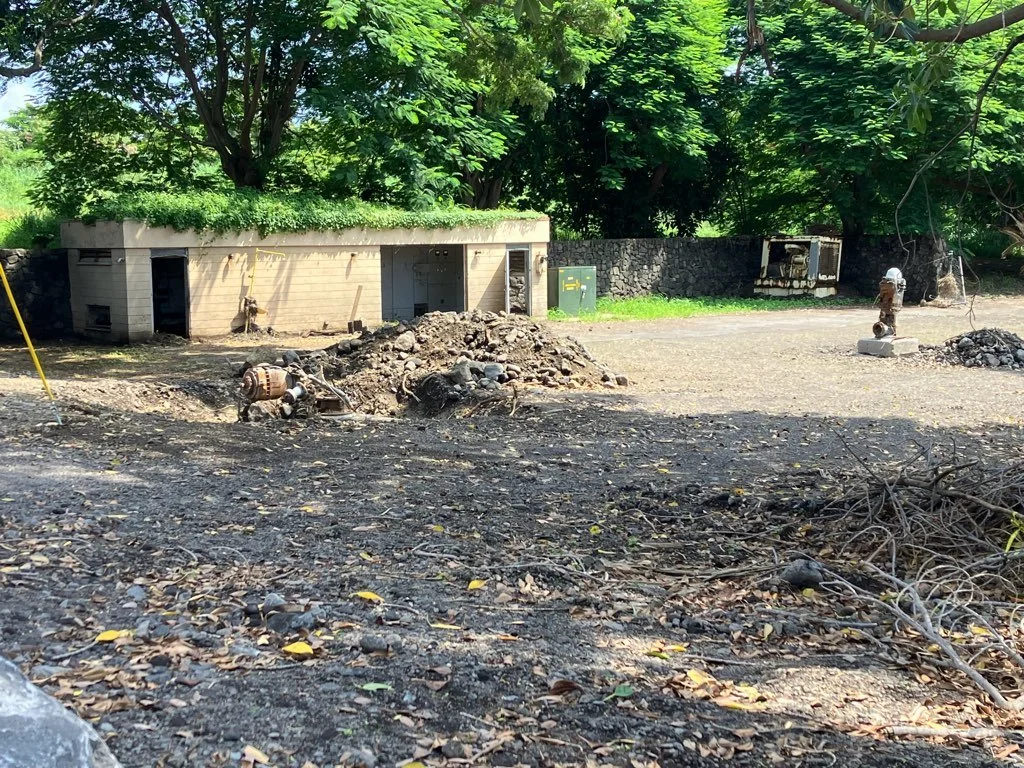
On Aug. 15, the same hurricane-driven rain that scoured new gullies into the mountainside sent a cascade of debris that buried the well supplying homes with drinking water and inundated the electrical system that powers the sewer plant.
After conducting an assessment of the water well and the wastewater pumping station and letting operators know the situation, Silva purchased two water tanks on his own credit card. A friend picked them up in Hilo as soon as the highway reopened, and they were functioning and filled by Aug. 21, but the water wasn’t drinkable.
The Association of Apartment Owners also purchased portable toilets for each unit at Colony 1 and Kalana Estates. PWS should have provided those services, Silva said. “This is the kind of stuff that a normal public utility would do in a situation. They have provided none of it.”
The Association of Apartment Owners also purchased portable toilets for each unit at Colony 1 and Kalana Estates. PWS should have provided those services, Silva said. “This is the kind of stuff that a normal public utility would do in a situation,” he said. “They have provided none of it.”
Silva, a Class 4 water operator himself, said Hurricane Lala damaged a system that had not seen significant improvements since Liu took it over nearly seven years ago. When PWS sought Hawaiʻi Public Utilities Commission approval for a temporary rate increase to avoid a sudden loss of essential water and wastewater service, Silva said he and other residents formed Nīnole Wai, a user-led effort to take over the system.
“We have big traction,” Silva told Kaʻū News of the Nīnole Wai Community Association. “We have a high level of support in the community. We have a high level of support with all the water users and we’re on the verge of forming a nonprofit.”
Colin Sakumoto, the ʻEwa Beach attorney representing PWS, agreed that the utility should have provided the water tanks and portable toilets.
Speaking with Kaʻū News on Oct. 3, about a week after Hurricane Nolo crept within 150 miles of South Point, Sakumoto said it’s something the utility would have “liked to have provided,” but PWS was focused on restoring water to the sewer system. Sewer services would have resumed had it not been for Hawaiian Electric’s decision to depower electricity to the plant ahead of Nolo, he said.
According to Sakumoto, as long as the water and sewer systems are inoperable, PWS has been unable to bill for service. As of Oct. 3, it had been about seven weeks.
“I hope that the community also submits their requests for reimbursements to the PUC,” Sakumoto said, adding that PWS wouldn’t bill its customers since it is unable to provide water. “They deserve to be reimbursed, absolutely.”
PWS will focus on getting SBA loans to cover repairing the system from the storm, Sakumoto said. “We would never bill anyone when we’re not providing water — that’s unconscionable,” he said. “There are bills for the month of August prior to Lala that we could bill for. But I’ve told PWS that you’re not going to submit those bills since you’re not providing water. It’s totally unethical to do so. I think it’s good because that money perhaps they applied to get portable toilets and water tanks and fill up the water tanks they’ve been using.”
In an Oct. 8 letter sent to Public Utilities Commissioner Naomi U. Kuwaye, Sakumoto said that following an inspection by an electrician and an on-site inspection from the Department of Health, the wastewater treatment plant would be operating by Oct. 12.
The well that provides potable water to Colony 1 and Kalana Estates, however, is totally destroyed, Sakumoto told the PUC. He said the county authorized PWS’s water hauler, Five-O Pumping, to use the fire hydrant near Kaʻū Hospital to fill its 3,000-gallon potable water tank.
“The county requires Five-O Pumping to agree to the terms, and I have personally requested that Five-O Pumping sign the agreement,” Sakumoto wrote. “But Five-O Pumping would prefer to haul water from a different potable water site, which is incredibly frustrating, but since they are the only certified hauler willing to haul potable water to Punaluʻu, it is not like I can threaten Five-O with anything.”
Sakumoto told the PUC that he would sort that challenge out. His letter was in response to an Oct. 1 letter from PUC Counsel Maria Y. Wang informing him of a public meeting at which “PWS will be expected to answer” a list of questions. Wang’s letter also demanded PWS’s plans for repairing both the water and wastewater systems.
In his letter, Sakumoto reiterated his statement to Kaʻū News that the sewer system would have been restored had it not been for Hawaiian Electric's precautions ahead of Hurricane Nolo. PWS built a berm to redirect floodwater from the hurricane, which sat about 150 miles offshore before drifting away from the Big Island on Sept. 26.
“While the berm did hold, Nolo caused significant damage to it,” Sakumoto told Kaʻū News. “It needed to be repaired. (Nolo) also took out a bridge that was on the golf course, which is also directing water to the wastewater plant.”
In his letter to the PUC, Sakumoto called the potable water system at PWS a complete disaster. A breakdown of concrete steps to restore full service to the system would be “totally useless” since the water operator concluded that the pump needs to be replaced, as does the motor control center, Sakumoto wrote.
“PWS cannot afford to repair the well site,” he told the PUC. “And it is not like PWS is close to affording the repairs that a reasonable rate increase would do the trick. No, PWS is nowhere close to affording the repairs to the well site. There is no concrete plan to restore the potable water system because PWS, concretely, cannot afford to repair the well site.”
PUC staff and Kuwaye visited the PWS service area on Aug. 28 to view reported damage to the water and wastewater systems, Communications Officer Deborah Kwan said in an email to Kaʻū News on Oct. 9.
Though Kuwaye asked Sakumoto to provide the system’s near-term and long-term plans for restoring essential services and keeping PWS customers updated, the utility has yet to provide all requested information, according to Kwan.
In her email, Kwan said that in a May 15, 2026 order extending a temporary rate increase through May 2027 “or when a final decision and order is issued,” the PUC addressed potentially placing PWS into receivership as an alternative.
Despite the PUC’s openness to placing the utility into receivership, Silva said it would be cumbersome for Nīnole Wai to take over operating the system in the current situation. “Even though Nīnole Wai is going to be a nonprofit, we would not have any of the funding available to nonprofits available to us because we’d be running a privately owned water system,” he said. “The only avenue for a nonprofit to get funding is if we have full and complete ownership.”
According to Sakumoto, the PUC will transfer ownership of PWS to any entity that shows it has the financial ability to cover repairs. “Unfortunately for my client, they’re in a position here where they’re being forced to perform repairs they can’t afford,” he said. “But if another entity steps up and says, ‘hey, we have sufficient funds to cover these repairs, give us PWS,’ well, that will happen. That’s exactly what will happen. But I have a feeling [Nīnole Wai doesn’t] have sufficient funds.”
Still, the lack of water worries residents. Mike Tom, who was off-island during Hurricane Lala but hurried back to his Kalana Estates home after, said that while this is the first time the area has been without water and sewer since he moved there about 25 years ago, it has always been a concern since Liu purchased the property.
There were community meetings over it and discussions with county officials, Tom said, primarily about the fire hazard. “We used to have fires every year across the street from us and none of the fire hydrants worked,” he said.
There’s no water to fight fires and the area is inundated with heavy brush, Silva told Kaʻū News on Sept. 25. That morning there was a fire at Kāwā and the day before there was another at Nīnole Cove, he said. Silva said he worries when the vegetation begins drying out. “We’re in real danger,” he said. “We have no fire suppression and they’re not doing their jobs for firebreaks or anything.”
