
Stars Over Kaʻū: May/June 2026
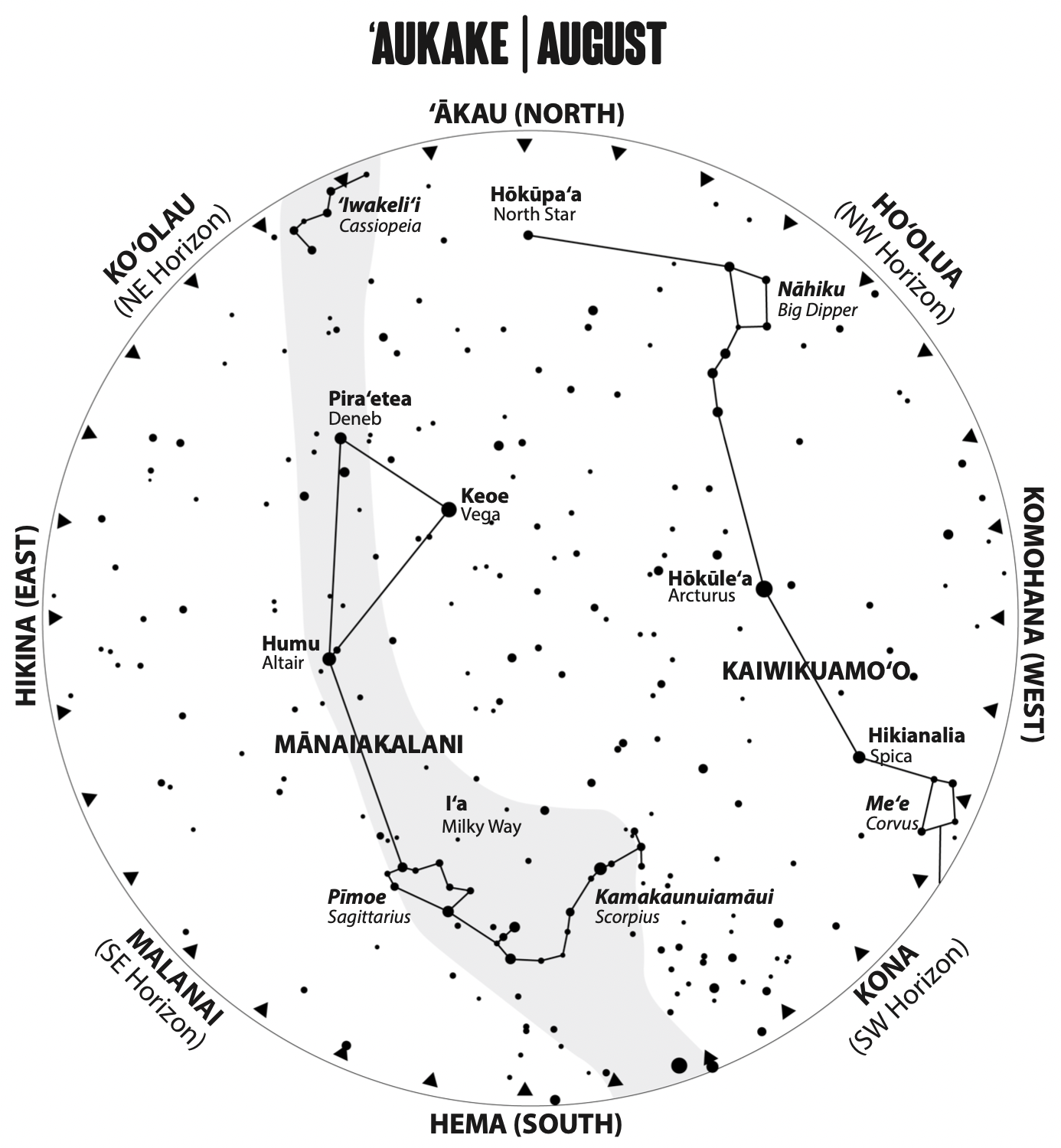
Image credit: ʻImiloa Astronomy Center of Hawaiʻi
By Christopher Phillips
Aloha stargazers! These next few months offer a beautiful selection of planets visible in both the evening and early morning skies. The highlight of this planetary menagerie is a major four-planet alignment consisting of Mercury (Ukalialiʻi), Venus (Hōkūloa), Saturn (Naholoholo), and Jupiter (Ikaika). It occurs in the morning sky and is best viewed on June 4 with the crescent moon. Make sure to observe this celestial parade from a location with a clear horizon to appreciate the alignment in full. These planetary appearances make for an excellent show throughout the following months, and you can expand your viewing pleasure by observing the planets through binoculars or a small telescope. Whether you’re out at sunset or up before the birds, our Kaʻū skies have something for every stargazer.
May brings with it a "blue moon." Typically, we experience only one full moon in a given month. However, there are months where the timing is such that we experience two full moons in a single month. This second full moon of the month is known as a blue moon. Our first full moon of May occurs on May 1, followed by a second full moon on May 31. However, if you like your skies nice and dark to see the spectacular Milky Way in our Kaʻū skies, then you will want to wait until around May 16 when the moon is in its new moon phase.
In the months of May and June, the Hawaiian starline of Ka Iwikuamoʻo (The Backbone) dominates our night sky. It is sometimes represented as the backbone of a great lizard or that of a genealogical backbone, with each star representing a generation. This magnificent starline begins in ʻĀkau (North) and extends from Hōkūpaʻa (the fixed star), which in Western tradition is known as the North Star, Polaris. Our starline extends all the way to Hema (South) to Hānaiakamalama (Cared for by the Moon), which is known as the Southern Cross. The line can be traced through the various constellations that make up Ka Iwikuamoʻo just as one can trace oneʻs own genealogy, a path from oneʻs self to oneʻs ancestors, back through time. Each set of stars is a unique entity with its own identity.
When tracing our path toward Hema, we encounter Nā Hiku (The Seven), or the Big Dipper as it is known. We then encounter Hōkūleʻa (The Star of Gladness), known as Arcturus in the constellation of Boötes. Hōkūleʻa is a zenith star here in Hawaiʻi, a star of prime importance to Polynesian navigators as they chart their course home. Hikianalia is our next stop on our way south. You may recall that both of these stars, Hōkūleʻa and Hikianalia, are the names of the two famous voyaging canoes of the Polynesian Voyaging Society, both of which participated in the historic worldwide voyage. Farther south still, we encounter Meʻe, which you may know as the constellation of Corvus the Crow.
We conclude our genealogical journey across the heavens from ʻĀkau to Hema at a formation of stars known as Hānaiakamalama. We have charted not only the stars on our journey, but we have metaphorically charted a course through time and space, discovering our beginnings, our ends, and those that stood in the spaces in between.
For decades, astronomers have pointed to the heart of the Milky Way and declared with growing confidence that a supermassive black hole lurks there. Known as Sagittarius A*, this unseen heavyweight, some 4 million times the mass of the Sun, has revealed itself indirectly through the dizzying orbits of nearby stars, whipping around an apparently empty point in space. It has even, in recent years, cast a shadow as can be seen in that now-iconic ring of light captured by the Event Horizon Telescope. And yet, what if that conclusion so long held as settled science is not the final word?
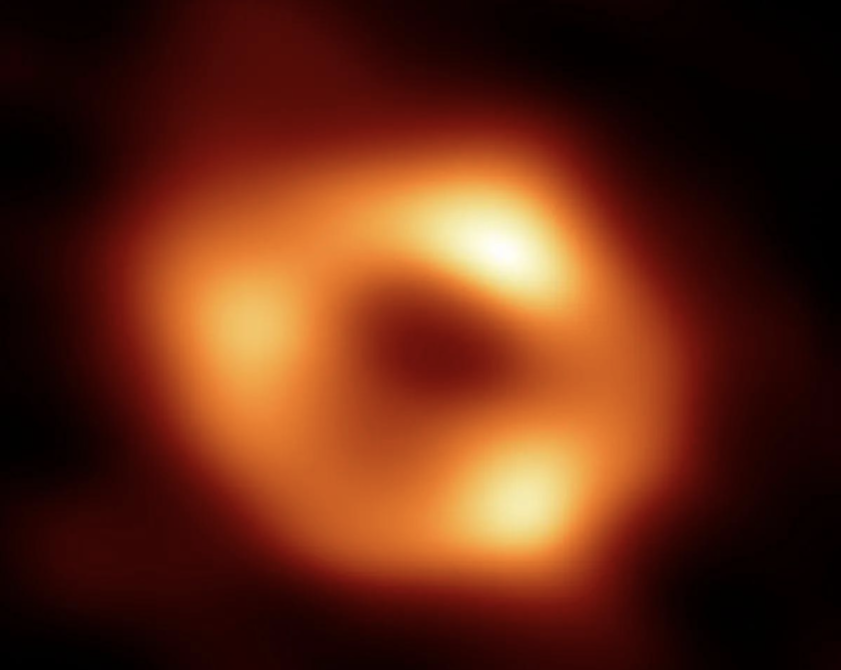
The first ever image of Sagittarius A* at the centre of our Galaxy. Credit: EHT Collaboration. Credit EHT Collaboration.
A new study proposes a provocative alternative: Perhaps there is no black hole at the center of our galaxy at all. Instead, the same gravitational effects might arise from something far more elusive: a dense, compact core of dark matter. Dark matter, that invisible scaffolding thought to make up most of the universe’s mass, is usually imagined as a vast, diffuse halo surrounding galaxies. But in this new model, it takes on a dual role. At the Milky Way’s center, dark matter particles could be highly concentrated. This central concentration would exert a gravitational pull strong enough to shepherd stars into the same rapid orbits we observe today.
Crucially, the theory does not stop at the galactic center. It also claims to explain the behavior of the galaxy on much larger scales — the way stars orbit across the Milky Way’s disk, governed by its so-called rotation curve. In this view, the central object and the surrounding dark matter halo are not separate components, but different expressions of the same underlying substance. Perhaps most strikingly, this dark matter core could even mimic one of the defining signatures of a black hole: its shadow. By bending light intensely — a phenomenon known as gravitational lensing — the dense core could produce a dark central region encircled by a bright ring, eerily similar to what astronomers have already observed.
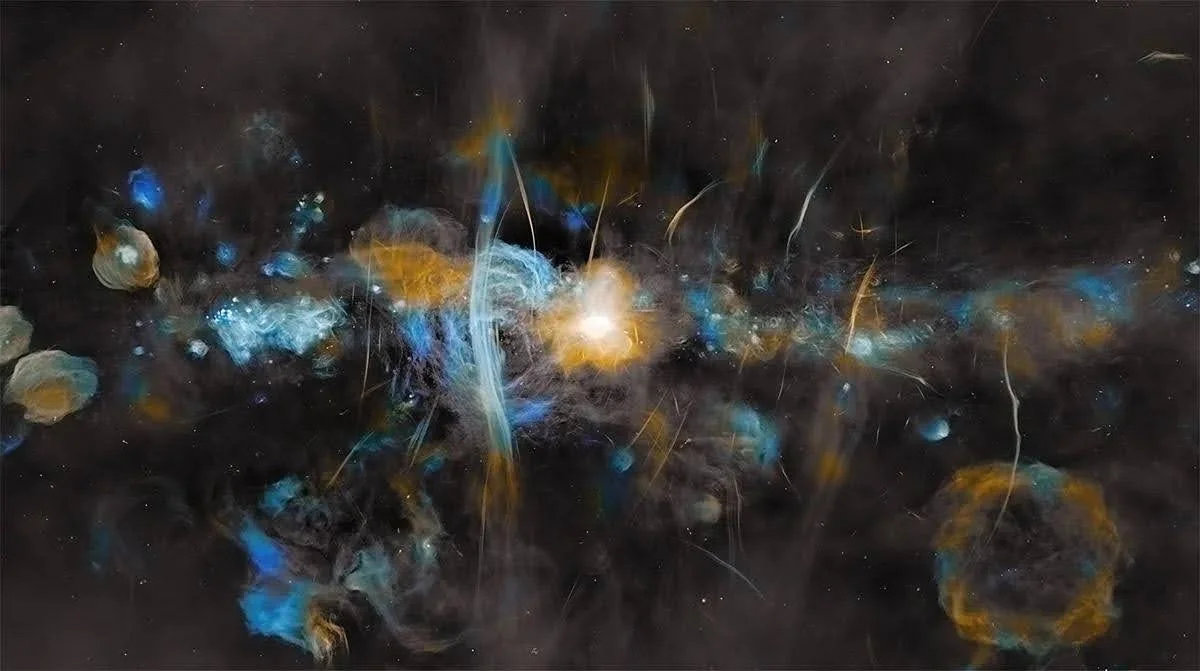
An image of Sagittarius A* at the centre of the Milky Way, captured by the MeerKAT radio telescope. Credit: NASA, ESA, CSA, STScI, SARAO, Samuel Crowe (UVA), John Bally.
If true, the implications would be profound. The familiar picture of galaxies anchored by central singularities, bottomless pits in spacetime, might give way to something more continuous, more interconnected. Instead of a black hole acting as the galaxy’s engine, the Milky Way could be structured by a vast, unbroken "skeleton" of dark matter, stretching from its core to its furthest reaches. However, the traditional black hole model remains extraordinarily successful, supported by decades of observational data. This new idea, while elegant, is still a hypothesis and one that must withstand the scrutiny of future measurements and sharper observations.
For now, though, the lesson is a humbling one. Even at the center of our own galaxy, a place we might imagine to be well understood, the cosmos keeps its secrets close. And every so often, it reminds us that certainty in astronomy is often just the prelude to an even deeper mystery.
