
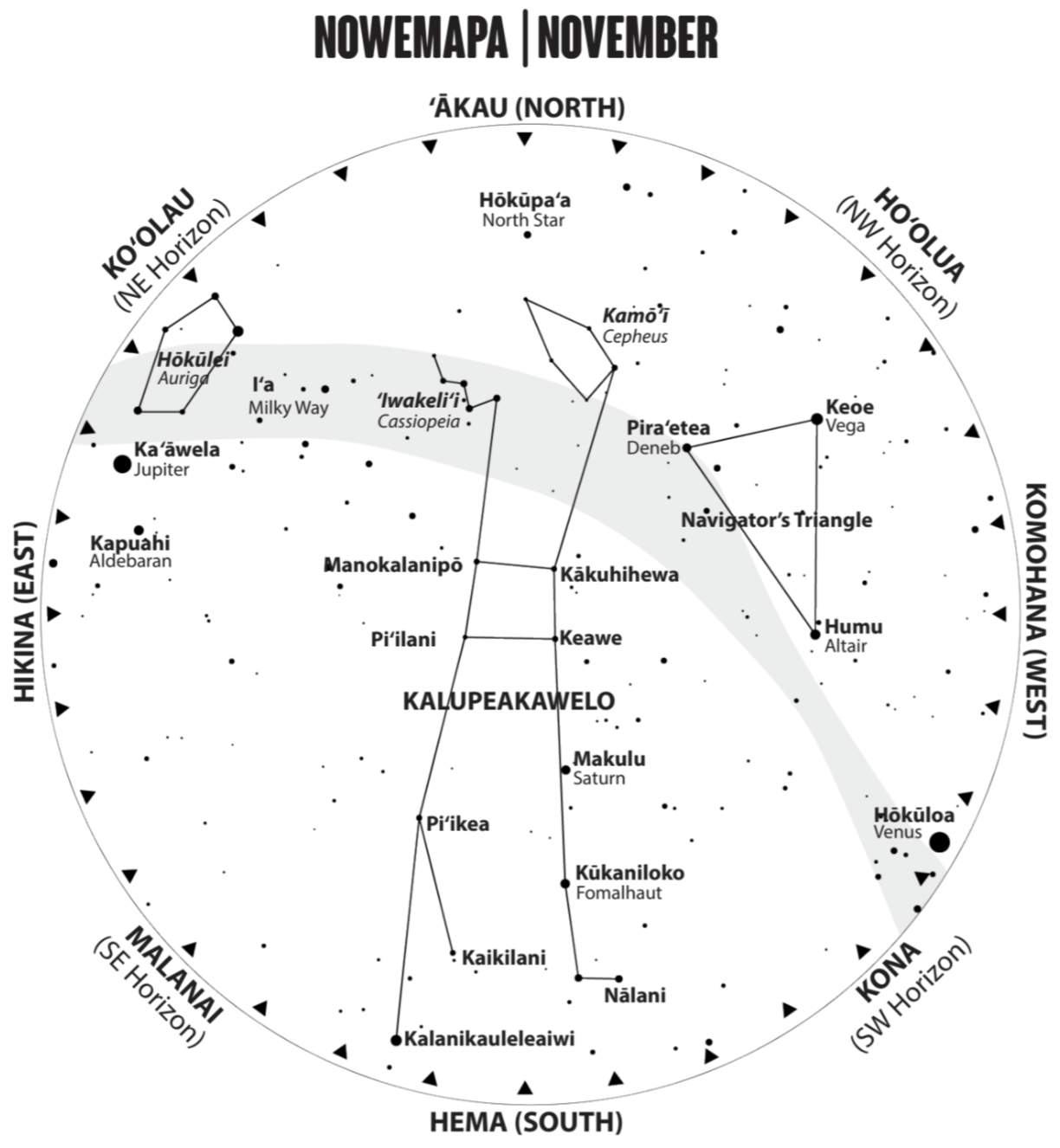
Image credit: ʻImiloa Astronomy Center of Hawaiʻi
By Christopher Phillips
Greetings stargazers! This month our planet parade has shifted, with the best viewing now happening in the morning sky before sunrise. Venus (Hokuloa) has moved into the dawn sky and is no longer visible at sunset. Saturn (Naholoholo) is still visible in the evening, but it now appears high in the south at twilight and begins to set in the west around midnight. Jupiter (Ikaika) rises in the east a bit before midnight, followed by Mars (Holoholopinaau) around 11pm. Both planets are quite bright and will remain visible together until sunrise.
Our Hawaiian Sky
During the months of November and December, the Hawaiian starline of Kalupeokawelo continues to dominate our skies. Kalupeokawelo is known as The Kite of Kawelo, and it is composed of some asterisms (collections, or patterns of stars) that may be familiar.
The largest of these is the Great Square of Pegasus, which is the mythical winged horse of Greek mythology. This large formation of four bright stars is the body of the kite of Kawelo. The four stars of the Great Square are named for Hawaiian chiefs: Keawe of Hawaiʻi Island, Piʻilani of Maui, Kākuhihewa of Oʻahu, and Manokalanipō of Kauaʻi.
From each corner star of the square we see celestial lines that are the guidelines of the kite. The lines are anchored in the northern sky to ʻIwakeliʻi, the constellation of Cassiopeia with its distinctive “W” shape. There is also Kamōʻī, known as Cepheus the King in Greek mythology. In the southern sky they are held in place by Piʻikea (Diphda); Kaikilani (Ankaa); Kalanikauleleaiwi, which is the bright blue giant star Achernar; Kūkaniloko, which is the star Fomalhaut; and Nālani, known as Alnair in Grus the Crane.
The story of the kite goes something like this. Kawelo sees his cousin Kauahoa releasing a kite into the sky. Kawelo, inspired by the kite riding on the winds, returned home and asked his grandparents for a kite of his own. They obliged, and the next day he took to the skies with his kite alongside his cousin Kauahoa.
The two boys were competitive, and both Kawelo’s and Kauahoa’s kites became entangled in the sky. During the fray, the string holding Kauahoa’s kite broke, and the kite came loose, landing somewhere in a distant forest. To this day near Kōloa is a place called Kahoʻoleināpeʻa in reference to Kauahoa’s fallen kite. Kawelo and Kauahoa could have come to blows over the loss of the kite, which was arguably Kawelo’s fault, but Kauahoa attributed the loss to the elements and was not angry at Kawelo. This apparent battle of kites was a powerful sign to those onlookers who witnessed the dramatic display. It was a sign that Kawelo’s mana, or supernatural power, was greater than Kauahoa’s.
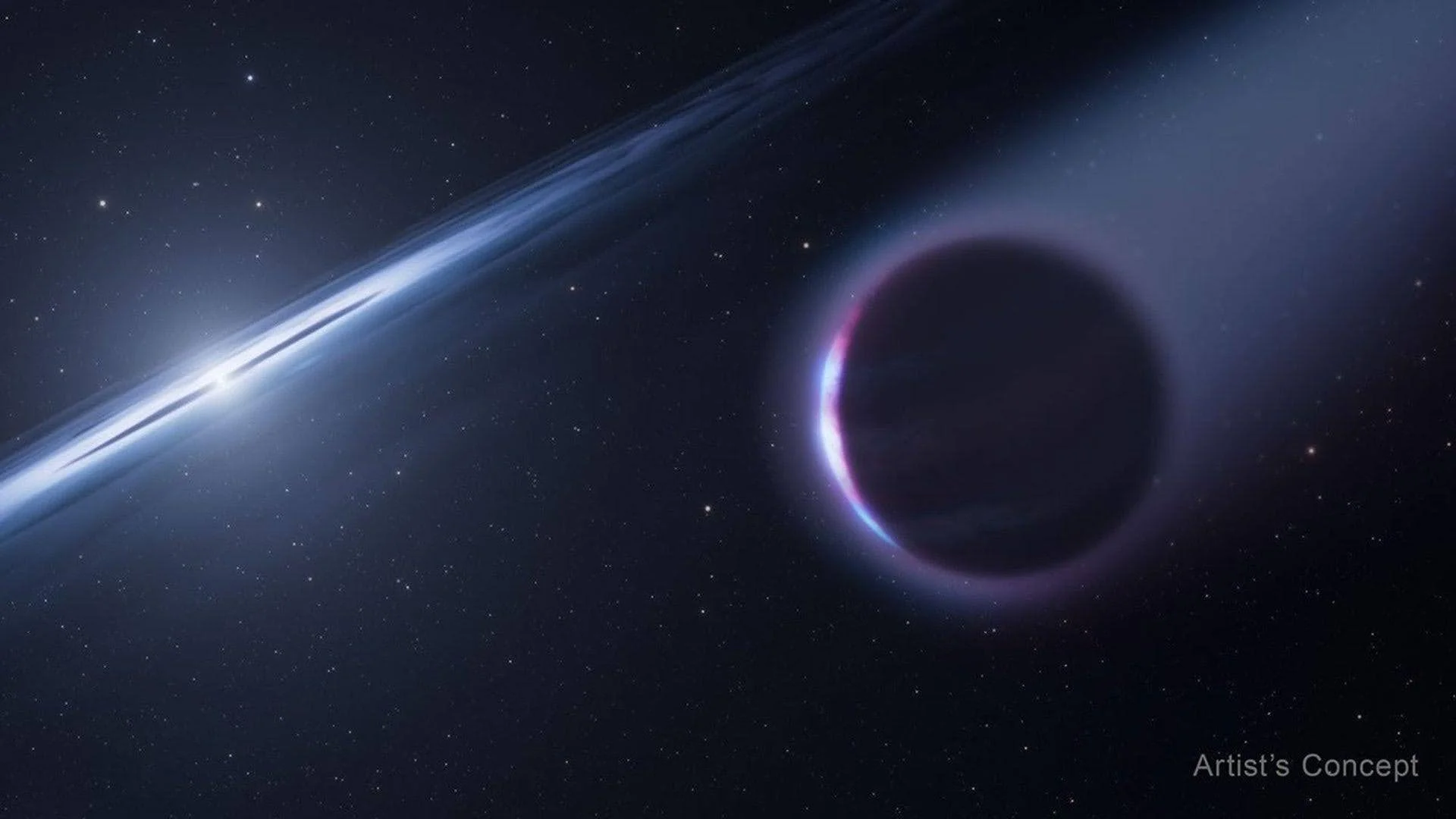
Image credit: NASA
A Second Chance?
Aloha stargazers! You know how we usually talk about planets forming alongside their stars, siblings raised in the same cosmic nursery? Well, astronomers may have just found a planet that came along much later, after its star had already died. And that, folks, is a first. The star in question is a white dwarf with a very license-plate-like name: HS 0209+0832, sitting about 270 light-years away in the constellation of Cetus, the whale located in the northern part of the sky.
So what is a white dwarf? It is a stellar remnant formed when a sun-like star reaches the later stages of its life. For our sun, this will occur in several billion years’ time after it has passed through its red giant phase. During this time, it will swell up to swallow the inner planets, possibly getting as far as the Earth, and then it will cast off its outer layers into the solar system. This creates a beautiful nebula and leaves behind its dense, hot core that will shine with a ghostly blue-white light. This is the white dwarf. Like a celestial ember of a dying fire, it will burn steadily over countless billions of years and then fade to black as it cools.
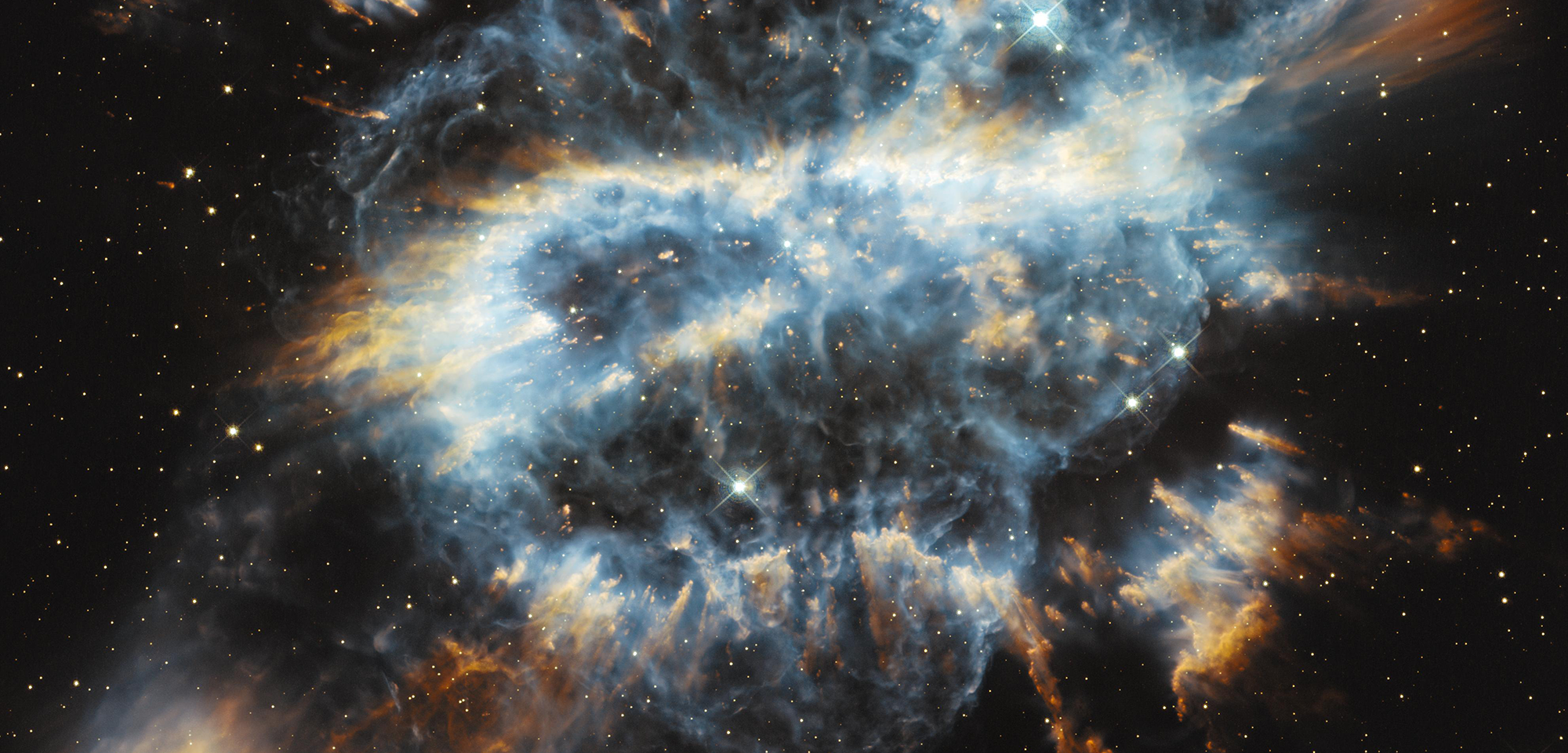
Image Credit: Daniel K Inoye Solar Telescope (NSF)
What is interesting in regards to HS 0209+0832 is that this particular stellar ember has an atmosphere laced with some seriously odd ingredients, including zinc, copper, aluminum, silicon, titanium and a rare earth metal called niobium. Not just a trace, either. More than a thousand times the niobium we see in our sun!
This is what tipped astronomers off to the presence of something interesting, because white dwarfs should burn clean, not dirty. When we detect heavy elements in such a stellar remnant, it means the star is actively gobbling up material from something nearby — and in this case, it appears to be a planet!
A team led by the University of Warwick went digging through 25-year-old Hubble data, plus observations from the FUSE telescope and NASA’s TESS, and landed on a remarkable answer. The most likely culprit is a giant planet orbiting that dead star in just 4.4 days, a planet that condensed out of a fresh disc of debris cast off during the star’s death throes. A second-generation planet, born not with the star, but from its ashes.
So what could these types of second-generation worlds be like? A white dwarf stays roughly the same temperature for tens of billions of years, far longer than our sun will shine. A rocky planet huddled in close, maybe just a couple million miles out, could in theory sit in the habitable zone (the zone suitable for liquid water and life as we know it) for an almost unimaginable stretch of time. Whether life could actually get started there is another question entirely, since such a world likely wouldn’t receive the same chemical building blocks that Earth did, but that doesn’t necessarily rule it out.
It’s fascinating to think that our own solar system of planets could be the sun’s first family, and that another may follow in the stages once thought to be so final for a star. The universe, it seems, is willing to give even the stars a second chance.
