
Stars Over Kaʻū: Sept/Oct 2026
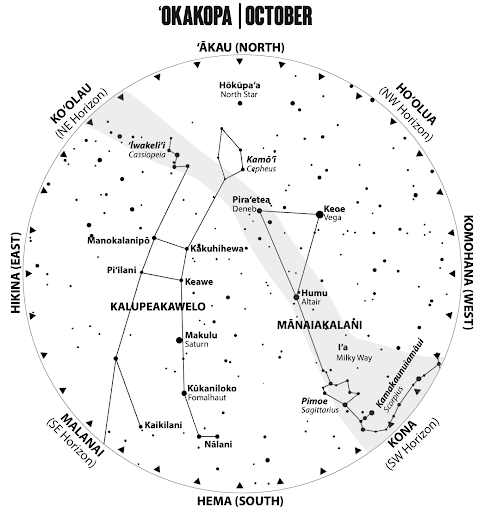
Image credit: ʻImiloa Astronomy Center of Hawaiʻi
By Christopher Phillips
Greetings stargazers! This month the planets are putting on a show at both ends of the night. We’ll begin in the west, just after the sun sets, where brilliant Venus (Hokuloa) blazes low over the horizon through twilight. Venus is near its most dazzling right now and impossible to miss, though it slips a little lower each evening as October wears on and edges back toward the sun.
Turn to the east and you’ll find Saturn (Naholoholo) climbing out of the twilight low in the eastern sky. Saturn is the real showpiece this time around: it reaches opposition on Oct. 4, which means it rises around sunset, stays up the whole night through, and shines at its biggest and brightest of the entire year. It’s an easy naked-eye catch, and a small telescope will show the rings beautifully.
The other two planets belong to the small hours. Jupiter (Ikaika), no longer an evening object, now rises in the east after midnight, blazing brilliant white and climbing high by dawn, coming up a little earlier with each passing week. Trailing behind it is Mars (Holoholopinaau), a much fainter, rusty-red point low in the pre-dawn east. The two are slowly drawing together through September and October on their way to a close meeting in November, and on the morning of Oct. 11 you can watch Mars glide right through the Beehive star cluster in Cancer, a real treat in binoculars. Both are best enjoyed in the hours before sunrise.
Our Hawaiian Sky
This month the Hawaiian starline of Mānaiakalani becomes less prominent in our sky as we celebrate the arrival of Fall. It makes way for the starline of Kalupeokawelo which will come to dominate our skies over the next couple of months. The starline of Kalupeokawelo is known as The Kite of Kawelo, and it is composed of some asterisms (collections or patterns of stars) that may be familiar. The largest of these is the great square of Pegasus, which is the mythical winged horse of Greek mythology. This large formation of four bright stars is the body of the kite of Kawelo.
The four stars of the Great Square are named for Hawaiian chiefs; Keawe of Hawaiʻi Island, Piʻilani of Maui, Kākuhihewa of Oʻahu, and Manokalanipo of Kauaʻi. From each corner star of the square we see celestial lines that are the guidelines of the kite. The lines are anchored in the northern sky to ʻIwakeliʻi, the constellation of Cassiopeia with its distinctive “W” shape. There is also Kamōʻī, known as Cepheus the King in Greek mythology. In the southern sky they are held in place by Piʻikea, Diphda; Kaikilani, Ankaʻa; Kalanikauleleaiwi, which is the bright blue giant star Achernar; Kūkaniloko, which is the star Fomalhaut; and Nālani, known as Alnair in Grus the Crane.
The story of the kite goes something like this: Kawelo and his cousin Kauahoa release a kite into the sky. Kawelo, inspired by the kite riding on the winds, returned home and asked his grandparents for a kite of his own. They obliged and the next day he took to the skies with his kite, alongside his cousin Kauahoa. Both Kawelo’s and Kauahoa’s kites became entangled in the sky. During the fray the string holding Kauahoa’s kite broke, and the kite came loose, landing somewhere in a distant forest. To this day near Koloa is a place called Kaho‘oleināpe‘a in reference to Kauahoa’s fallen kite. Kawelo and Kauahoa could have come to blows over the loss of the kite, which was arguably Kawelo’s fault, but Kauahoa attributed the loss to the elements and was not angry at Kawelo. This apparent battle of kites was a powerful sign to those onlookers who witnessed the dramatic display. It was a sign that Kawelo’s mana, or supernatural power, was greater than Kauahoa’s.
Our Closest Star
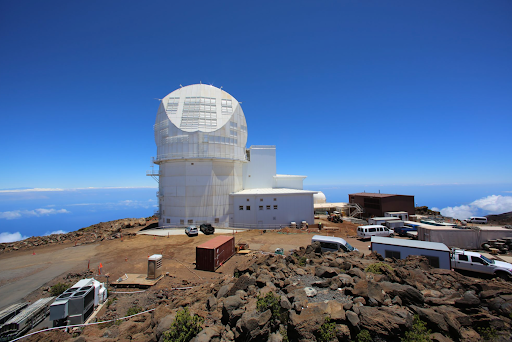
Image credit: NSF
Usually in this column we look outward to the planets and distant stars, but this month I want to bring our gaze closer to home, to the star on our own doorstep, and a discovery made right here in the islands. Perched atop Haleakalā on Maui, the four-metre Daniel K. Inouye Solar Telescope has just captured the sharpest images of the sun’s surface ever taken. Hidden in that extraordinary detail, astronomers found something no one had ever glimpsed on the sun’s visible face before: tiny whirlpools of plasma, each only about 20 kilometres (12 miles) across. On the sun, that counts as small.
These little eddies carry a grand name, Kelvin-Helmholtz instabilities, but you’ve met their cousins many times. They form wherever two flows slide past one another at different speeds, curling into breaking waves along the boundary. Think of wind combing ripples across a bay, or the long scalloped cloud-waves that sometimes ripple over our island skies at dawn. The very same physics, first described by Lord Kelvin and Hermann von Helmholtz around 1870, shapes the cloud bands of Jupiter and Saturn and the place where the solar wind slams into Earth’s magnetic field.
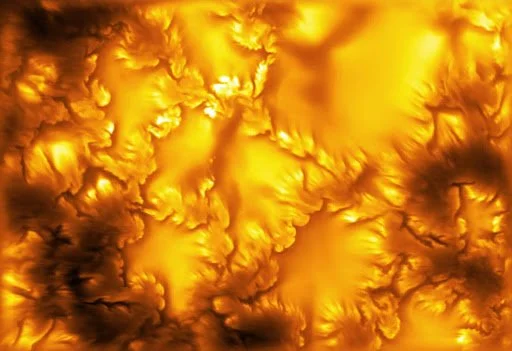
Image Credit: Daniel K Inoye Solar Telescope (NSF)
Until now, we’d caught these curling vortices on Earth, in planetary atmospheres, and high in the sun’s outer corona, but never in the photosphere, the blinding surface layer we actually see. Spotting them there took a telescope sharp enough to resolve features the size of a small town, from 150 million kilometres away.
Here’s why it matters. These microscopic whirlpools may be hidden engines. As they spin, they twist and tangle the sun’s magnetic field lines, winding them tighter and tighter until, like an over-wound spring, they snap and release their stored energy. That energy is thought to help power solar flares and the great coronal mass ejections that spark our auroras and rattle our satellites. It may also help crack one of solar physics’ oldest riddles: why the sun’s thin outer atmosphere blazes at over a million degrees, while the surface beneath simmers at a comparatively cool 5,500.
There’s a second prize, too. The sun rebuilds its entire magnetic field every eleven years, dizzyingly fast in cosmic terms, which means all that old magnetism must be dismantled just as quickly. Our best models have long struggled to explain how. These newly found vortices, shredding and mixing the field at the smallest scales, may be exactly the missing ingredient.
It’s a lovely reminder that even our nearest, best-studied star still keeps secrets, and that sometimes you must look at the very small to understand the very large.
So the next time you feel the sun on your face, picture those countless little whirlpools turning across its surface, quietly stirring the star that makes all life here possible. Until next month, clear skies!
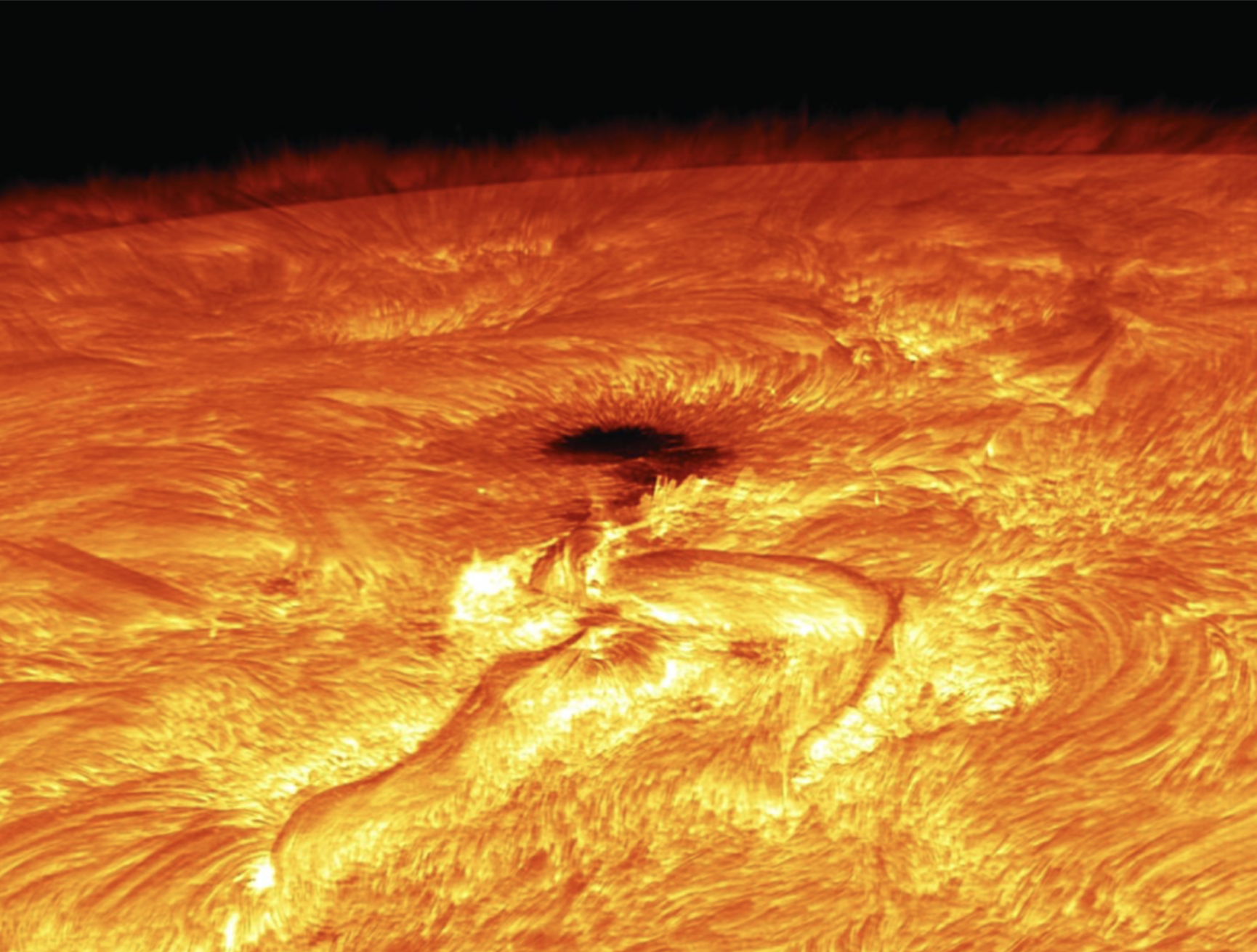
Image Credit: Daniel K Inoye Solar Telescope (NSF)
