
Bookmarks: “Sunrise on the Reaping” by Suzanne Collins
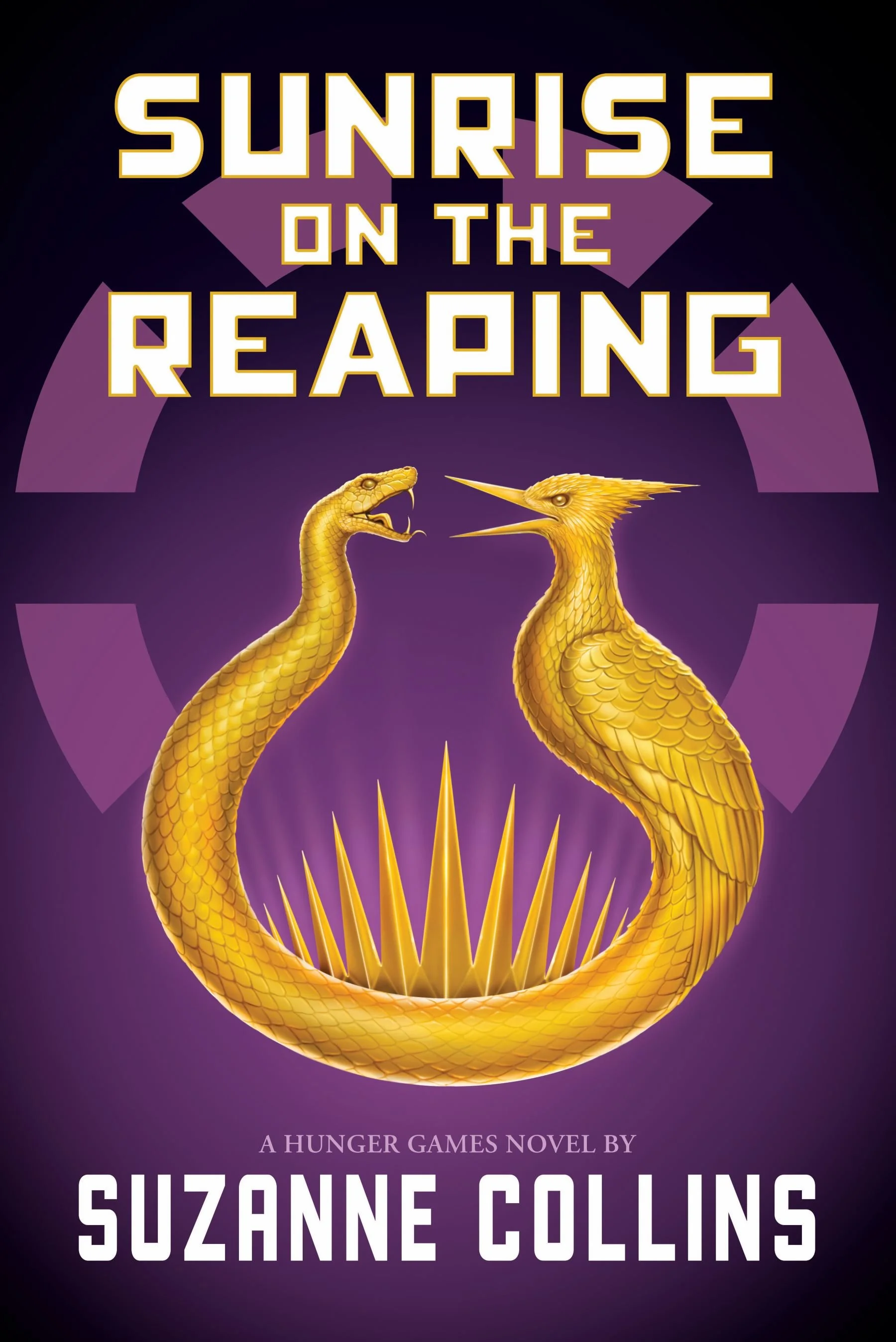
Bookmarks: 'Sunrise on the Reaping' by Suzanne Collins
By Drew Foster
There’s a line in “Infinite Jest” where the protagonist, Hal Incandenza, describes himself as the type of guy who would jump in a cab and tell the driver to take him to the library and step on it. I’m that type of guy.
I could spend an afternoon perusing library shelves or wandering the aisles of a bookstore. There’s magic in those places. Novels are transformational experiences in paper and ink, portals to other worlds. The characters we meet elucidate our own lives, shape our thoughts, and sharpen our awareness. They help us make sense of the world around us. Fiction takes me places I’ve never been, introduces me to people I’ve never met. It deepens my empathy and expands my awareness.
Novels also provide a touchstone for time and place. I remember with absolute clarity the first time I read an excerpt from a David Foster Wallace novel in The New Yorker nearly fifteen years ago. I remember the novels my wife and I shared during our honeymoon. I remember where I sat each afternoon in a Subway sandwich shop in Rawlins, Wyo., devouring “The Kite Runner.”
As an artform, I think the novel offers the widest breadth of expression, an almost-infinite, borderless canvas of creativity. The simple medium of inked words on paper – or text on a screen, if you’re into that sort of thing – is not constricted by imagery or sound. We interpret characters and landscapes with our mind’s eye; we ferret out meaning with our own personal prism of understanding. A single novel can mean many different things to many different readers.
My love for reading inspired this column. I’ll review mostly fiction, and I’ll review only books that are either available in Kaʻū public libraries or can be requested through the Hawaii State Public Library System. Our local library staff is stellar. They feel like friends and remind me of what a wonderful community we call home. Pay them a visit.
“Sunrise on the Reaping” by Suzanne Collins
Published March 2025, Scholastic Press
3 stars out of 5 (3/5)
I arrived late to “The Hunger Games” party, which worked in my favor. I read the first installment, “The Hunger Games,” a full decade after its publication. By that time, “Catching Fire” and “Mocking Jay,” books two and three in the series, had both appeared. This allowed for some serious binge reading.
The first prequel, “The Ballad of Songbirds and Snakes,” set sixty-four years before the events of the opening novel, was printed in 2020. “Sunrise on the Reaping,” a second prequel set twenty-four years prior to what took place in the first novel, was published in May.
In “Sunrise on the Reaping,” we follow Haymitch Abernathy, mentor to the original series’ protagonist Katniss Everdeen, as a teenager through his selection to the Hunger Games, his eventual victory, and the immediate aftermath. The Haymitch of the original novels is a broken, alcohol-riddled man, and “Sunrise” shows us how he got there.
Young Haymitch lives with his mother and siblings in The Seam, the poorest section of Panem’s District 12. He bolsters his mother’s meager washerwoman's salary by helping brew moonshine liquor. What little free time he has is spent with Lenore Dove, a confident, rebellious young woman from a musical family. Though poor and overworked, Haymitch seems a joyful young man.
His undoing begins during the reaping, when teenagers from the twelve districts are randomly selected to compete in the Hunger Games, a battle to the death that’s both entertainment for the Capitol’s residents and punishment for denizens of the districts, which unsuccessfully rebelled against the Capitol decades earlier. But Haymitch’s selection is anything but random – chaos ensues during the reaping when one of the chosen teenagers attempts to flee and is killed by a Capitol peacekeeper. Haymitch’s girlfriend, Lenore, scuffles with a peacekeeper and Haymitch comes to her rescue. His chivalry is punished. Haymitch is selected as the dead teen’s replacement. Lenore is hauled off to jail. Thus begins “Sunrise on the Reaping.”
Haymitch’s Hunger Games is a special one – it’s the fiftieth anniversary and dubbed a Quarter Quell, where twice as many tributes are selected. We watch Haymitch being ripped from his grieving family, shuttled off to the Capitol with the other District 12 tributes like cattle to the slaughterhouse and confined to a hotel room in preparation for the Hunger Games. And the Capitol watches as well. Everything is recorded for entertainment and propaganda.
Readers are quickly reunited with a plethora of characters from the original series – Plutarch Heavensbee, now a cameraman assigned to gather footage of the District 12 tributes; Effie Trinket, one of Haymitch’s stylists; Mags Flanagan and Wiress, the District 12 mentors; Caesar Flickerman, longtime Hunger Games host and master of ceremonies; Coriolanus Snow, the nation’s longtime autocratic president. And several more. This section reads like a greatest hits album, so much so it borders on pandering.
Haymitch and his fellow tributes are simultaneously treated as stars of the show and prisoners of the machine. We watch resentment build, fear take hold, alliances form. And the crux of the novel takes shape – Haymitch hones a subversive plan; his aim is not to win or survive, but to “break” the Hunger Games and humiliate the Capitol’s powerbrokers.
Here, too, emerges the crux of my less-than-stellar rating: This being a prequel, the reader knows A) Haymitch indeed survives and wins despite his acceptance of impending death and B) he fails to “break” the Hunger Games because both the Games and the Capitol are going strong twenty-four years later when Katniss Everdeen is reaped and the original series kicks off. Haymitch’s desire to disrupt the Hunger Games and humble the Capitol becomes the central plot point. And knowing what we know from the earlier books removes all suspense.
But you say: It’s a prequel, Drew – we’re bound to know how it ends. Sure, okay. Still, what truly guts Haymitch isn’t so much what takes place before and during the tournament (although that contributes); it’s what unfolds after the Games. There was fresh ground to till here, especially in the ending. We truly see young Haymitch turn into broken Haymitch during the last pages of “Sunrise on the Reaping.” One could argue that author Suzanne Collins should have started the novel where she ended it. I found washed-up blotto flukey Haymitch of the original series far more interesting than young, overwhelmed, defiant, “rascal” Haymitch of “Sunrise.”
This raises another issue: the general thinness of young Haymitch’s character. He seemed poorly developed despite Collins having spent more than half the book working up to the actual Games. I felt like I knew his girlfriend, Lenore Dove, better than I knew him. In fact, he seemed so underwhelming as a character that, during the Games, I routinely slipped into thinking I was reading about Lenore instead of Haymitch (this was enabled by a first-person perspective).
All that said, admirers of the series should read this book. You’ll find the “Hunger Games” collection in the library’s Young Adult section. But don’t be fooled – these novels hold appeal for readers of all ages. They have something to say. Layered between the barbarity of the Hunger Games tournament and the shattered lives of the competitors and their families is a cutting social commentary. The Capitol is populated by self-absorbed, fashion-obsessed, entertainment-hungry, propaganda-swallowing geese. The districts by poverty-stricken and oppressed second-class citizens. There’s a clear bourgeois-proletariat struggle afoot. This underpins the original novels, and Collins keeps the notion front and center throughout “Sunrise on the Reaping.”
Judging by the sky-high cumulative rating on Goodreads.com, superfans might very well love “Sunrise on the Reaping.” If you’ve never read the series, I encourage you to check out the original “Hunger Games” from the Na’alehu or Pāhala libraries. These novels provide brisk reads, but provide more depth than one might initially bargain for.
May the odds be ever in your favor.
