
Stars Over Kaʻū: August 2025
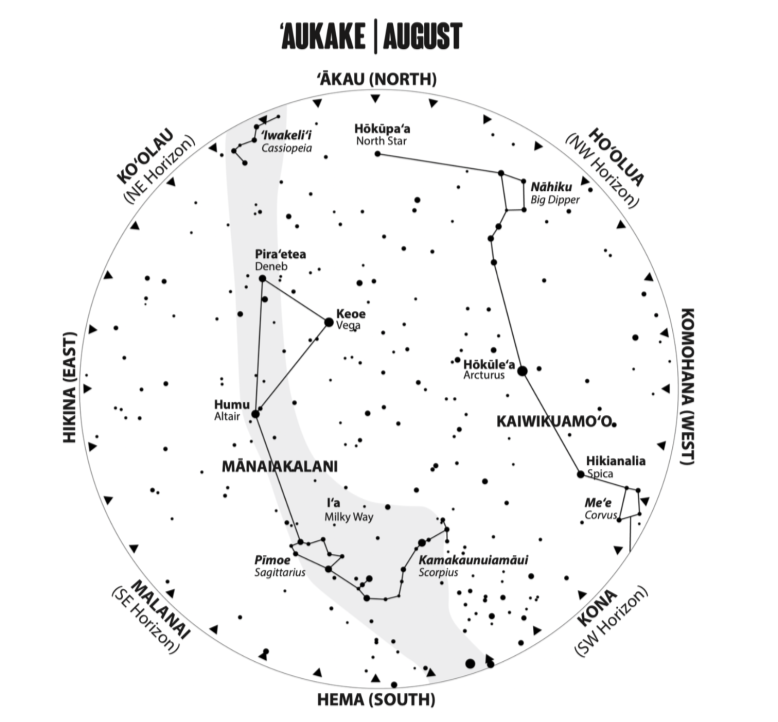
Image credit: ʻImiloa Astronomy Center of Hawaiʻi
By Christopher Phillips
Greetings stargazers! This August, our island skies offer a brilliant display of naked-eye planets. Just before dawn, look to the east for a spectacular pairing of Venus (Hokuloa) and Jupiter (Ikaika), drawing close to one another throughout the month and reaching a beautiful conjunction on August 12. Saturn (Naholoholo) rises earlier in the evening sky and remains visible most of the night, shining steadily in the southeast. Toward the end of the month, Mercury (ʻAukele) peeks above the eastern horizon just before sunrise. Mars (Holoholopinaʻau) will remain hidden this month, too close to the Sun for viewing. Be sure to catch this graceful planetary parade and keep an eye out for the Perseid meteor shower, which originates from the direction of the constellation of Perseus. This meteor shower will peak around August 21.This will coincide with excellent viewing conditions afforded by the new moon.

Image credit: ʻImiloa Astronomy Center of Hawaiʻi
Our Hawaiian Sky
This month the Hawaiian starline of Ka Iwikuamo‘o (The Backbone) begins to wane in prominence in our night sky. Making way for Mānaiakalani to take the stage during the nights of the month of August. You may recall that Ka Iwikuamo‘o is sometimes represented as the backbone of a great lizard or that of a genealogical backbone, with each star representing a generation. This magnificent starline begins in the North (ʻĀkau) and extends from Hōkūpaʻa (Fixed star) which in western tradition is known as the North star, Polaris. Our starline extends all the way South (Hema) to Hānaiakamalama (Cared for by the Moon), which is known as the Southern Cross. The line can be traced through the various constellations that make up Ka Iwikuamoʻo just as one can trace oneʻs own genealogy. A path from oneʻs self to oneʻs ancestors, back through time. Each set of stars is a unique entity with itʻs own identity.
Mānaiakalani, which is known by several names depending on translation. It can be known as The Chiefʻs Fish Line, Come-From-Heaven, or Mauiʻs Fish Hook. The prominence of this starline in our evening sky marks the height of summer. The starline is composed of several notable asterisms (collections or patterns of stars), the largest of these is the fishing spool, made up of a great triangle of three bright stars. This trio is referred to as The Navigator’s Triangle (Huinakolu), or the Polynesian triangle. Within it are the stars of Piraʻatea, Keoe, and Humu. In the Polynesian triangle they represent the islands of Aotearoa (New Zealand), Hawaii, and Rapa Nui (Easter Island). You may also know these stars by their Arabic names, Deneb, Vega, and Altair, respectively. The fishing line extends to the constellation of Sagittarius, which in this context is Pimoe, the giant Ulua fish. Next to this is the distinctive shape of the hook itself, Ka Makau Nui o Māui, also known as Scorpio, the scorpion.
The region dominated by Pimoe, and Ka Makau Nui o Māui also marks the center of our Galaxy, the Milky Way. On a moonless night the bright core of the Galaxy, filled with the light of millions of stars, is a sight to behold. On either side, the great spiral arms of the Milky Way can be seen extending out from the bright core, with vast dark clouds of star forming material silhouetted against the light of countless stars.
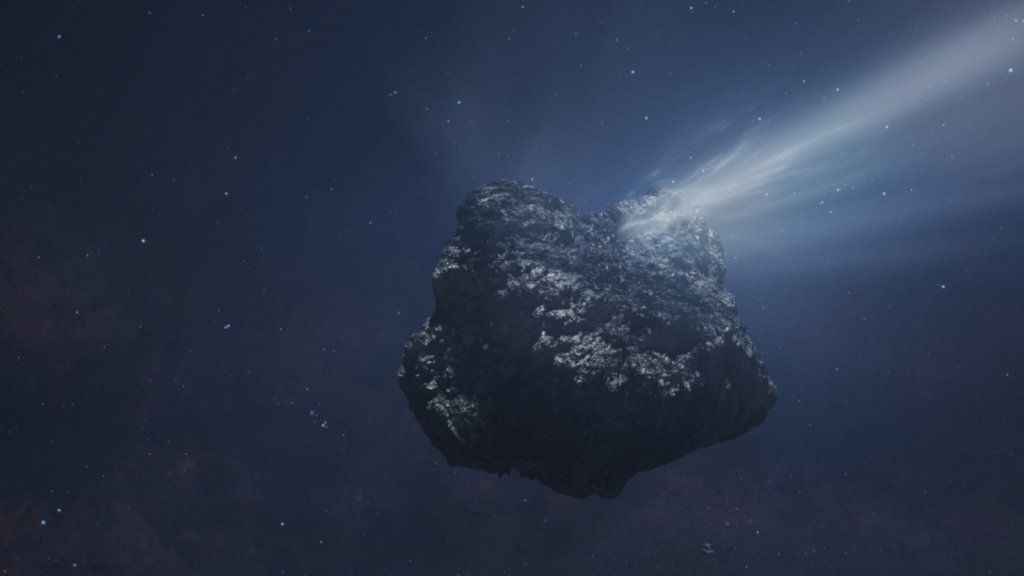
Image credit: space.com
A Visitor From Beyond the Solar System
We’ve got a brand-new cosmic guest in our skies and it's not from around here. Meet 3I/ATLAS, the third confirmed interstellar visitor ever spotted passing through our solar system. That’s right, it’s another rock from beyond the stars, just casually cruising through our celestial neighborhood. Discovered on July 1st, 2025, by the ATLAS telescope in Chile (a sharp-eyed sky scout if ever there was one), this object immediately caught astronomers’ attention. Why? Well, it’s moving far too fast to be bound by the Sun’s gravity. It came from deep space and once it swings by, it’s never coming back. Think of it like a ship on a one-way cruise through the islands. Unlike our first interstellar mystery object, ʻOumuamua, 3I/ATLAS is definitely a comet. It has the distinct glowing tail and fuzzy nucleus that we associate with these icy travellers, and it is shedding dust and gas as it warms up in the Sun’s rays. Incidentally this makes it much easier for astronomers to study when compared to ʻOumuamua, which was as elusive as it was intriguing.
What makes this cosmic visitor even more exciting is its possible age. Astronomers believe 3I/ATLAS might be over 7 billion years old, which, for perspective, is older than our entire solar system. It likely formed around another star system far, far away, and has spent eons drifting through the galaxy before finally passing through our little corner of space. Talk about a long-haul journey. It’s not going to get very close to the Earth though so no need to panic or prep the telescopes just yet. At its closest, it’ll be about 170 million miles from our planet this December. That’s nearly twice the distance to the Sun. So unfortunately, it won’t be lighting up the night sky like a Hollywood comet. You’ll need a decent-sized telescope and a clear night if you want even a chance to catch it.
Still, scientists are thrilled. Space telescopes like Hubble and JWST are lining up to study the comet’s light and chemistry, hoping to learn what it’s made of and maybe even uncover clues about the early days of planet formation in other star systems. Think of it like a time capsule from another world, delivered to our doorstep by the universe itself. By studying these objects, even at a distance, we can catch a rare and enticing glimpse into the past. We can also explore the origins of worlds born around distant stars, cousins of our own solar family.
So keep your eyes on the skies, folks. Even if we can’t see 3I/ATLAS with the naked eye, just knowing it’s out there, an ancient traveler from another star, passing through our solar system for the very first and last time is enough to stir the stargazer’s soul.
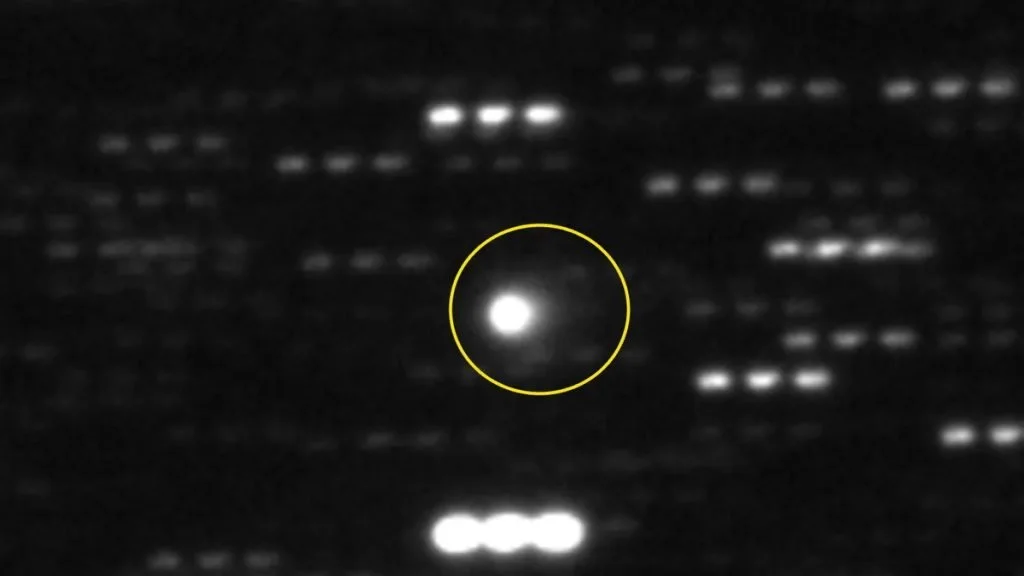
Image credit: Darryl Seligman et al.
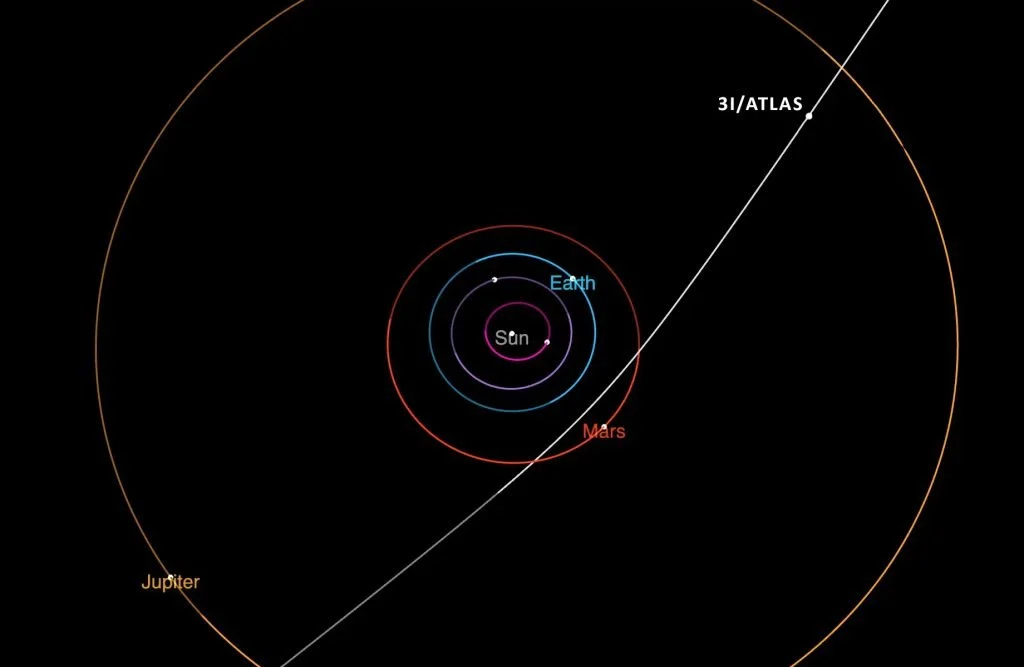
Image Credit: NASA/JPL
