
Ike Kūpuna Kaʻū: Homer Hashimoto
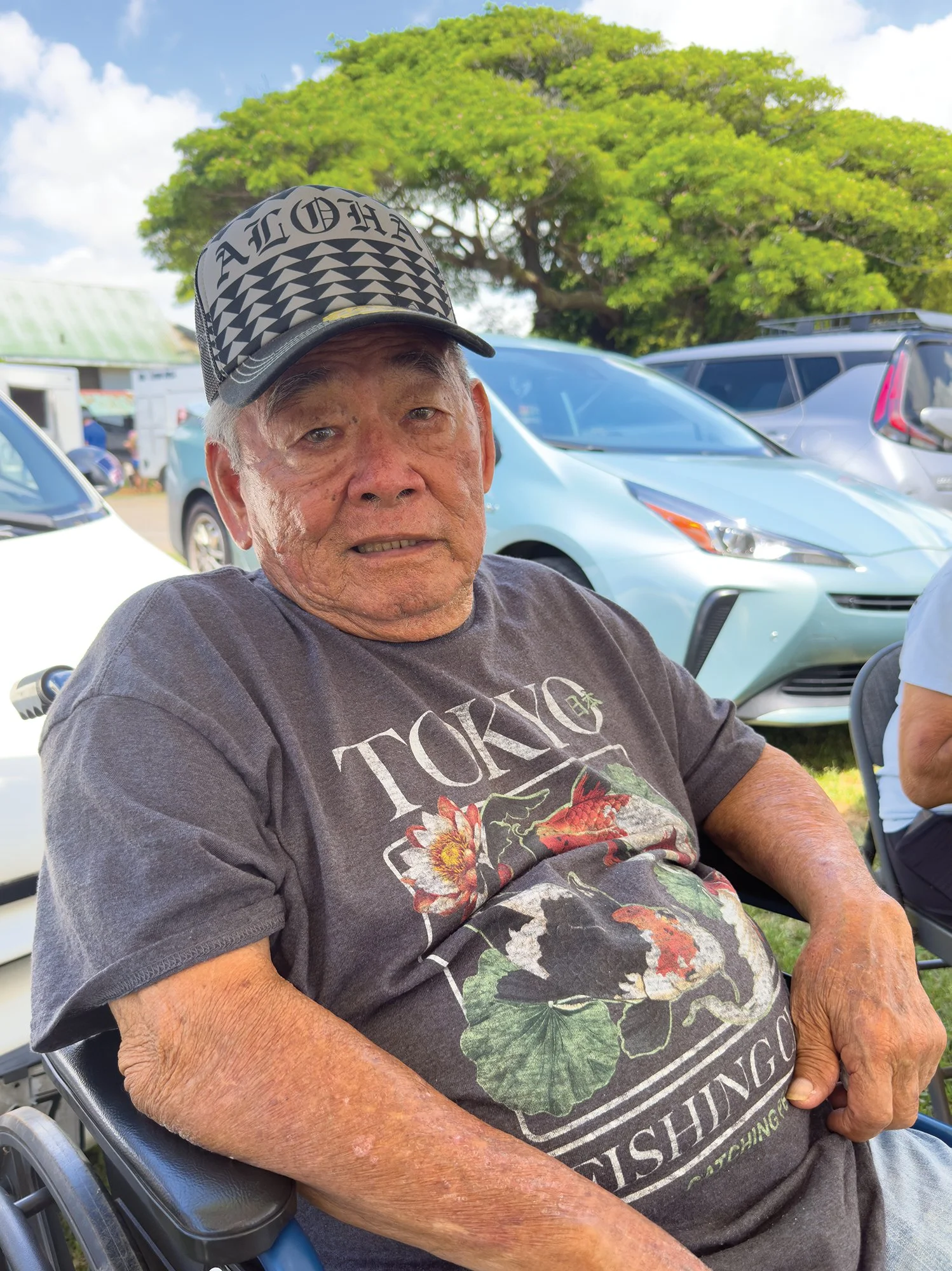
Photo and Interview By Laila Moiré-Selvage
Welcome back to ʻIke Kūpuna Kaʻū, our column dedicated to preserving the wisdom, memories, and living history of our district’s elders. For this edition, we sat down with lifelong Kaʻū resident Homer Hashimoto at the OKK Farmers Market in Nāʻālehu. Born April 27, 1938, Homer has built a life defined by a 40-year career working across local plantations, dairies, and ranches, alongside a deep dedication to his ʻohana. Here are his memories of growing up, working the land, and raising a family in Kaʻū.
What was this community like when you were growing up? I was born right here in Pāhala, in the old wooden plantation hospital — not the concrete one they have now. My dad was from Japan, and my mom was from Kona. When I was young, there were no farmers markets or flea markets like we have now. Big difference from today! I enjoyed growing up here as a youngster. I went to school at Pāhala Elementary and Kaʻū High, and back then, the principal was very sports-minded. If you didn’t play a sport, you missed the boat because you couldn’t travel! So I played every sport they had: baseball, basketball, and six-man football. We got to travel off-island for games to Maui, Oʻahu, and Kauaʻi.
What was your childhood like? My dad worked for the sugar plantation for 40 years, and when that closed, he worked at the dairy farm owned by C. Brewer & Co. My mom worked for the state as an assistant to the cafeteria manager at Nāʻālehu Elementary School. I was fourth in our family, with three older brothers and one younger sister. My mom was very young when she passed away from cancer — she was only 48 years old, and I was about 15 or 16. After she died, all my siblings eventually moved out to Honolulu, got married, and raised their kids in the city. I was the only one who stayed back home to take care of my dad. He lived up in the Nāʻālehu camp and loved having his one Primo beer after work. I stayed by his side until he passed of old age at 88.
What was your work life like? I put in almost 40 years of service across the plantation, the dairy, and the ranch. Right after getting married in December 1961, I was drafted into the Army in January 1962 and served two years on Oʻahu. My oldest son, Kevin, was born at Tripler Army Medical Center during that time. My heart was always in the ranch. When I came back home to Kaʻū, I worked for S&S Dairy for 10 years, taking care of 500 head of cattle from South Point all the way to Pāhala. I worked seven days a week, non-stop, through holidays and vacations, because the animals needed me. My specialty was breaking wild horses and artificial insemination. I would pregnancy-check the cows and pull the calves when the mothers had trouble giving birth. Sometimes a calf gets stuck, and you have to go in, push the calf back, straighten out the two front legs, and pull them out. I tried to save every single cow and calf. I got bucked off, run over, even kicked in the back by a cow one time, but I loved that ranch work. After they closed down, I went to work for Kaʻū Sugar as a construction supervisor. I took care of repairing all the roads from Pāhala to Nāʻālehu, and all the way up to Hawaiʻi Volcanoes National Park.
What is your fondest memory of living in Kaʻū? I miss the ranching days, especially having my kids out there with me. I owned my own string of horses and taught all my children how to ride. My late wife, Barbara, and I raised one son, Kevin, and two daughters, Fern and Terri. Since I worked weekends and holidays, I used to bring my kids along to help. When Kevin was 15, he liked to ride, so I’d have him bring the cows in for me down the long chute. My wife would make us lunch, and the kids would ride horses with me out on the range. Sometimes I would sleep in the jeep if I had to. Kevin had a trained heeler dog to help herd the cattle. The only problem was, if the cows saw that dog, they would come chasing after it — and if you were in the way, they’d run you right over! Having my family out there working together on horseback are memories I hold onto.
What is your advice for a long life? I don’t drink and I don’t smoke. When I was young, I took exactly one choke of a cigarette, coughed, and quit right there. When I got drafted into the Army in 1962, all my friends from the ranch told me, “When you come back, you’re going to learn how to drink and smoke.” I told them I wouldn’t, and I proved them wrong. I survived my time in the service — even a night training accident where I got stuck in a helicopter harness with a full pack and got pushed out by the copilot! I still feel the pain in my knees from that night, but I survived all of that. I think I’m still kicking today because I took my own advice. I was the only one in my family who stayed entirely smoke-free and alcohol-free, and I’m proud that my kids followed that same healthy path.
What does your life in Kaʻū look like today? I’m glad we have places like the gas station, the coffee shops, and the bakery. It’s a beautiful place to live. I don’t drive anymore, but I have wonderful support from my family. My daughter Fern went to the University of Hawaiʻi at Hilo for college, and her husband, Kip Albrechtson, is a retired Hilo fire captain who takes me to all my doctor appointments. Every single Wednesday, he drives out from Kurtistown to pick me up and bring me to the farmers market so I can sit with my old friends and talk story. Otherwise, I’d just be sitting in my garage looking at the clouds and seeing all the shapes! My youngest daughter, Terri, works up at the gate for Hawaiʻi Volcanoes National Park, and my son, Kevin, works as a state building caretaker in Nāʻālehu. I’m a country boy at heart! I am so grateful to have my children and six grandchildren close by.
Know Kaʻū kūpuna we should feature? Contact us at kaunewshawaii@gmail.com.
