
Kaʻū Hawaiian immersion school aims for fall start
By Laura Stocker
Raylene “Auliʻi” Moses of Nāʻālehu years ago wrote a list of dreams of how she’d like to help her community. The list included how to provide access to health care, education and help for kūpuna. Today one of those dreams is becoming a reality – starting a Hawaiian immersion school in Kaʻū.
“I always thought about how to help. Of course, that was an ambitious list way back when,” she said. “I’d like to have some alternative education. But I put (my idea of that) on hold until my moʻopuna (grandson) Kaʻili DeLeon, 9 years old now, started school.”
Then came Covid.
Kaʻili was enrolled in pre-kindergarten in summer 2021, and Moses was teaching Kaʻili online with the Kamehameha School District in the Nawahiokalani Opu’u Hawaiian immersion charter school.
As her grandson learned, Moses became enthused.
“As he was learning and I was excited to learn with him, the school invited family to (get together) one night a month to learn Hawaiian (beginner, intermediate or advanced). They made it fun and welcoming,” said Moses, Nā ʻAʻaliʻi Kū Makani’s executive director."
By nature, Moses said she likes to be involved. So, she developed the plan and said that what she lacks in education on the subject, “I make it up with my drive and determination. I thought we needed something like this in Kaʻū. So that’s when I started my journey,” she recalled.
Moses attended kindergarten through 8th grade in Nāʻālehu and graduated from Kaʻū High School in Pāhoa. Parents, she said, tried to protect children then, saying “Speak good English” and didn’t promote the Hawaiian language. However, she got to hear her grandparents speak in Hawaiian.
Moses learned it’s not so easy to start a school. But she started a learning journey by asking many questions.
“We have an opportunity to do something very unique for keiki and parents to meet their expectations,” she said. “We want a program that will allow keiki to grow and know their culture, a connection to place and language, and continue that education beyond.”
Although not yet affiliated with the Hawaii State Board of Education, Moses said the school possibly could be a charter school after having their space approved by the county and state. Organizers are still deciding which model they will follow. However, core subjects will be taught in the Hawaiian language.
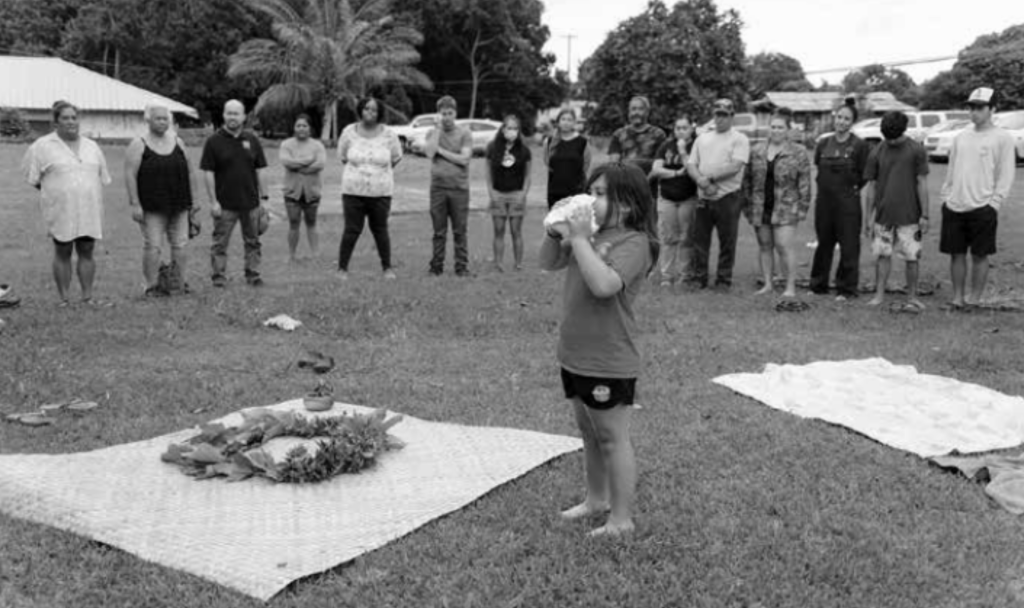
Since January and through June this year, 25 families with children 0 to 5 years old have come together on the second and fourth Saturday mornings each month at the school, the former Shirakawa Hotel in Waiʻōhinu. When the weather is nice, they take the class outside to sit on mats to learn in the shade of a large ʻulu (tree).
In addition to talking about Hawaiian culture, place and language, students are learning about native plants. They tend to a flourishing māla (garden) on the school property that Hawaiian Civic Club of Kaʻū helped them secure. They start with blowing the pū (conch shell) and chanting “E hō mai,” or “inspire,” which Moses said is a simple way to start learning. And students recite a pule (prayer).
Moses wants Kaʻū to pick up what began 40 years ago and move it forward.
“We are one of the few districts that don’t have Hawaiian history, culture and language (studies),” she said.
But that didn’t stop Moses from moving forward with the plan. In addition to the Hawaiian Civic Club of Kaʻū, Moses enlisted help from ‘O Kaʻū Kākou and other groups that protect the land, including Nohea Ka’awa and Berkeley Yoshido.
“When it comes to our keiki, that’s something we all should be united on,” she said. “Our hope is that we start along with them (public schools) when school starts this fall.”
Short of that, Kona has a home-school model that could be used for Kaʻū. “Everything is still tentative; nothing is concrete,” she said. “We’re more like a village, rather than a classroom. I’d love to see kūpuna be a part of the program.”
Wai’ala Ahn, mother of Kupuohi Ahn, 4, learned about the group starting an immersion school while reading Kaʻū’s facebook page. Since then, she helped with an online fund-raiser last November, after helping with organizing in April through May 2024. She and her son have been participating in the family learning program every two weeks since January.
She didn’t grow up speaking Hawaiian, but Ahn knew that her father and grandmother spoke the language to each other. “When I got older and (became) a mother myself, I was determined not to let the language die with me,” she said.
If the local Hawaiian immersion school joins Hawaii’s public schools system as a charter school, there will be hoops to clear.
Charter schools in this state, according to the State Department of Education, “are tuition-free public schools of choice open to all, serving students in kindergarten through 12th grade. Each charter school offers a different learning environment: some offer blended learning, others focus on Hawaiian language immersion or arts integration, and others offer project-based learning or a Waldorf model of learning.”
A Charter School Commission authorizes “high-quality public charter schools” in Hawaii. After approval of a charter school, the commission monitors the performance and legal compliance of existing schools. The commission’s major responsibilities include providing help and support for the development, growth, progress and success of each school and the charter school system. The commission also is a liaison between charter schools and the state’s Board of Education, governor and Legislature. It also allocates and distributes state and federal funds.
Volunteers operate a thrift store that also provides support to the new immersion school. It’s open on Wednesdays 10 a.m. to 4 p.m. next door to the Shirakawa Hotel.
