Kaʻū Weighs In on Punaluʻu Future
By Kainoa Tabar
District 6 (Kaʻū) County Council member Michelle Galimba collaborated with Elizabeth Dykstra and the Department of Research and Development on the development of a recent survey about Punaluʻu Black Sand Beach. Galimba said she “just wanted people to have an opportunity to express their opinions about Punaluʻu. The question is always, ‘Do you like the master plan?’, and there are so many other ways to ask that question. We got up to 100 (completed surveys) within six weeks.” Galimba said they decided to leave the survey open to accommodate the story on the survey published in Kaʻū News.
Results of the Punaluʻu Community Survey are now in. A total of 309 people took the survey, most of whom are residents of Kaʻū. The survey consisted of a mixture of multiple-choice questions and one open-ended question. The survey was open for four months and it collected Kaʻū community residents' opinions about the future of Punaluʻu.
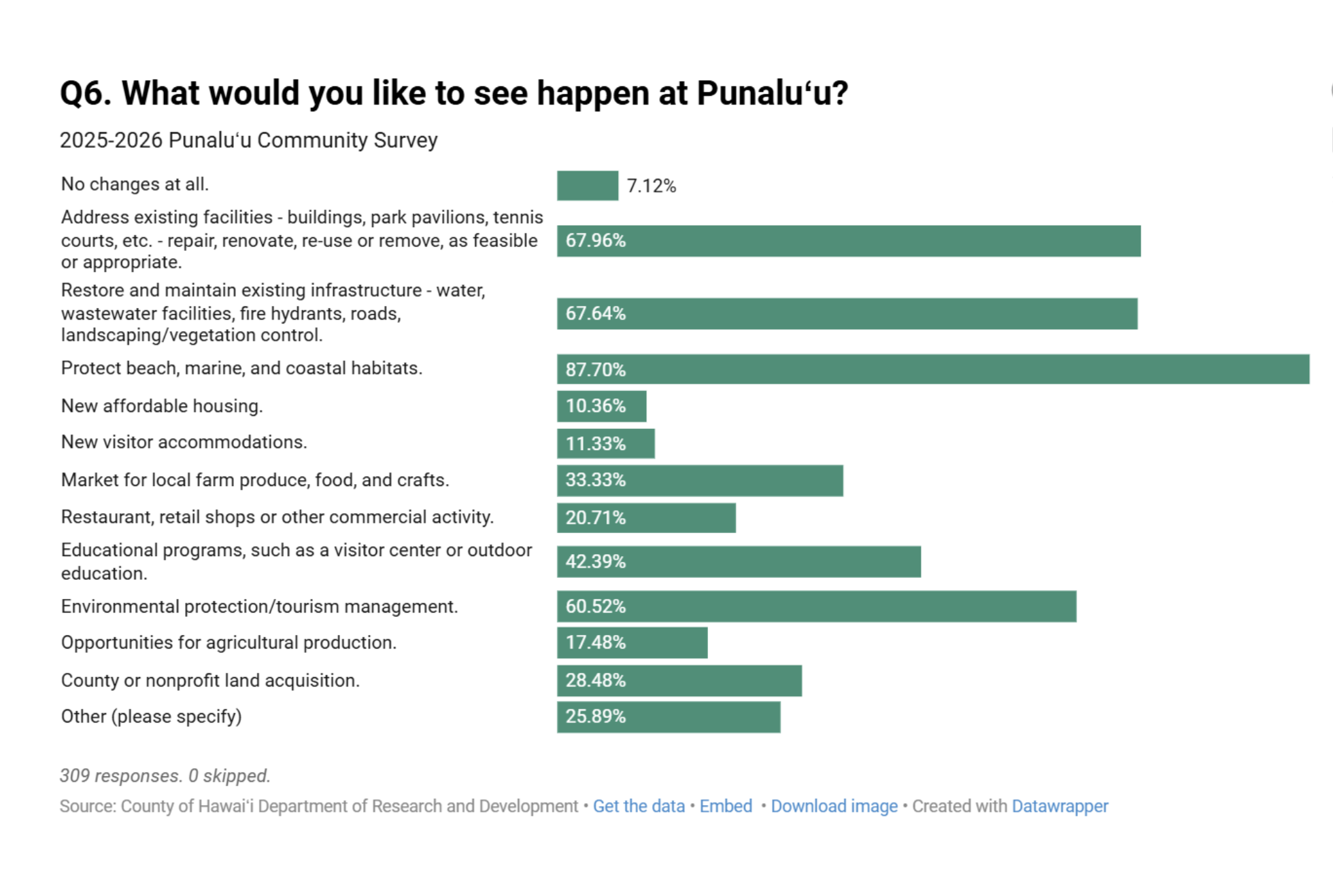
All of those surveyed made important contributions and the results of what people wanted were quite varied. Protecting the beach and coastal habitats, environmental management and management of tourists were high on the list of priorities.
Addressing upgrades, repair, or removal of the old buildings and the park pavilions as appropriate and restoration of current infrastructure — water and sewer, fire hydrants, and landscaping — both received over 67% of votes.
There were 175 responses to the one open-ended question in the survey. The most prevalent theme, appearing in roughly 55% of responses, was unambiguous opposition to any significant new development at Punaluʻu. Multiple comments mentioned having a restaurant and/or a food store. Some wanted camping cabins so their family could enjoy weekends at the beach. Some respondents expressed their desire for Punaluʻu to not fall to large commercial development. A few people wanted to see affordable housing there, but not hotels. Others wanted to have a farmers’ market, a place to buy food, the golf course reopened, walking trails created, the old restaurant and dilapidated buildings repurposed or demolished. Approximately 30% of respondents called for cleanup and repair of existing infrastructure — not new construction, but attention to existing infrastructure that has already deteriorated. The dilapidated remains of the former resort hotel and restaurant were cited repeatedly as eyesores, safety hazards, and symbols of neglect. Respondents called for the structures to be demolished, the land restored, and the pond behind the beach rehabilitated.
In response to the survey question, “What aspect of Punaluʻu is most important to you?” 64.5% of people surveyed indicated “Native species and the natural environment,” while 10% chose “Current and potential economic opportunities.”
Notably, 91% of those surveyed use Punaluʻu for recreational activities or “holoholo, swimming, camping, exercise,” while only 21% said recreation was the most important use for them. According to the survey, 28% find “Historic and Cultural Sites” the most important element at Punaluʻu.
A significant number of people also mentioned the impact of tourism on Punaluʻu. “Local folks are not feeling so comfortable there,” Galimba said.
After the results of the survey were published, Galimba said she presented them to the Kaʻū Community Development Plan Action Committee and asked if they would get involved. She said they put the matter on their agenda for discussion at their July 28 meeting. “This is just the beginning of the conversation, I would like to see facilitated in-person conversation around specific topics. Not many people understand how complicated it is,” Galimba added. Further complicating matters is the fact that nearly all of Punaluʻu is private land. How that figures into future planning remains to be seen.
The full results of the survey may be read at rd.hawaiicounty.gov/data-information/punalu-u-community-survey.