
Lāʻau Letters: Native Plants of Kaʻū (ʻŌlapa)
By Jodie Rosam
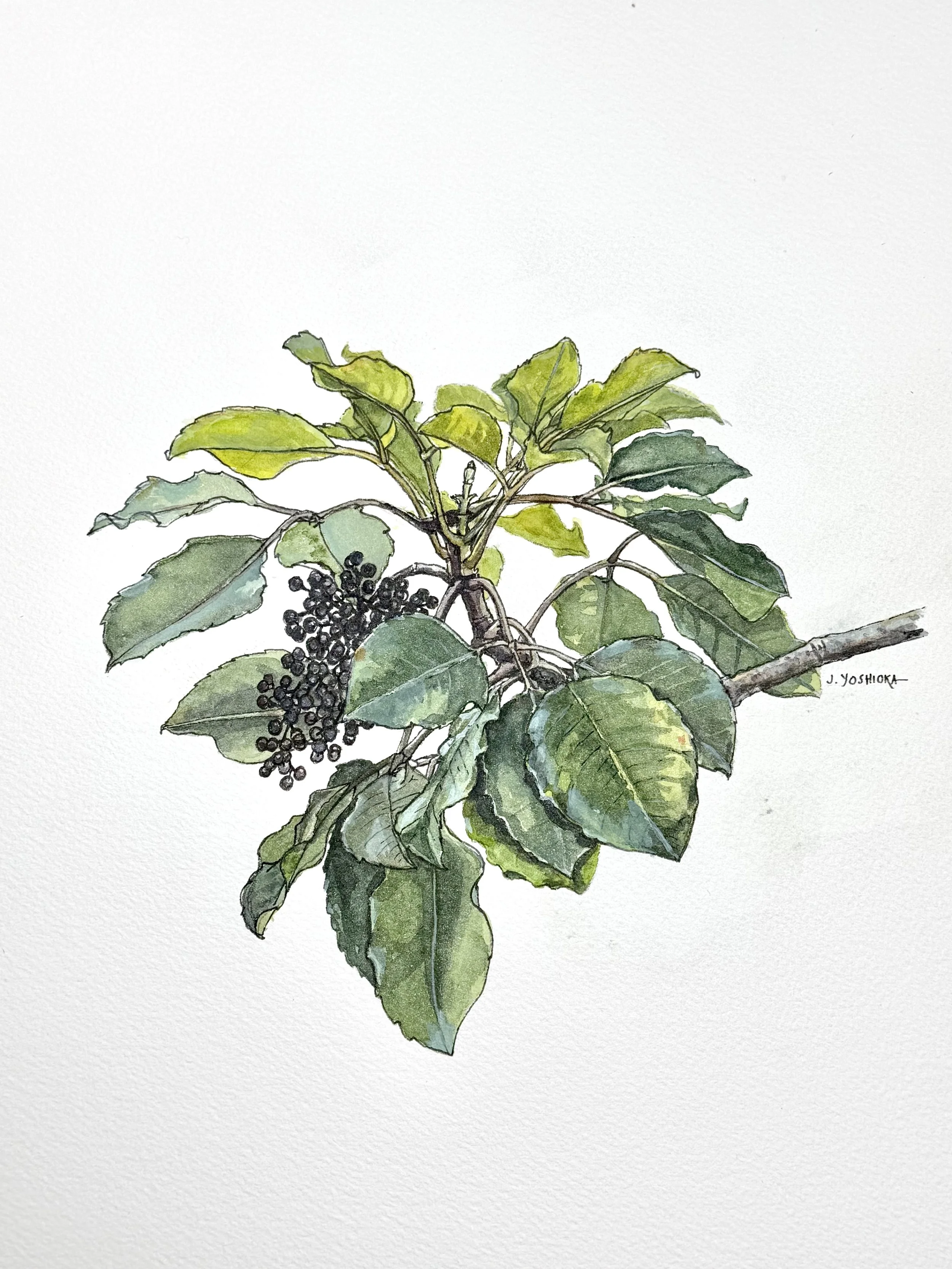
Artwork by Joan Yoshioka
Aloha to all of the plant lovers of Kaʻū – we are back and so grateful for the opportunity to continue to share about all of the amazing native plants of Kaʻū. If you are a new reader, welcome to Lāʻau Letters: Native Plants of Kaʻū. Each month, you can read about Kaʻū’s native plants and their moʻolelo (stories), uses, preferred habitats, opportunities to adopt them for stewardship, and other fun tidbits. This column really is a place for you to connect with new plants you may not know or to reignite your relationship with ones you already do. Because let’s face it – we need them more than they need us! To those who have read this column before (and thank you for doing so!), expect a slightly different structure than you are used to, but hopefully this will still be a helpful resource to you. Hawaiʻi is home to so many endemic (only found here), endangered, and truly unique plant species. Not only do they perform ecological and ecosystem services, but they also connect us to who we are and where we came from. I encourage you to not only read and research about the plants that interest you (hopefully all of them), but to also seek them out (if possible, safely and legally) - smell them, touch them, observe them, listen to them. Dive deep into what they represent to you and form the relationship that keeps us thriving. And please use a Hawaiian dictionary or wehewehe.org to dissect the names to really uncover all of the connections these plants have to the universe, including all of us. Enjoy!
ʻŌlapa (cheirodendron trigynum)
About: I found it fitting to kick off the new ʻAlemanaka Kaʻū column with a dear friend (and so much more), ʻŌlapa. ʻŌlapa is ubiquitous in our native wet forests and is easy to learn and identify, but you know I must have a deeper reason. ʻŌlapa is truly embodiment. Embodiment of nature into physical human bodies and minds. All too often, we busy humans are innate overthinkers, searching for definitions and patterns. But really, nature is our greatest teacher. That concept may be difficult to grasp for a lot of us, but ʻŌlapa is a good place to start to understand it. Hula dancers are referred to as ʻŌlapa, dancers accompanied by chanting or drumming. Why? Well, that is a good discussion for your next hike with a friend. But to ignite that conversation, here are some prompts: what do ʻŌlapa leaves look like when the wind blows? What do hula dancers embody? ʻŌlapa is a kinolau or incarnation of Laka, who is known to many as the goddess who drives the movements of hula, and also the goddess of the forest and of fertility and abundance. Start there, and then read on to make more connections.
Physically, ʻŌlapa is an endemic mid-canopy to canopy tree that occupies mesic forests and wet forests from about 1,000 feet to 7,000 feet in elevation on all of the main Hawaiian islands (except for Kahoʻolawe). In Kaʻū, you can find ʻŌlapa in most of the mesic and wet forests above about 2,000 feet in elevation. Not all islands have the same species of ʻŌlapa, and some even have island specific, endemic subspecies. There are six Cheirodendron species in the Araliaceae (or ginseng) family, and all but one is found only in Hawaiʻi (the other is in the Marquesas). If you get excited about etymology (like I do), Cheiros is Greek for hand, and dendron refers to the tree with leaflets that look like a 5-fingered hand. ʻŌlapa is easily recognizable by this description, as its bright and shiny, palmately compound leaves typically are arranged in sets of five (though sometimes you will see threes, or even sevens). No matter where ʻŌlapa stands in the canopy, those leaves are the first to flutter in the breeze, making a gentle, calming lapalapa sound that will draw you in to watch (lapalapa is also one of the other names for this tree). If you find a leaf within reach, pick it and crush it between your fingers and smell it – ʻŌlapa leaves have terpenes in them and it smells like ʻono green mango!
Uses: ʻŌlapa is such a valuable plant person in our forests. The deep purple, fleshy fruits are an important food source for native forest birds such as the ʻŌmaʻo, and other now extinct honeycreepers (the ʻŌʻō and ʻŌʻū). Unfortunately, feral ungulates enjoy bark stripping ʻŌlapa and grazing on the seedlings, so seeing ʻŌlapa naturally regenerate in our forests is less common than just a few decades ago (as is the story for most of our native plant species). The fruits (along with the bark) make a beautiful dark blue to almost black dye. ʻŌlapa bark can also be used to make kapa smell better (the bark also contains terpenes). The beautiful, light yellow wood is neither heavy nor light, and was used as both the sticks to catch birds with (using Pāpala kēpau gum on the end) and for making spears. Many parts of ʻŌlapa are medicinal. When mixed with other plants for lāʻau lapaʻau, the bark can be used to treat sores, boils, and infections.
Growing: Lucky for us, ʻŌlapa is relatively easy to germinate and to grow, and is a prolific fruiter during the right season. All you need to do is pick fruits when they are deep purple and ripe, remove the flesh (I like to use a bowl of water and a strainer), and sow them fresh in a mixture of soil and cinder. Keep the soil moist and cool and be patient because they can take a couple (or more) months to germinate. Up pot the seedlings as necessary, and remember ʻŌlapa like to be cool and love it when it rains, so find a spot that fits its needs. If your property doesn’t have a cool area that gets enough rainfall, consider passing your seedlings on to someone whose place is better suited - friends that share plants are the best friends to have!
As always, if you have any questions about what you read, feel free to ask me!
About the artist: Joan Yoshioka is a conservationist at heart and has dedicated her life to preserving the native plants and animals of Hawaiʻi through her work with various federal, state, and private organizations over the past 30+ years. She describes herself as an outdoor-lovin' optimist, biologist/botanist, and habitual creator of art-stuff. She believes the key to our most fundamental and truest part of ourselves is found in nature and she constantly draws on it for inspiration.
About the Author: Jodie Rosam has a deep love for native plants and a passion for exploration, with over 20 years of experience stewarding Hawaiʻi’s forests. She works for The Nature Conservancy and with Hawaiʻi Wildlife Fund, and serves on many non-profit boards. Jodie wears her love for Hawaii’s native plants on her sleeve, and thrives on sparking a love for nature in her children, making new friends in the plant kingdom, and sharing her passion with others. When she is not in the forest, you can find Jodie rooting for her boys at baseball or keeping their fishing pole hooks baited! Feel free to send questions to her email: jodie.rosam@gmail.com.
