
Lāʻau Letters: Native Plants of Kaʻū (Pāpala)
By Jodie Rosam
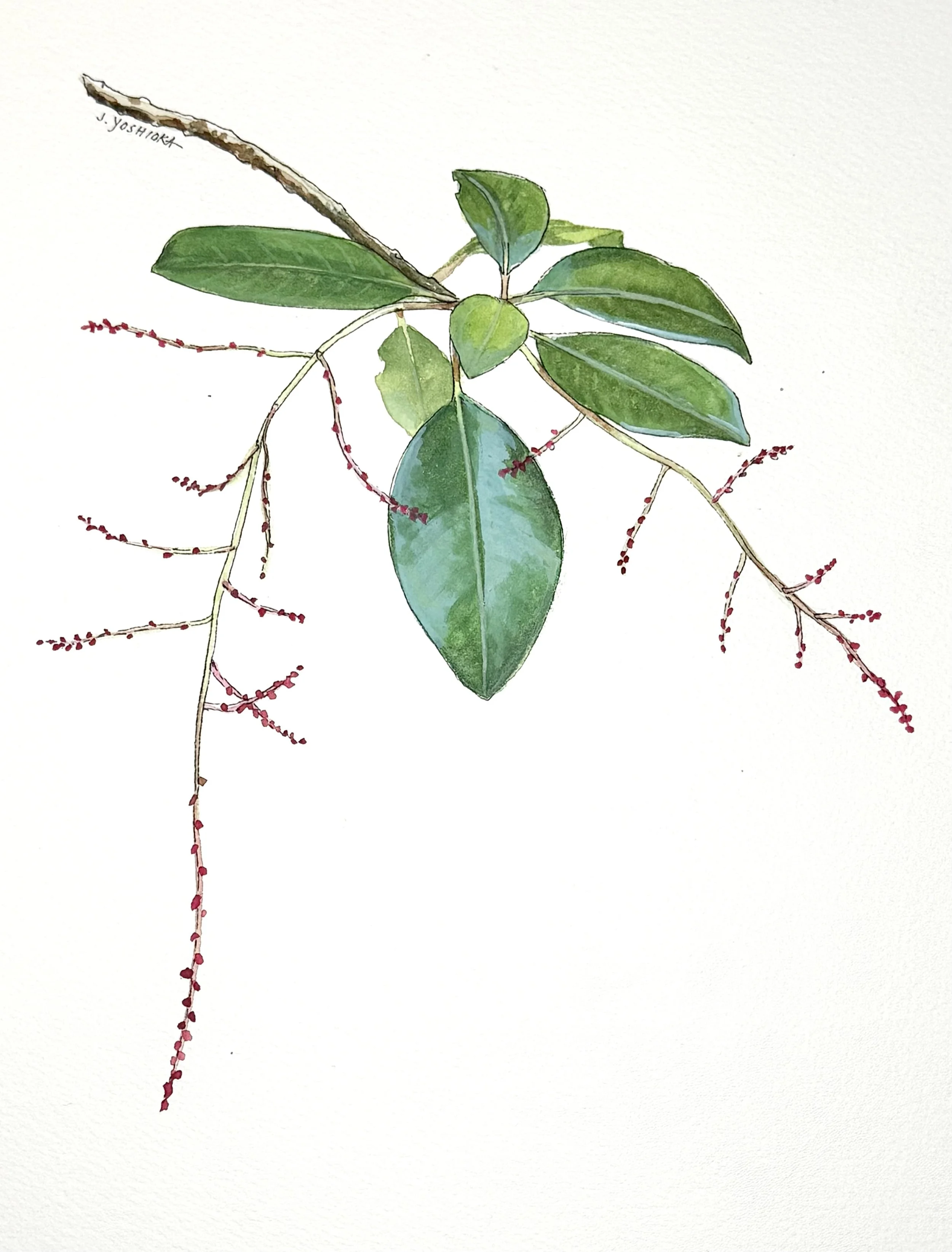
Artwork by Joan Yoshioka
Aloha to all of the plant lovers of Kaʻū – we are back and so grateful for the opportunity to continue to share about all of the amazing native plants of Kaʻū. If you are a new reader, welcome to Lāʻau Letters: Native Plants of Kaʻū. Each month, you can read about Kaʻū’s native plants and their moʻolelo (stories), uses, preferred habitats, opportunities to adopt them for stewardship, and other fun tidbits. This column really is a place for you to connect with new plants you may not know or to reignite your relationship with ones you already do. Because let’s face it – we need them more than they need us! Hawaiʻi is home to so many endemic (only found here) and endangered, and truly unique plant species. Not only do they perform ecological and ecosystem services, but they also connect us to who we are and where we came from. I encourage you to not only read and research about the plants that interest you (hopefully all of them), but to also seek them out (if possible, safely and legally) - smell them, touch them, observe them, listen to them. Dive deep into what they represent to you and form the relationship that keeps us thriving. And please use a Hawaiian dictionary or wehewehe.org to dissect the names to really uncover all of the connections these plants have to the universe, including all of us. Enjoy!
Pāpala (Charpentiera obovata)
I am excited to introduce you to a less common but very special species this month, Pāpala. Pāpala is an endemic tree in the Amaranthaceae family, cousin to other endemic species including ʻāweoweo (Chenopodium oahuense), kūlui (Nototrichium spp.), and Achyranthes spp. There are six species in the Charpentiera genus, five of which are endemic to Hawaiʻi (and the other from Rarotonga). This species of Charpentiera can be found on Kauaʻi, Oʻahu, Lānaʻi, Maui, and Hawaiʻi Island as a bushy understory component of mesic forests (and sometimes wet forests) at roughly 600 to 5,700 feet in elevation. Pāpala is a beautiful tree with obovate (egg-shaped…notice the etymology there?) leaves that can grow to about the size of your hand. The liko or new growth can show itself in shades of purple and magenta, and the leaf veins can be green, but you can also see them in hues of yellow or even maroon, pink, and even purple. The white, yellow, or red flowers grow in groups along the tree’s branches. Those flowers are small and not very showy themselves, but the most striking feature of Pāpala is how the flowers dangle off of a long (12+ inches), hanging, and deep-red inflorescence. These delicate sprays seem to erupt from the stems, mimicking spattering lava sparks.
Pāpala has a soft, buoyant, fibrous wood, and if you were to cut one of its thicker branches, you would notice that it has a really beautiful arrangement of vertical rings. Though found on most of the main Hawaiian Islands, Pāpala is best known from Kauaʻi, specifically Hāʻena, where it was brought to the steep cliffs on dark moonless nights, lit on fire, and tossed off the cliffside. The light wood would be carried by the wind, and when the soft pith burned rapidly, it would emit streams of sparks. Botanist and Hawaiian historian Beatrice Krauss adds that “some of the embers dropped into the sea; others were intercepted by some of the spectators in canoes in the sea below the cliffs and used to brand themselves as a form of tattooing to commemorate the occasion…such a person was looked upon as a hero.”1 This practice of hurling firebrands is called ʻōahi.
While Pāpala is not found in Kaʻū, it likely was a component of Kaʻū’s mesic and wet forests in the past, prior to large land clearing for the sugar cane industry. Aunty Mary Kaweni Pukui associates the place name of Kapāpala with this endemic species,2 though other moʻolelo identify Kapāpala as the name of a chief who was killed by Pele. Although you won’t see Pāpala growing wildly in Kaʻū today, it is found in the North Kona district, and Pāpala was actually the featured plant of this year’s Run For The Dry Forest, which took place on October 18th at Puʻuwaʻawaʻa.
Pāpala, though much more common in the Waiʻanae’s on Oʻahu, is becoming increasingly uncommon on Hawaiʻi Island because of habitat loss and the expansion of feral ungulates. It could be one of the species we see extirpated from Hawaiʻi Island in the wild during our lifetimes. What can you do? Encourage land managers to remove feral ungulates from sensitive habitats and support funding for your local restoration projects! Plants like Pāpala, which serve as a home for endemic insects (if you look closely, you might find that Pāpala is a host plant for an endemic long-horned beetle (Plagithysus elegans), a food source for native birds, and have medicinal and cultural value, need us to fight for their existence. A little plant-altruism goes a long way, even if it is not something you are used to. I hope one day you get to meet Pāpala and remember these words. As always, if you have any questions, feel free to ask me! jodie.rosam@gmail.com
1 Krauss, B.H. 1993. Plants in Hawaiian Culture. A Kolowalu Book. University of Hawaii Press, Honolulu.
2 Pukui, M. K., S. H. Elbert, and E. Moʻokini. 1974. Place Names of Hawaii. Revised and Expanded ed. University of Hawaii Press, Honolulu.
About the artist: Joan Yoshioka is a conservationist at heart and has dedicated her life to preserving the native plants and animals of Hawaiʻi through her work with various federal, state, and private organizations over the past 30+ years. She describes herself as an outdoor-lovin' optimist, biologist/botanist, and habitual creator of art-stuff. She believes the key to our most fundamental and truest part of ourselves is found in nature and she constantly draws on it for inspiration.
About the author: Jodie Rosam has a deep love for native plants and a passion for exploration, with over 20 years of experience stewarding Hawaiʻi’s forests. She works for The Nature Conservancy and with Hawaiʻi Wildlife Fund, and serves on many non-profit boards. Jodie wears her love for Hawaiʻi’s native plants on her sleeve, and thrives on sparking a love for nature in her children, making new friends in the plant kingdom, and sharing her passion with others. When she is not in the forest, you can find Jodie rooting for her boys at baseball or keeping their fishing pole hooks baited! Feel free to send questions to her email: jodie.rosam@gmail.com.
