
The Greening of the News Desert in Ka'ū
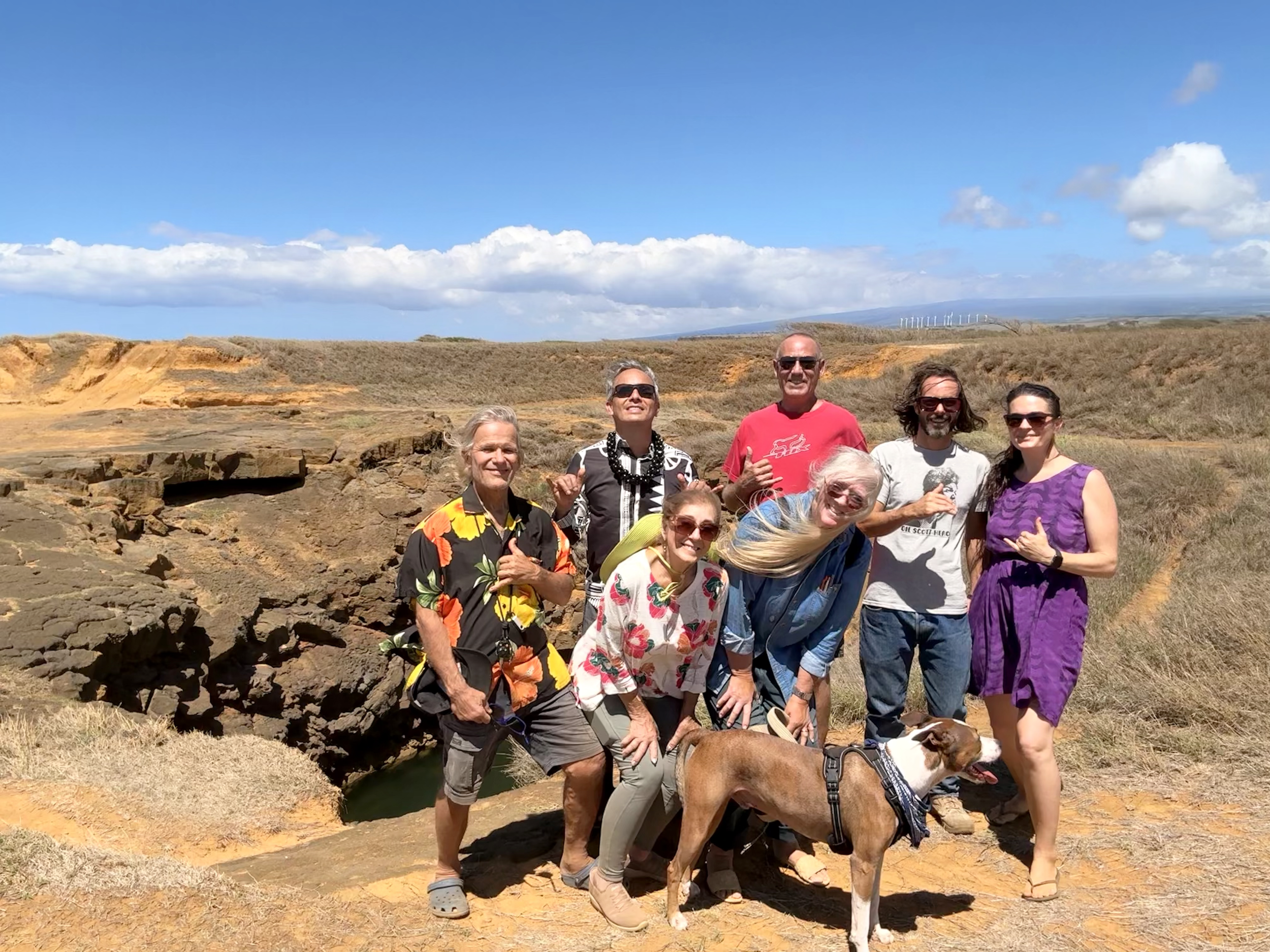
Those on the volunteer news team not pictured: Chayanee Brooks, Cadence Feeley, Kevin O’Connor, Christopher Phillips, Jodie Rosam, Peter Serafin, Ryan Williamson, Alison Yahna, and Joan Yoshioka
Those pictured are: Jimmy Cocallis, Kainoahemolele Tabar, Tim DeLozier, Laura Stocker, Drew Foster, Linda Raquinio, Laila Moiré-Selvage and her dog, Riley. Photo by Laila Moiré-Selvage.
A Mahalo from Ka'ū News
By Kainoahemolele Tabar
There is an old Hawaiian saying, “I ‘ike ‘oe iā Kaʻū a puni, a ʻike ʻole ʻoe iā Palahemo, ʻaʻole ʻoe ʻike iā Kaʻū,” which means, if you have seen all over Kaʻū, and you have not seen Palahemo, then you have not seen Kaʻū. This saying, while honoring Palahemo as an iconic historical site, speaks to the importance of digging deep and knowing a place thoroughly before you can claim to know it or to have seen it. In Kaʻū, the test for that depth of knowing is having seen Palahemo.
Palahemo itself is a magical place, a 30-foot in diameter hole in the ground created by Pele, the master land builder herself, wherein a fresh water lens sits atop ocean water. It was where the first natives gathered clear, fresh water in a barren landscape, and it was guarded by a moʻo that holds the same name. If you ascribe to the Hawaiian traditions of Kaʻū, you would understand that the first Hawaiians landed on this archipelago at Ka Lae, and Palahemo was one of the first wonders they must have beheld. It is no wonder then that the test for knowing Kaʻū is to have seen Palahemo. Palahemo is a unique formation on Hawaii Island, as it is an anchialine pool (a landlocked body of water with an underground connection to the ocean) that is home to endemic shrimp or ʻŌpae ʻula (Halocaridina rubra), some specific to Palahemo itself. Additionally, to attest to the gravity of standing at Palahemo, on a clear day, you can see Kaʻū’s boundaries - from the edge of the ahuapuaʻa of Kahuku on the western flank of Mauna Loa all the way to the ahupuaʻa of Keauhou and on the eastern flank of Mauna Loa. There are no other land formations or sighting points like it in Moku of Kaʻū.
The Kaʻū News team chose this location for its inaugural photograph because it reminds us of the importance of truth-telling and knowing Kaʻū well before proceeding with our good work of publishing the news of this place. Like knowing Palahemo, we will seek to do our best to provide a forum for good, solid journalism for the people and community of Kaʻū.
Kaʻū News’ mission is “to share Aloha by informing, inspiring and connecting our Kaʻū community through factual and unbiased news, articles and moʻolelo rooted in our ʻāina, history and culture.” Following that statement, our team of volunteers will go forth to tell the news in Kaʻū with earnestness. We have many thanks to Julia Neal for blazing the trail of sharing the news about these magnificent lands, and also we give thanks to Julia’s entire family, and especially her two nephews, William Neal and Michael Neal, for their enduring support of our volunteer team’s efforts. With their support, we were recently able to claim Julia’s legacy account on Facebook (that has roughly 15,000 followers) and continue to distribute the news to each of your 4,095 mailboxes in Kaʻū from Volcano all the way down to Ka Lae and around to Miloli’i. It is heartwarming that the Neal brothers have championed their Aunty’s cause and supported us the whole way. Mahalo aku mākou iā ‘olua!
In the near future, Kaʻū News may obtain nonprofit status. It is our expectation and intention that by obtaining nonprofit status, we will assist Kaʻū News in perpetuating the organization’s existence and the telling of the news in Kaʻū so that Kaʻū will have a source for news forevermore. It is going to be a bit of an experiment and challenge, and we therefore invite the full support of the Kaʻū community as we go forward in fulfilling our mission statement. We need advertisers, copy editors, reporters, news leads, and columnists. If there is some way you can think of to help the Kaʻū News, we invite you to step forward and contact us. Mahalo nui loa!
