
Planning Pāhala’s Future
By Jessica Andrews
Though not the support letter she hoped for, Brenda Iokepa-Moses told the Kaʻū Community Development Plan (CDP) Action Committee on March 24 that the Olson Trust will move forward with its plans for the Pāhala Center.
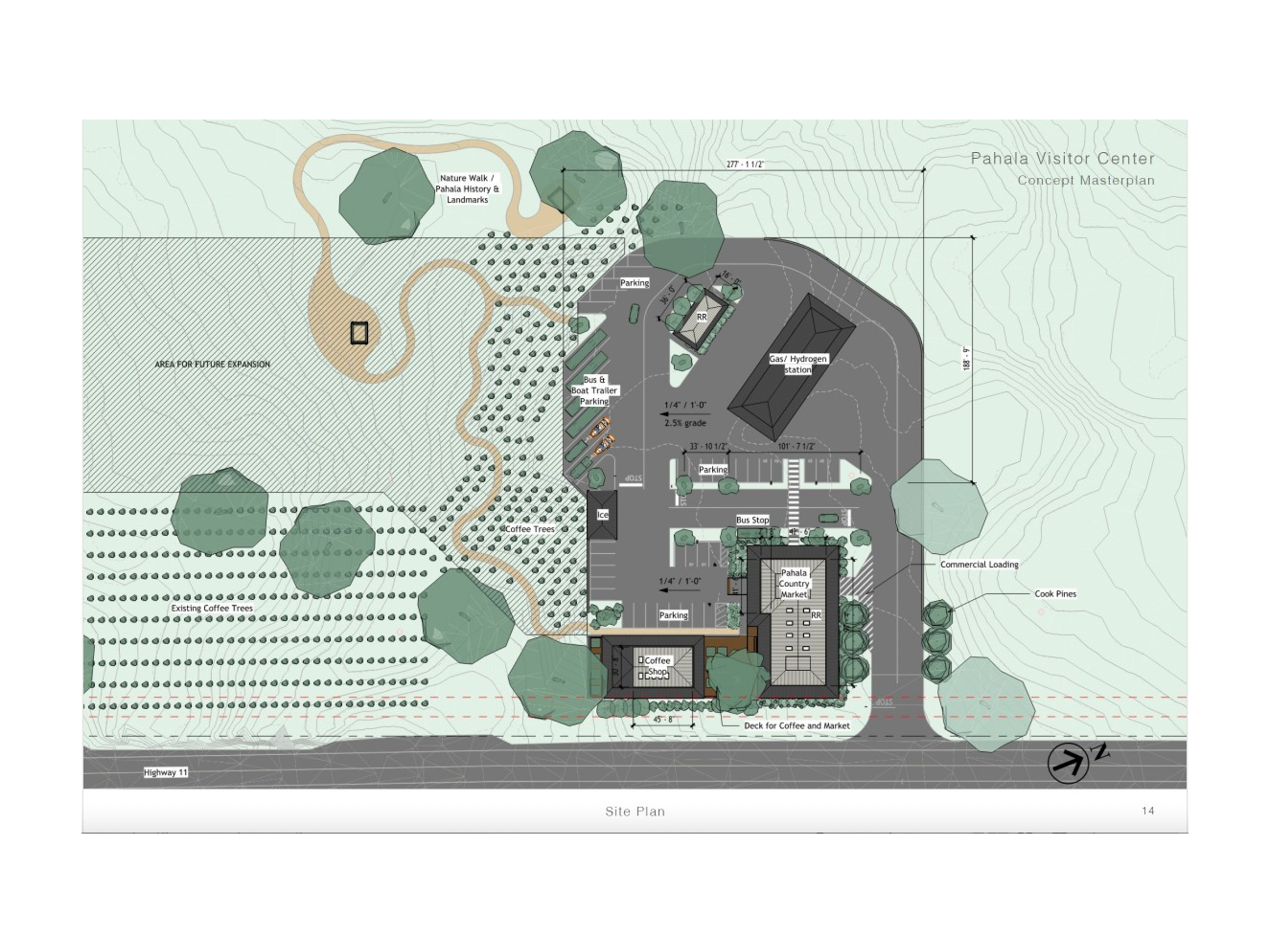
Located about a mile from the town center on Highway 11, the Pāhala Center will feature a convenience store with hot food, a fruit and vegetable market, a nature trail and a gas station — something the community has lacked for about three years. There will also be EV charging stations.
After about six months of coming to CDP committee meetings, Iokepa-Moses, the Olson Trust’s community and government liaison, called the combined letter from committee members Kaweni Ibarra and Babette Morrow “not that great.” But, she said, the trust will put it in their folder as they move forward with the planning process.
“One thing I don’t want to do is I don’t want to have so many excessive community meetings without having new information coming in front of our community. Their time is important,” Iokepa-Moses said. “We’re going to move forward. As soon as we have new information, we’re going to always come in front of the community, and we’ll invite you as well.”
The Olson Trust, which owns Kaʻū Coffee Mill, is asking the Hawaiʻi County Planning Commission to change the proposed site’s land-use and zoning designations. The 87-acre site is currently designated for low-density urban and agricultural use, which doesn’t allow for community development.
The Olson Trust proposes changing the land-use designation to medium-urban density under the county’s Land-Use Pattern Allocation Guide, or LUPAG, and the zoning to commercial village.
According to Senior Land Manager John Cross, the land-use designation changes would apply to about 10 of the 87-acre parcel. The Pāhala Center would “probably cover no more than about 3 acres,” Cross told CDP commissioners on Jan. 27.
As of the Kaʻū CDP’s March 24 meeting, the Olson Trust hadn’t finalized or submitted applications to the county planning department.
In their letter, Ibarra and Morrow noted that the Action Committee (AC) isn’t tasked with deciding whether it likes a project, but determining if it complies with the goals outlined in the Community Development Plan.
The proposed Pāhala Center aligns with the CDP’s goals of generating jobs and entrepreneurial opportunities for Kaʻū residents as well as expanding retail, dining and entertainment centers in “rural villages and towns,” the letter states. It also increases opportunities for Kaʻū residents to “buy local,” the letter states.
However, the letter Ibarra and Morrow wrote states that the proposed Pāhala Center’s location along the highway may be inaccessible to the youth and elderly. They state that the development does not align with CDP policies concerning walkable mixed-use town and village centers as well as concentrating commercial uses around Pāhala’s “central core areas.”
“While there is strong community support for the services as presented in the conceptual plan, community members and members of the Kaʻū CDP AC have presented issues with the proposed project area being in close proximity to the highway,” the letter states. “As proposed, the development is inaccessible by foot through the town of Pāhala, and would require traveling along Highway 11.”
Committee member Taylor Spurgeon, however, was dissatisfied with the letter and made a motion to “disapprove” it. Spurgeon said he and his colleagues should reject the letter Ibarra and Morrow wrote, pointing out that at a CDP AC meeting Nov. 18, his colleagues supported the proposed land-use designation and zoning change for the Pāhala Center. That discussion resulted in an earlier letter Ibarra wrote on his own that Spurgeon said “kind of got hijacked.”
“In minutes of Nov. 18th, everybody supported the first letter,” he told his colleagues. “Everybody was in agreement. And since then, this thing has gone so many different directions it’s crazy.”
Fellow CDP AC member David Kuahiwinui seconded Spurgeon’s motion and noted that all the Olson Trust wanted was community support before they moved ahead in the planning process. The community in Pāhala supports the project, he said, and not moving forward is a waste of time. Kuahiwinui also pointed out that if the Community Development Plan isn’t working for Kaʻū residents, it could be changed.
The committee voted down Spurgeon’s motion to “disapprove the letter” by 6-2, with Spurgeon and Kuahiwinui voting in favor of it. Spurgeon and Kuahiwinui were the only dissenting votes against approving the combined letter Ibarra and Morrow wrote, pointing out where the Pāhala Center was aligned with the CDP and where it fell short.
Before the vote, Vice Chair Kaʻohinani Mokuhaliʻi praised the Olson Trust and said everyone should follow its example when it comes to community outreach and public input before moving forward in the planning process. However, she said, the CDP AC can only weigh in on whether or not a proposed development complies with the CDP.
“We can’t blankly give you a letter of support,” Mokuhaliʻi told Iokepa-Moses. “We have done our job with creating this letter and now (you can) move forward.”
Iokepa-Moses told committee members that Pāhala residents have been asking for a gas station and mentioned the most recent Kona low that brought flooding to the region and damaged local roads.
“We were locked into this town, a gas station is important,” she said. “Our community has spoken, and I’ve listened. We’re going to continue to have our community meetings.”
