
Punalu'u Turtles
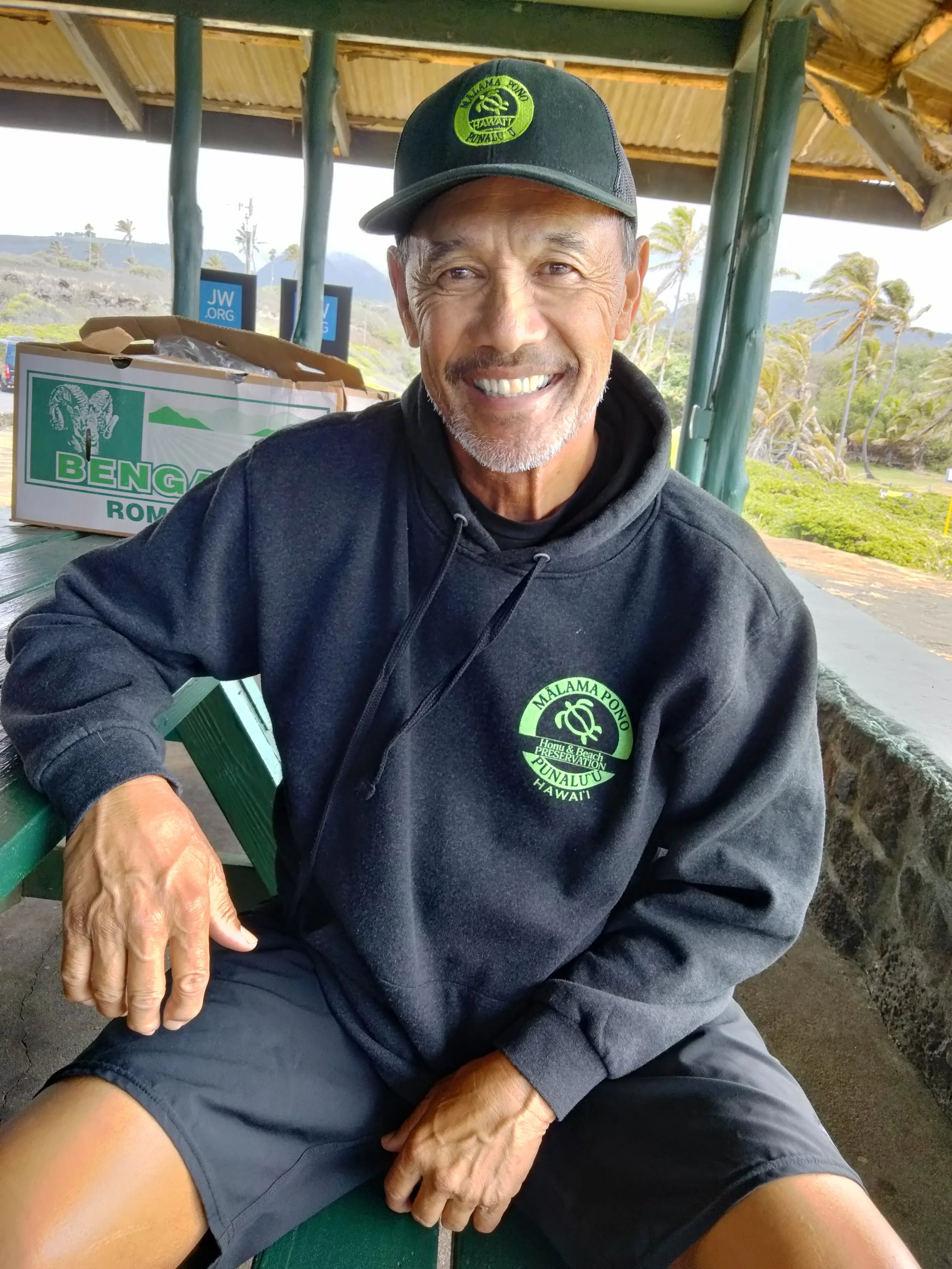
Photo by Laura Stocker — Guy Enriquez
By Laura Stocker
Editor’s update: As of Oct. 13, 2025, nesting season for the Hawksbill turtles was ongoing. But contrary to reports that nesting has increased, Kelleigh Downs, one of three sea-turtle recovery technicians with the Hawaii Island Hawksbill Project, couldn’t confirm that report. “We’re seeing the female nesting tracks,” she said. “We’re still in nesting season. It’s too soon to tell if the count is up yet. Typically, it (nesting) goes into December and we won’t know if the numbers are up until the hatchlings are out.”
He’s a Punalu’u native who grew up catching and eating honu, Hawaiian green sea turtles, not unlike other Ka’ū residents who were born and raised here. Guy Enriques today, however, sees the unique sea turtles from a different perspective.
“I used to eat ‘em,” said Guy Enriques. “Now I’m their guardian. I do my best to protect them. Once they got protected federally by the Endangered Species Act (in 1975), I changed.” Enriques, now 50, watches over the turtles today at Black Sand Beach near where he grew up, along with a cadre of locals who are dedicated to help ensure these turtles will survive.
He invites others to join his efforts and coordinates with the University of Hawaii’s Marine Science Department’s Marine Animal Response Team. Volunteer turtle monitors arrive at Black Sand Beach between 4 p.m. and 5 p.m. to see the turtles’ eggs, take care of the turtles and count them. “They definitely tell people about keeping the turtles safe,” Enriques said. Development in the area, especially at Black Sand Beach and its surrounding area, should be done with care, he said. Enriques has helped environmentalists to catch the marine reptiles at Punaluʻu beach and release them after they’ve been tagged and examined.
“We want community-based people who connect with the land,” he said. “Hopefully, they can organize and take care of the land. Here we have people whose families go back hundreds of years. They have reasons to develop strategies to make everyone happy.”
To that end, the group has cordoned off sections of the beach with large stones where Hawaiian Green Sea turtles can sun themselves after a long swim to eat algae that grows on the rocks before sunning themselves. Turtles usually come in the early morning with the tide and go back to the ocean with the receding tide, usually at about 1 p.m. It’s not unusual to see tourists and other interested folks walking right up to the rock barriers to look at and take photos of the resting turtles. Signs warn humans to stay clear and see the turtles but not molest them as they rest after dining, “leave the turtles in peace,” are posted in and around the protected spaces along the beach.
“The ‘keep out’ signs were made by Volcano Elementary, Middle and High School students,” he said. “About 50 kids in the Summer Fun program with Parks and Rec also planted to keep the sand from eroding.”
Ultimately, Enriques said he’d like to see an education center near Black Sand Beach. “I’d like to see a big education center for kids, everyone, ahupua’a (Hawaii Land Division System), where they created segments of land from mountain (mauka) to sea (makai),” he said.
Part of Enriques' volunteer activities were to help the University’s Marine Animal Response Team get turtles ashore to check for injuries, tag and place locators on their shells and get them unentangled from trash they encounter in the ocean. Ocean Conservancy reports that 11 million metric tons of plastics end up in the world’s oceans every year just from the land. Turtles and other marine life get entangled, and some die.
Amy Krommes of Na’alehu watches over Hawksbill Sea Turtles who return to Punaluʻu Black Sand Beach. She said that although those turtles’ diet consists mainly of jellyfish and sponges, they sometimes are victims of plastic bags. “The way plastic bags float along makes them look like jellyfish to turtles,” she said. “They eat the bags and end up starving or getting their internal systems clogged.”
Krommes role as a volunteer of 10 years with Hawaii Island Hawksbill Turtle Project is to observe, report and follow instructions given by the Project’s staff professionals. She walks Black Sand Beach to look for nests made by the turtles and report back. “We look for tracks that go to high areas and possible nests,” she said. “We take photos and report by phone for instructions,” Krommes said. “(Hawksbill Turtle Project) Staff comes out to confirm the nest. We put a wire cage over it to prevent predators from getting at, disturbing the nests — preying on the turtle eggs and hatchlings,” said Krommes, who walks the area in early mornings three times a week to check nests that appear as “cave-ins” on the sand.
Volunteers go out early because beachgoers’ tracks cover the beach by 10 a.m., Krommes said. Volunteers usually also keep watch several nights in a row to “keep guard and watch for turtle babies heading to the ocean,” she added. Krommes is concerned about continuing development and its impact on the light that distracts turtles trying to find their way back to the ocean, particularly the newly hatched ones.
“Generally, turtles return to make nests where they were born. When turtles come back to their home beach to lay their eggs. They stay in the bay to observe if it’s safe to come ashore,” Krommes said. “There could be a parking lot, housing development, bright lights that cause them to stay out in the bay.”
Krommes explained that lights confuse turtles, who instinctively follow the light of the moon and stars to return to the water. About artificial lights, including streetlights and home lights, she added, “Lights are very disorienting for turtles. They will go to the light and get lost.” There have been times at Black Sand Beach when turtles have gone toward a large streetlight on the beach’s periphery and have been stranded, she added.
While Hawaiian Green Sea Turtles make their nests by the high-water line, Hawksbill prefer to make theirs in higher ground among naupaka vegetation. Naupaka is a native Hawaiian plant with several varieties that have unique, half-flower blossoms. The most well-known is naupaka kahakai, a coastal shrub, while naupaka papa is a smaller, flat-lying shrub found in drier coastal areas. Both are valued for their resilience and cultural significance.
Besides lights, another hazard for newly hatched hawksbills is footprints made by humans. The seemingly small indentations in the sand for humans can appear like a mountain to hatchlings and inhibit the small creatures from seeing their way to the water.
One of Krommes’ duties as a volunteer guardian is to “sweep” the sand with her sandaled feet to clear a safe route for the tiny turtles to get to the water and to be a shadow to protect the hatchlings from being distracted by bright artificial lights.
“Lights! Lights! Lights!” she said. “We stand out to shade hatchlings from park lights using umbrellas or beach towels to create a shadow.” Her other advice for anyone who thinks it’s OK and is tempted to interact with the turtles is simple: “Don’t touch or try to help the turtles you see on the beach.”
Hawaii County has people in place for that purpose. Brad Young, a lifeguard with Hawaii County Fire Department, also keeps an eye on the turtles. “We focus on people’s safety. But when we see people too close to the turtles, we step in,” he said on a sunny June day while looking toward the few turtles resting.
“There’s a language barrier sometimes; that’s why we have pictures on the signs (about steering clear of the turtles).”

Photo by Laura Stocker — Limu / Seaweed
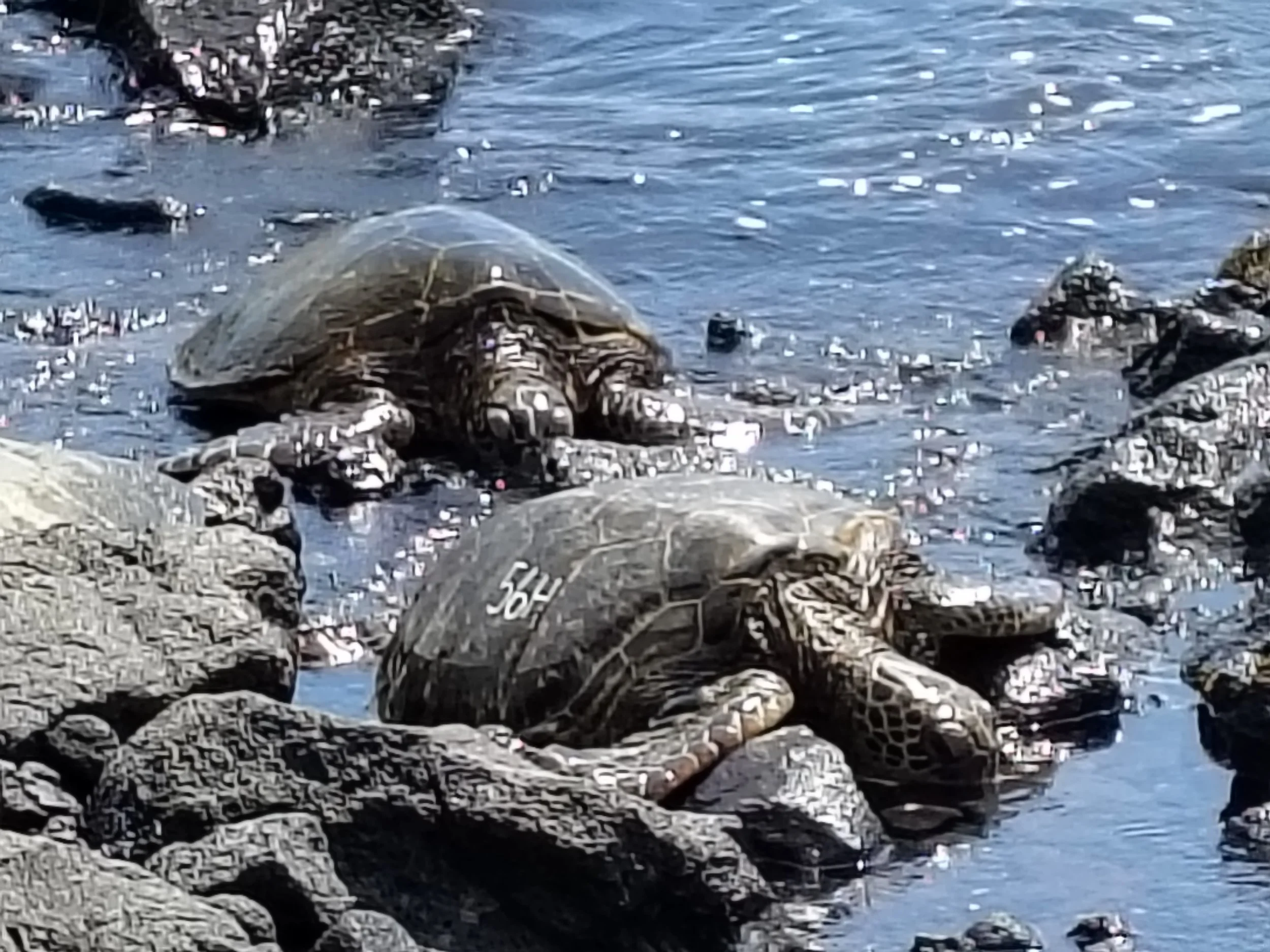
Photo by Laura Stocker — Honu / Green Sea Turtles
