Restoring the Heart of Honuʻapo
Community Efforts to Revitalize the Historic Loko Iʻa
Story & Photos By Jessica Andrews
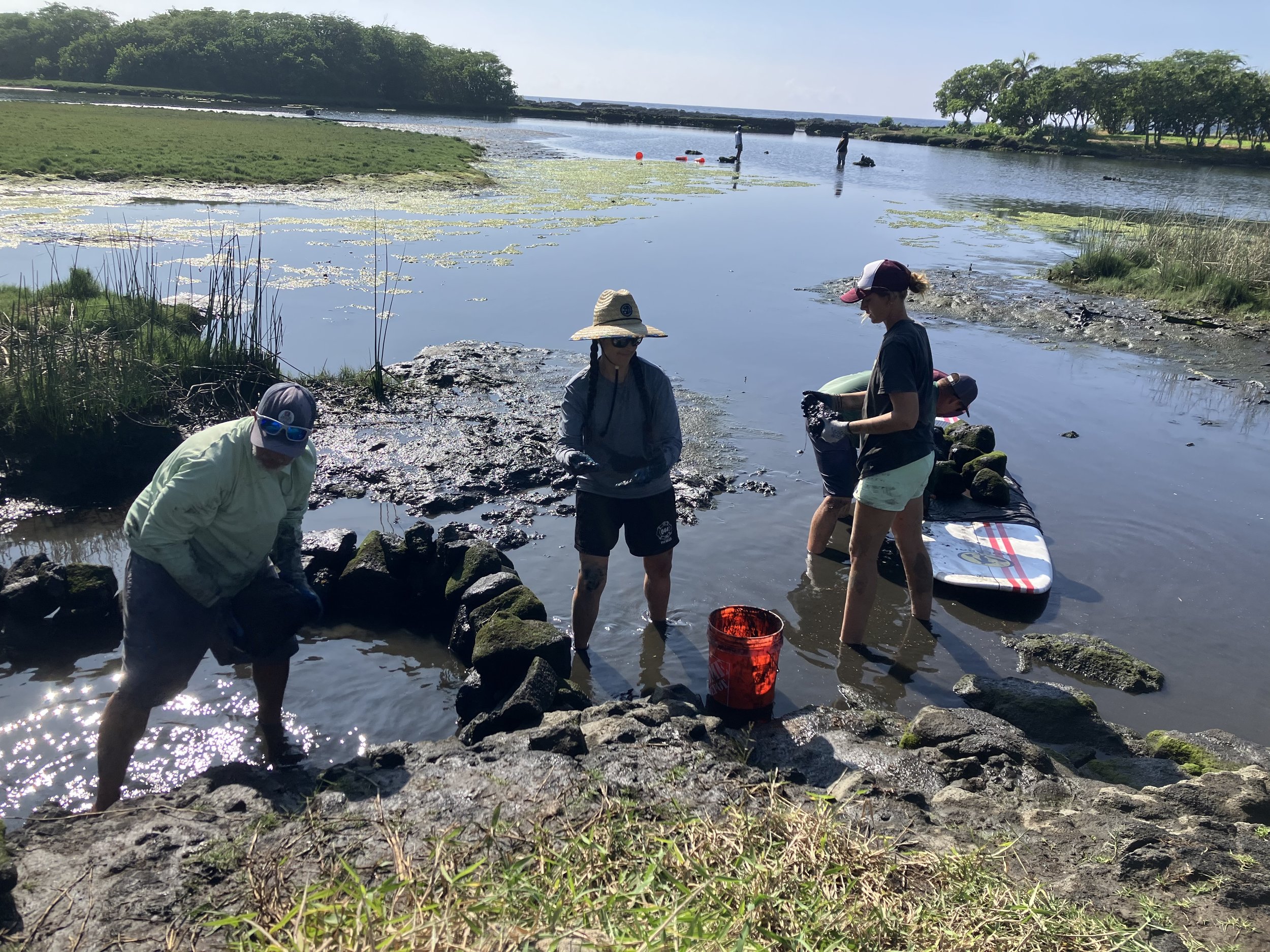
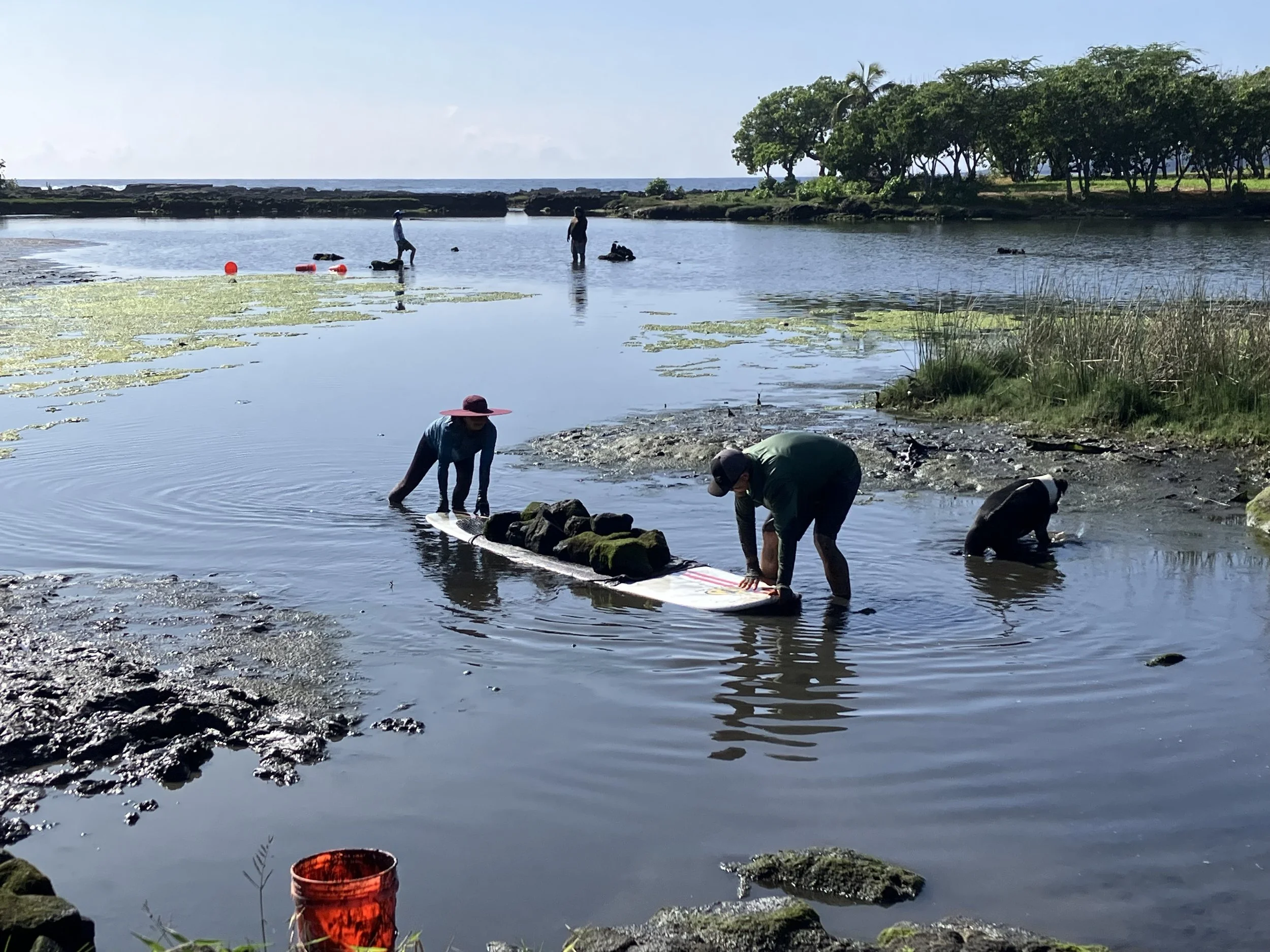
Kaʻū Johnston-Kitazawa waded through shin-deep water and sediment to guide the rock-laden surfboard to the edge of the Honu’apo estuary.
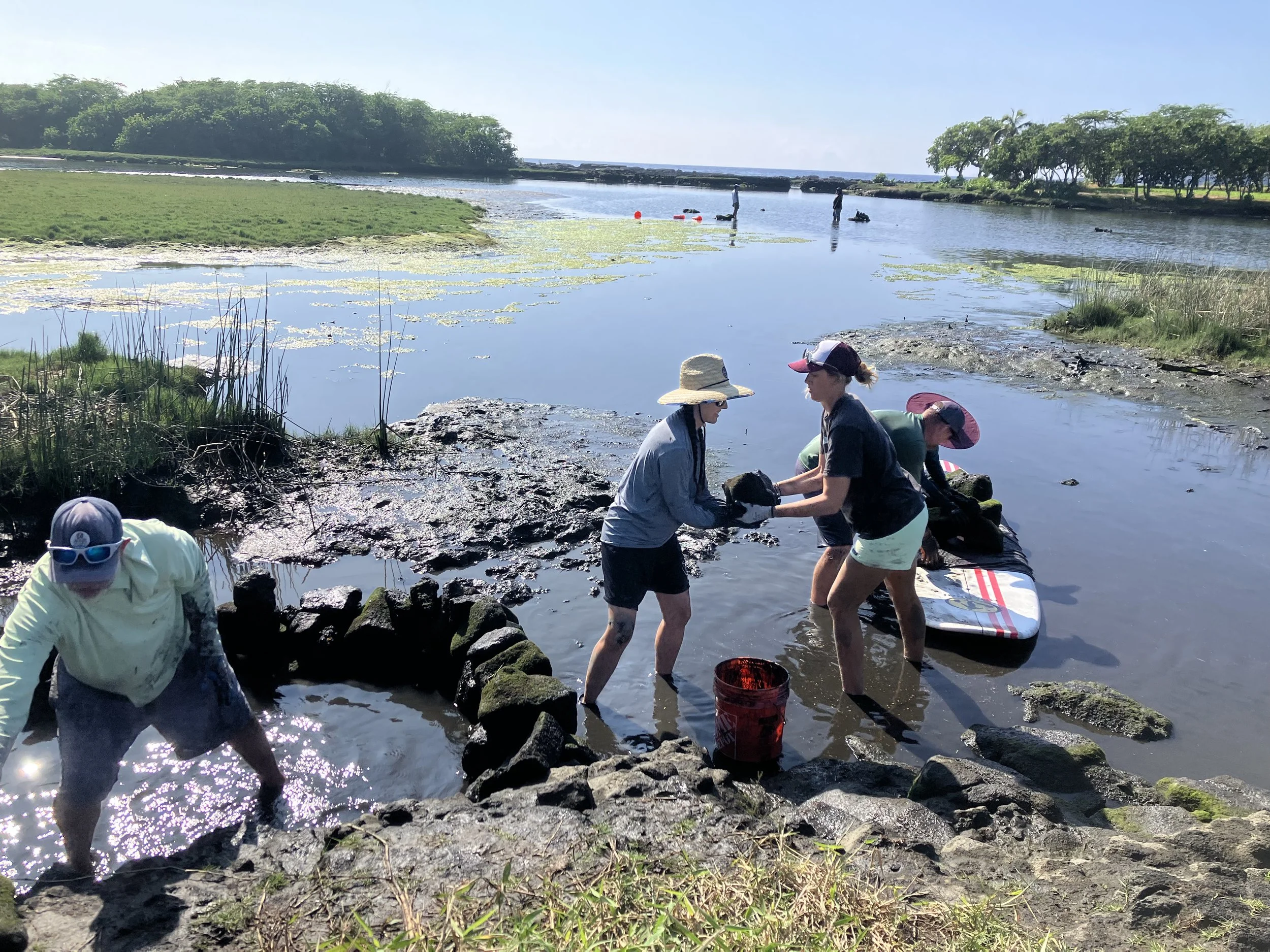
A sunny morning on the last Saturday in January saw him and other Ka ‘Ohana o Honuʻapo (KOOH) volunteers forming a human conveyor belt to construct a barrier around one of dozens of freshwater springs feeding the estuary.
“It was a loko i’a, a fish pond,” said Johnston-Kitazawa, a steward with Kaʻū Hoa Pili ‘Āina training program. “It was a food source. It was a place where you could have readily available food in terms of you trap the fish when they’re younger, and they grow, and they’re readily available when it comes time to harvest.”
Colby Lund, co-coordinator for KOOH’s volunteer days, estimates that there are 50 freshwater springs feeding the estuary. The organization’s goal, he said, is to remove sediment from the old sugar plantation days that has built up around the springs and keep invasive plants at bay.
Lund and 10 to 15 volunteers have spent about a year and a half working on the back part of the estuary. Part of this project involves restoring an island that had been filled in with sediment and replanting it with native species. Though he says restoring and maintaining the estuary is indefinite, Lund has seen more turtles accessing the pond in search of limu as well as native and migratory birds.
“A lot of this sediment, it’s almost 3 to 4 feet deep in certain parts,” he said. “We’re going to dredge all that so we get the natural depth again.”
Honuʻapo provides critical habitat for endangered species, including the Hawaiian stilt (aeʻo) and hoary bat (ōpeʻapeʻa), and is an essential stopover for migratory shorebirds, KOOH Secretary Megan Lamson said.
Its loko iʻa was once part of a thriving village, she said. Restoring the fishpond will help perpetuate traditional Hawaiian practices, including the construction of a kuapā-style rock wall as well as sustainable food gathering.
“Geographically, Honuʻapo is part of the longest stretch of undeveloped coastline in all of Hawai’i, connecting several protected conservation areas along the Kaʻū coastline,” Lamson told Kaʻū News. “It’s one of the few coastal wetlands in the region, providing refuge to both birds and juvenile fish in an otherwise dry landscape. And, most importantly, it’s a beloved community gathering place that has become treasured by Kaʻū residents for generations.”
Ka ‘Ohana o Honuʻapo has been actively restoring the estuary since 2010. Since March 2021, the organization has hosted monthly work parties and has welcomed more than 1,450 pairs of helping hands since then. That includes 550 youth, Lamson said.
But the major construction and contouring work KOOH hopes to do to deepen pools in the backwater areas of the wetland requires state and federal permits as well as funding. The Hawaiʻi Department of Land and Natural Resources completed a final environmental assessment with a finding of no significant impact in January, with a release in February, Lamson said.
KOOH is also in the final stages for a U.S. Army Corps of Engineers permit and is seeking a Tier 3 Hōʻala Loko Iʻa permit, Lamson said, referring to a state permit governing the reconstruction of traditional fishponds. The organization is also nearly finished with the process of securing other state and county permits, according to Lamson.
“Once these federal, state, and county compliance requirements are satisfied, we’ll be able to move forward with the more intensive on-the-ground restoration activities outlined in our plans,” she said.
In addition to continuing to remove invasive plants, including seashore paspalum and other invasive grasses from the intertidal mudflats, the project will include extensive re-vegetation and ongoing predator control targeting mongoose and rats, Lamson said.
“The next phase will focus on the deeper water features and final habitat enhancements that require heavy equipment and engineering expertise,” she said.
Still, every pair of helping hands helps, Lamson said, urging Kaʻū residents to stay tuned for opportunities to volunteer as well as to participate in KOOH workshops.
For Alice Birnbaum, a KOOH volunteer and steward with Kaʻū Hoa Pili ‘Āina, working to restore the Honu’apo estuary had opened her eyes to what a gem Kaʻū is.
“We show up in all different ways,” she said, standing in calf-deep water above a bubbling freshwater spring. “We’re very interconnected. We do a lot of collaborative work, there’s so much to treasure here.”
Johnston-Kitazawa, who was born in Hilo but grew up in Kaʻū, described Honu‘apo as a place “where I got to come to regularly.” Johnston-Kitazawa agreed with Lund, who said that taking care of the estuary would be an ongoing endeavor.
“It’s this element of I don’t want to see (the land) disappear or just fall fallow,” Johnston-Kitazawa said.
Imparting that connection to his son, Alexander, including the need to take care of it, is important to him.
“My son is a year and a half, and hopefully one day he can come down and partake in this,” he said. “There’s an element of needing to take care of it to ensure that it sticks around for those who follow. This is me finally getting around to doing a little bit of that myself.”
To get involved with the Honu‘apo restoration, find @kaohanaohonuapo on Facebook and Instagram or visit honuapopark.org.