
Stars Over Kaʻū: January 2026
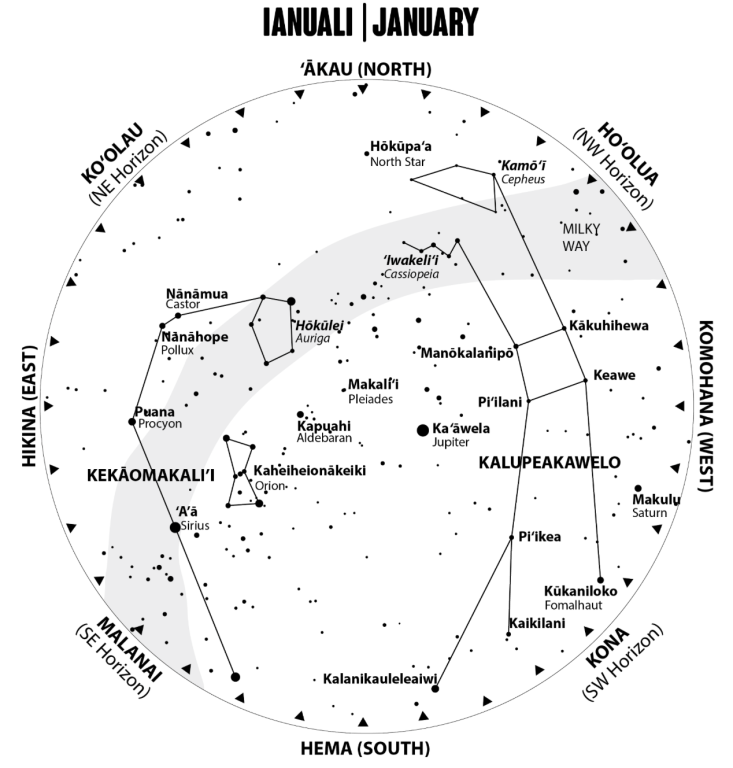
Image credit: ʻImiloa Astronomy Center of Hawaiʻi
By Christopher Phillips
Greetings stargazers! This month we are treated to a parade of planets stretching from dusk into the night. As the Sun sets, brilliant Jupiter (Ikaika) rises to prominence, shining high in the sky and dominating the evening hours as it moves toward opposition. Easily one of the brightest objects in the night sky, Jupiter is often mistaken for an aircraft or a distant beacon. Nearby, Saturn (Naholoholo) can be spotted lower in the evening sky, its steady golden light marking the ringed planet as it slowly sets later in the night. Venus (Hokuloa) and Mars (Holoholopinaau) remain tucked close to the Sun this month, making them difficult to observe. Even so, January offers excellent opportunities to explore the outer planets, whether with the naked eye, binoculars, or a small telescope.
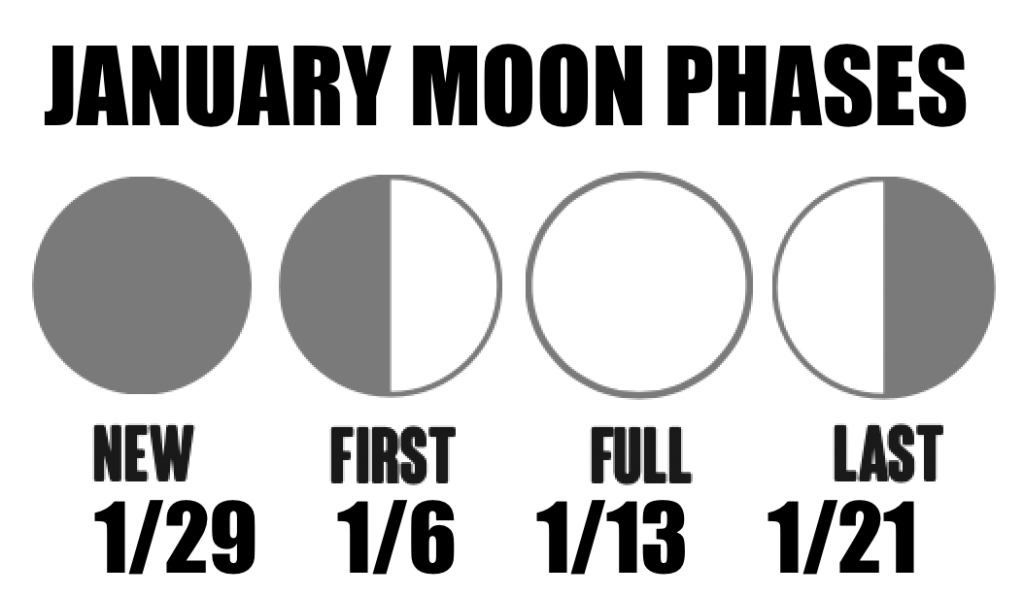
Image credit: ʻImiloa Astronomy Center of Hawaiʻi
Our Hawaiian Sky
This month the Hawaiian starline of Kalupeokawelo begins to make way for the rising starline of Ke Kā o Makali‘i, known in English as The Great Bailer of Makaliʻi. It is composed of some asterisms (collections or patterns of stars) that may be familiar to you. One such asterism is Makaliʻi itself, the Hawaiian name for the Pleiades star cluster, which holds significant cultural importance, especially in marking the start of the Hawaiian Makahiki season (a time of harvest and renewal).
This starline connects several bright stars in the night sky, such as Hokulei is also the name for a circle of five stars forming a star-lei, the star Hokulei being the brightest star in the celestial lei. The Western name for the star Hokulei is Capella. To the naked eye this star appears as one bright star, but in reality it is a quadruple star system. Four Sun-like stars, all orbiting one another in a complex yet graceful celestial dance. The name of the constellation that includes the circle of five stars of the lei is Auriga, the Charioteer. As we progress along the line we come across Na Mahoe (The Twins), which you may know as Pollux and Castor, the twins of Gemini, and ʻAʻā (Sirius), which were used to maintain bearings and locate islands during voyages. The line runs through these stars and concludes at Ke Ali‘i o kona i ka lewa (The chief of the southern sky). These stars form a celestial "line" that resembles a canoe bailer used for scooping water. For the keen eyed amongst us, we notice that the bailer appears to scoop up the stars or Orion and the Pleiades, before appearing to empty them out into the western horizon as it passes overhead during the night. For a casual observer, it’s a simple and beautiful way to recognize some key stars and learn about Hawaiian cultural perspectives of the cosmos.
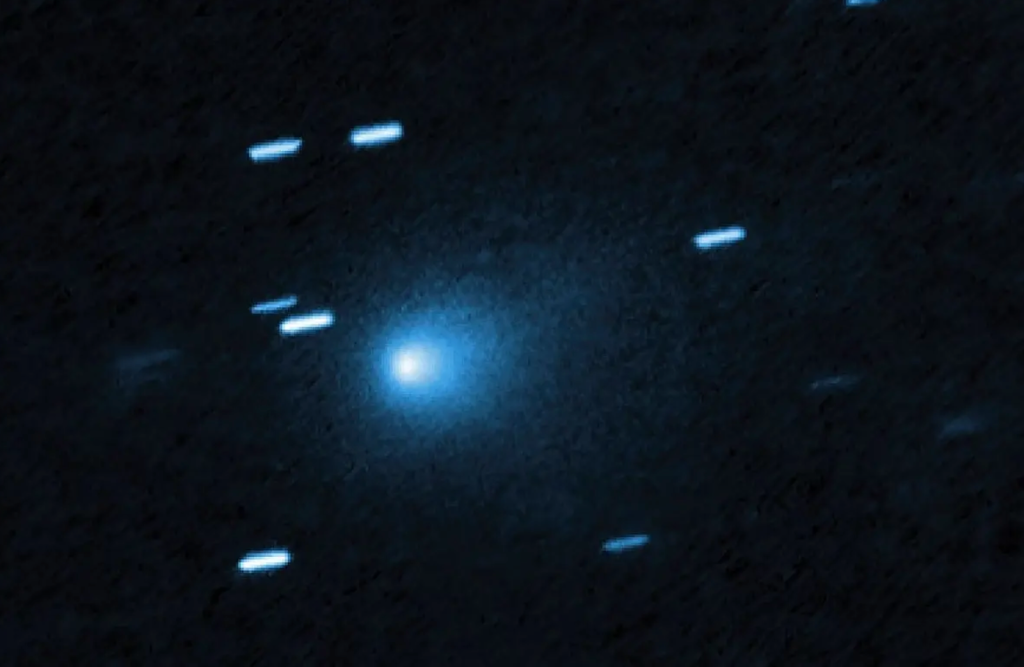
Visible light Image of Comet 3I /ATLAS | Image Credit: Institute for Astronomy Hawaii / NASA
A Celestial Spectacle Continues Into 2026
This January, astronomers are turning their eyes to a truly rare celestial visitor, Comet 3I/ATLAS, only the third known object ever confirmed to have entered our solar system from interstellar space. Unlike comets born alongside our Sun, this traveler began its journey around another star entirely, carrying with it clues from a distant and unfamiliar planetary system.
Discovered earlier this year by the ATLAS survey, Comet 3I/ATLAS has surprised scientists as it continues its passage through the inner solar system. Recent observations have revealed a distinct green glow surrounding the comet’s coma, a telltale sign of energized carbon compounds released as sunlight interacts with its icy surface. While green comets are not unheard of, seeing this phenomenon in an interstellar object offers astronomers a rare opportunity to compare the chemistry of other star systems with our own.
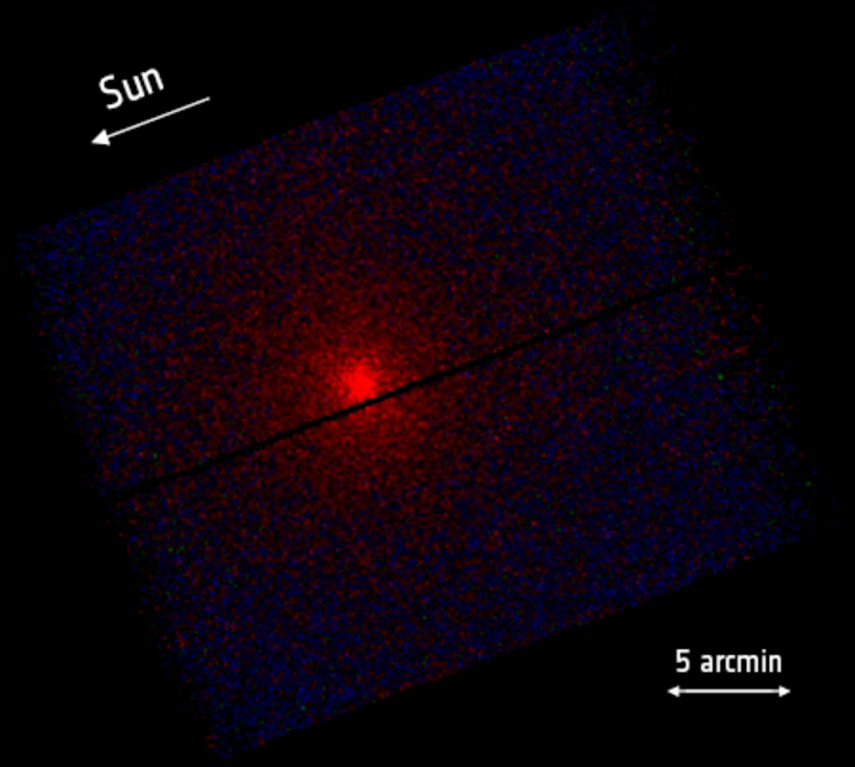
X-ray image of comet 3I / ATLAS | Image Credit: European Space Agency (ESA)
Even more remarkable, Comet 3I/ATLAS has become the first interstellar comet ever observed emitting X-rays, as observed by the XMM-Newton X-ray Space Telescope.. These X-rays are produced when charged particles streaming from the Sun collide with neutral gases escaping the comet, a process known as charge exchange. Detecting this high-energy interaction allows scientists to study not only the comet itself, but also how the solar wind behaves far from Earth, a cosmic handshake between our Sun and matter forged beyond it.
As the comet continues to recede from the Sun, astronomers are racing to collect as much data as possible before it fades from view. Every measurement from its speed and trajectory to the composition of its gases and dust helps refine our understanding of how planetary systems form across the galaxy. Intriguingly, Comet 3I/ATLAS appears to be richer in certain volatile materials than many native solar system comets, hinting that planet-forming environments elsewhere may follow different chemical recipes. Though this interstellar visitor is far too faint to be seen without powerful telescopes, its significance looms large. Each such encounter reminds us that our solar system is not isolated, but part of a vast cosmic exchange, where material can wander between stars over millions, even billions of years.
As Comet 3I/ATLAS slips back into the depths of interstellar space, it leaves behind more than just data. It leaves us with perspective, a reminder that the night sky is not only a window into our past, but a bridge to distant worlds we may never see, yet can still come to know through the quiet glow of a passing comet.
