
Stars Over Kaʻū: July/August 2026
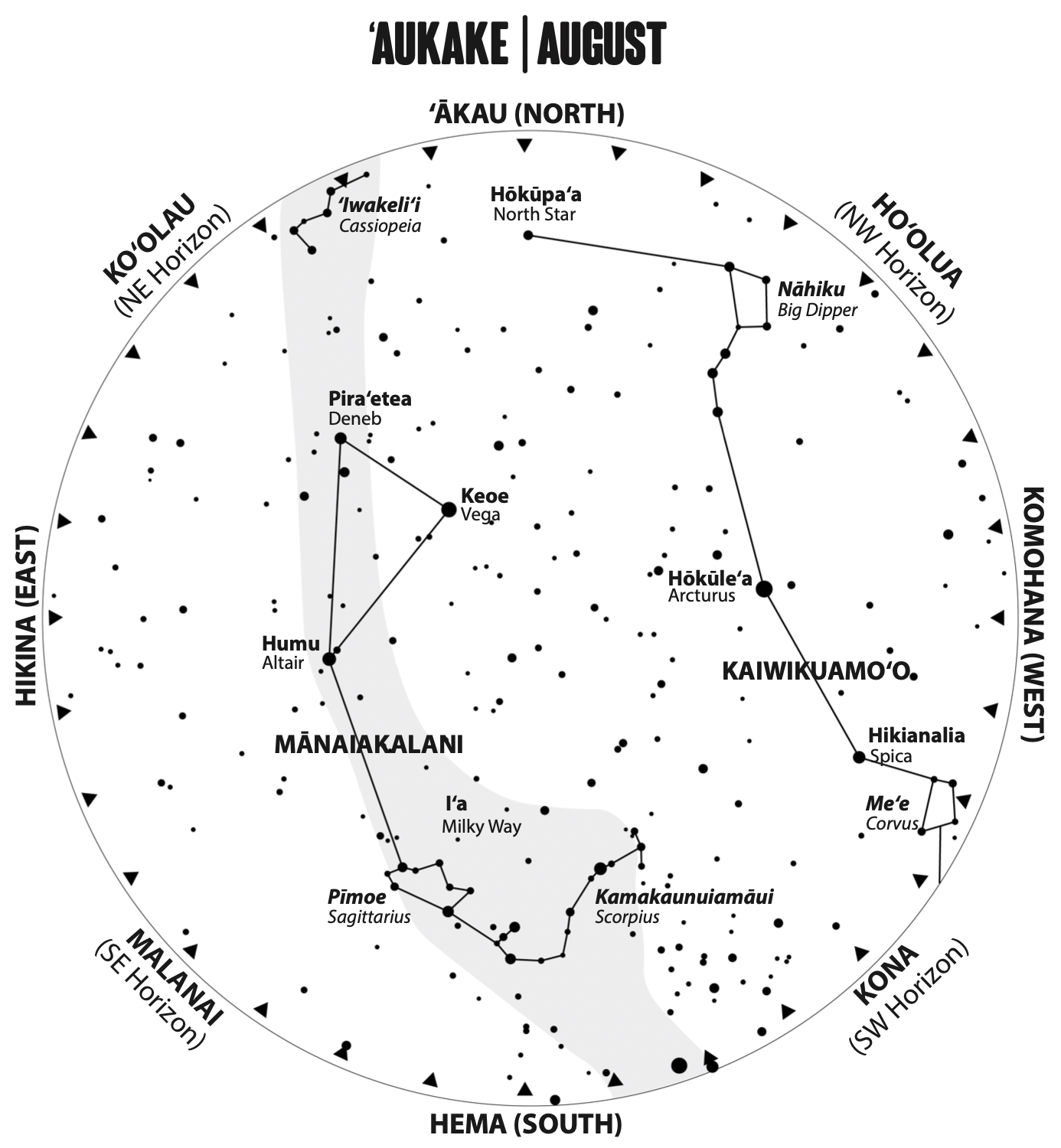
Image credit: ʻImiloa Astronomy Center of Hawaiʻi
By Christopher Phillips
Greetings stargazers! During July and August, keep an eye on the eastern sky before dawn for a gathering of celestial visitors. Mars (Holoholopinaʻau), Jupiter (Hōkūloa), and Saturn (Naholoholo) will be joined by Mercury (Ukalialiʻi) and, with the aid of binoculars or a small telescope, the distant worlds Uranus (Heleʻekala) and Neptune. Together they create a beautiful planetary display stretching across the morning sky.
A special treat occurs on July 4, when Mars passes very close to Uranus. Mars will shine much brighter than its distant companion, making it an excellent guide for locating the ice giant low in the predawn sky.
In the early evenings of July, Venus and Jupiter remain visible shortly after sunset, offering a nice contrast to the planets gathering before dawn. The highlight of the season arrives on August 12, when six planets — Jupiter, Mercury, Mars, Uranus, Saturn, and Neptune — form a grand planetary parade across the eastern and southeastern sky before sunrise. Look for the planets tracing a gentle arc from the horizon upward toward the south.
Just a few days later, on August 15, Jupiter and Mercury appear close together near the eastern horizon. Their conjunction makes both planets easy to spot during morning twilight. For the best views, find a location with a clear, unobstructed eastern horizon and begin observing about an hour before sunrise. Jupiter, Mars, Saturn, Venus, and Mercury are bright enough to be seen with the naked eye, while Uranus and Neptune will require optical aid. Clear skies and a little patience will reward you with one of the finest planetary displays of the year.
Our Hawaiian Sky
This month the Hawaiian starline of Ka ʻIwikuamoʻo (The Backbone) begins to wane in prominence in our night sky, making way for Mānaiakalani to take the stage during the nights of August. You may recall that Ka ʻIwikuamoʻo is sometimes represented as the backbone of a great lizard or a genealogical backbone, with each star representing a generation. This magnificent starline begins in the North (ʻĀkau) and extends from Hōkūpaʻa (Polaris / the North Star) all the way South (Hema) to Hānaiakamalama (the Southern Cross). The line can be traced through the various constellations that make up Ka ʻIwikuamoʻo just as one can trace one’s own genealogy — a path from oneself to one’s ancestors, back through time. Each set of stars is a unique entity with its own identity.
Mānaiakalani is known by several names depending on translation, including The Chief’s Fish Line, Come-From-Heaven, or Māui’s Fish Hook. The prominence of this starline in our evening sky marks the height of summer. The starline is composed of several notable asterisms, the largest being the fishing spool made up of a great triangle of three bright stars. This trio is referred to as The Navigator’s Triangle (Huinakolu), or the Polynesian Triangle. Within it are the stars of Piraʻatea, Keoe, and Humu (known by their Arabic names as Deneb, Vega, and Altair, respectively). In the Polynesian Triangle, they represent the islands of Aotearoa (New Zealand), Hawaiʻi, and Rapa Nui (Easter Island).
The fishing line extends to the constellation of Sagittarius, which in this context is Pimoe, the giant ulua fish. Next to this is the distinctive shape of the hook itself, Ka Makau Nui o Māui (Scorpius). The region dominated by Pimoe and Ka Makau Nui o Māui also marks the center of our galaxy, the Milky Way. On a moonless night, the bright core of the galaxy, filled with the light of millions of stars, is a sight to behold. On either side, the great spiral arms of the Milky Way can be seen extending out from the bright core, with vast dark clouds of star-forming material silhouetted against the light of countless stars.
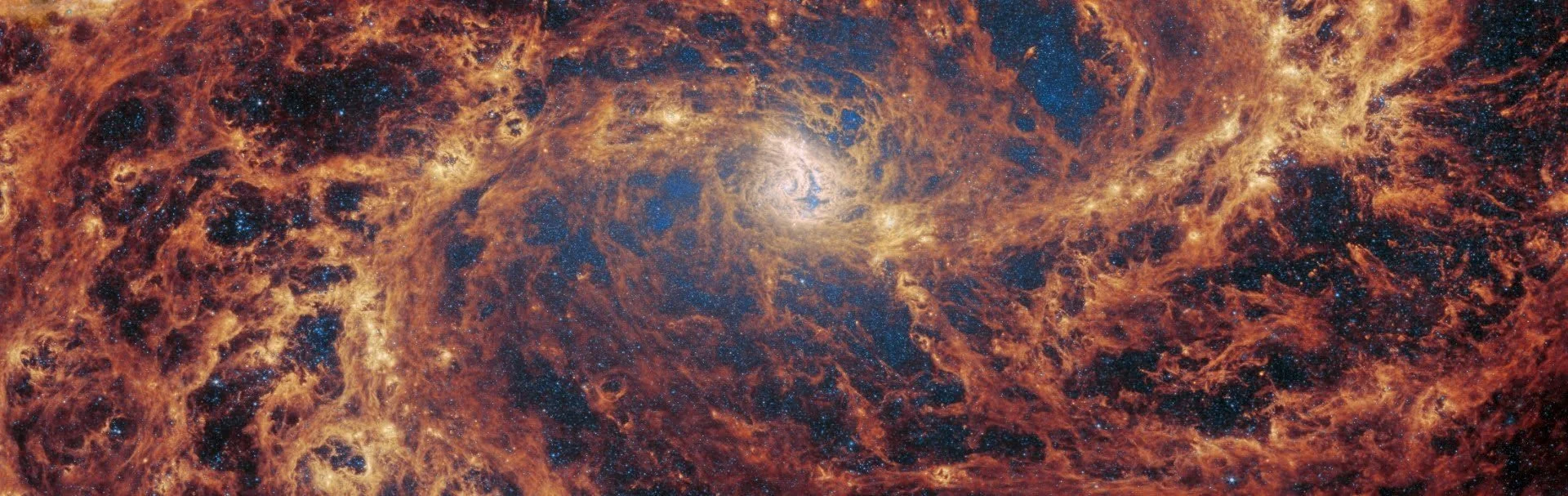
Spiral galaxy Messier 83 as seen by the James Webb Space Telescope. Credit: ESA/Webb, NASA & CSA
Stellar Ghosts in the Southern Pinwheel
When we look up at the night sky, it’s easy to imagine the cosmos as a place of permanence. The stars seem fixed. The galaxies appear timeless. Even the grand spirals of distant island universes look frozen against the darkness. But every so often, astronomers discover something that reminds us the universe is alive with change.
One such discovery comes from the beautiful spiral galaxy Messier 83, often called the Southern Pinwheel. Located some 15 million light-years away in the constellation Hydra, M83 is a galaxy rich in star formation and littered with the remains of stellar explosions. Hundreds of supernova remnants — the expanding debris clouds left behind when massive stars die — have been identified there. For decades, astronomers regarded these remnants as relatively slow-moving actors on the cosmic stage whose evolution unfolds over centuries and millennia.
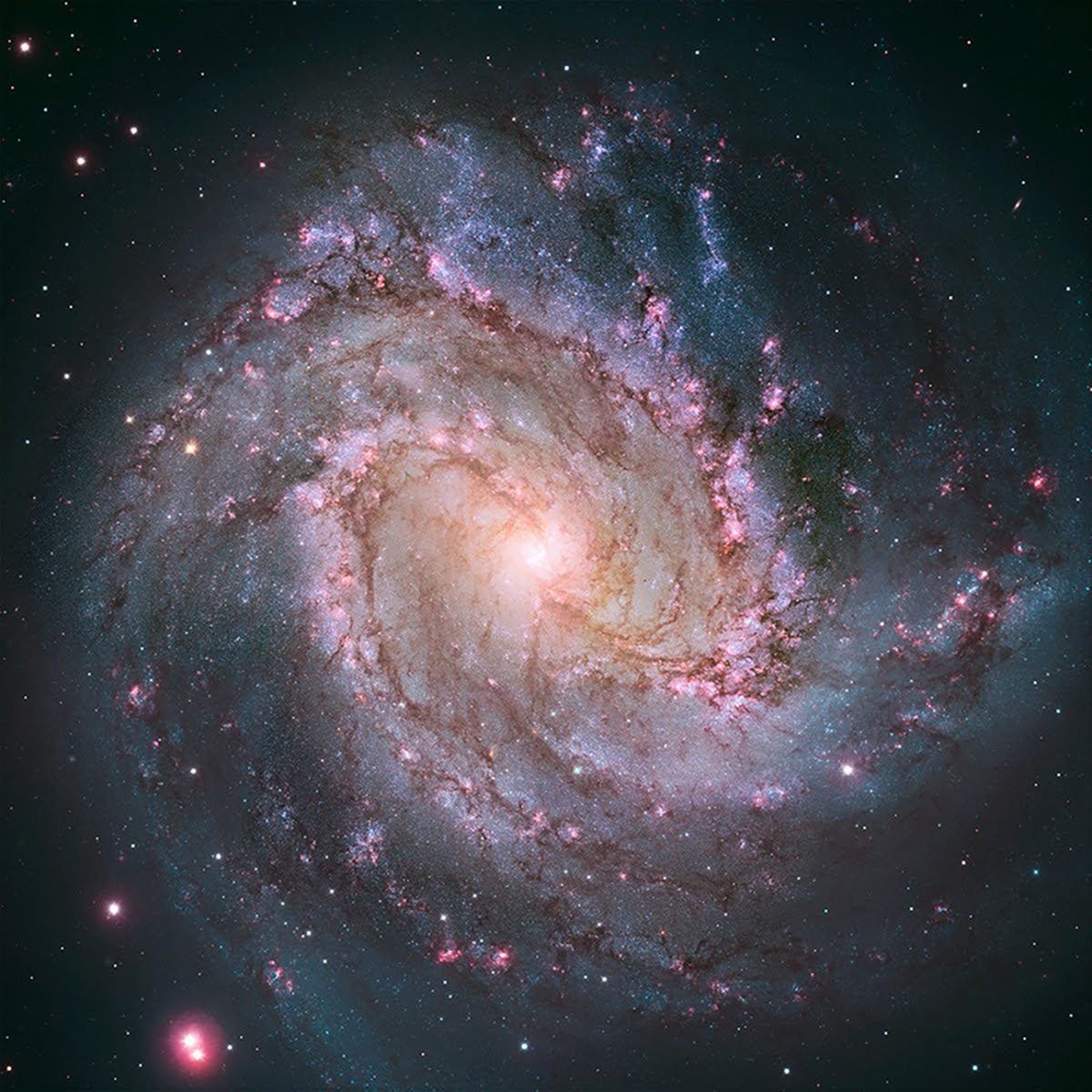
Image of galaxy M83 captured by the Hubble Space Telescope. Credit: NASA/ESA/AURA/STScI
Yet recent observations have revealed a surprise: some of these stellar ghosts appear to be changing brightness over periods of just a few years. In astronomical terms, it’s rather like watching a mountain grow before your eyes. By comparing observations taken over many years, researchers found that several of M83’s supernova remnants are brightening or fading in ways that can actually be measured.
These changes provide valuable clues about what happens after a star explodes. The expanding shock waves from the blast continue to plow through surrounding gas and dust, lighting up the environment and creating structures that evolve as they encounter different regions of interstellar space. What we’re witnessing is not the explosion itself — that happened long ago — but the ongoing conversation between a dead star and its surroundings. It is a reminder that the universe does not simply create and destroy; it recycles.
The elements forged inside stars are scattered into space by these titanic explosions. Over time, that material becomes part of new stars, new planets, and perhaps even future living things. The calcium in our bones and the iron in our blood were once created in ancient stars and dispersed by events much like the ones whose remnants we now observe in M83.
Seen from Earth, the Southern Pinwheel is a faint smudge in a telescope. Yet hidden within that distant spiral are countless stories unfolding in real time — vast clouds expanding, shock fronts colliding, and the lingering echoes of stars that ended their lives millions of years ago. Thanks to modern observatories, such as those atop Maunakea and in the Canary Islands, we can detect those subtle changes and watch these cosmic ghosts continue their slow dance across the ages.
The night sky often appears unchanging. But if we are patient enough, and if we keep looking, the universe reveals something remarkable: even the remnants of long-dead stars are still telling their story.
