
Bookmarks: “Angel Down” By Daniel Kraus
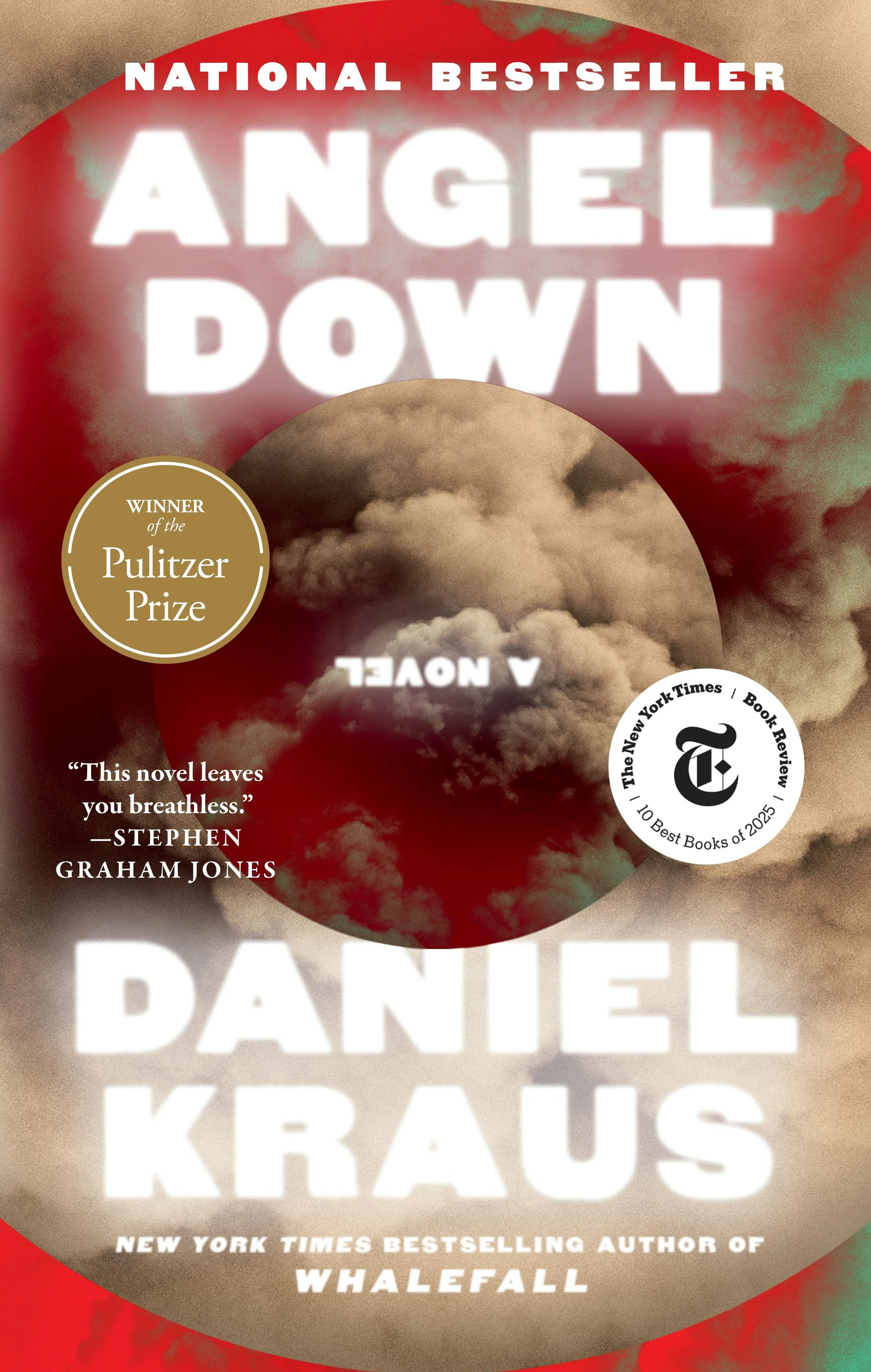
Published July 2025, Atria Books | Review By Drew Foster
Daniel Kraus will make you feel.
With his newest novel, “Angel Down”, you’ll feel the brutality of war – the whiz of bullets, the percussive bomb blasts, the nausea of death, the watery depths of a flooded, fetid trench. You’ll feel the bootheel of authority, the tenderness of compassion, the fleeting flicker of hope, the weighted yoke of despair. You’ll feel everything, all at once. And, eventually, you might even feel nothing at all.
“Angel Down”, a speculative novel set amidst the carnage of World War I, won the Pulitzer Prize for fiction in May. It’s no easy read – both its form and content are likely to turn off some readers. But it is vivid and immersive, imaginative and transportive. Written almost entirely in a single sentence – the only full stops occur within dialogue, which isn’t frequent – the novel’s structure produces a breakneck pace, hurtling the reader across intense battle scenes before meandering through stretches of uneasy calm.
Each clause begins with the lowercase “and”, including the novel’s start: “and Cyril Bagger considers himself lucky, he ought to be topped off, gone west, bumped, clicked it, pushing daisies, a new landowner, napooed, just plain dead …”
And so it goes.
Structure aside, the novel takes its most inventive turn when Bagger and his misfit cohorts come across an angel entangled in barbed wire. The angel isn’t a metaphor. She’s an actual fallen angel. Rescuing the angel, deciding her fate and sealing their own defines the rest of the novel. The angel has a way of bringing each soldier’s basest desire to the surface, often to that soldier’s detriment.
“Angel Down” is a timely work despite its historical setting. Google the title and you’ll receive an AI blurb that describes the book as a “horror novel.” This is patently false. “Angel Down” is not a horror novel. But it is replete with the horrors of war. Descriptions of gruesome injury, gory death, fiery exchange, and fields of bodies are frequent. Considering between 15 and 22 million people were killed in World War I, Kraus’ grisly focus is not hyperbole. It actually belies the novel’s central challenge – do you feel it? Do you feel the war?
Yes, you do.
Until, maybe, you don’t? As the novel progresses, a sort of desensitization takes place. The gore and brutality become commonplace. Tolerable. That, in and of itself, is brutal. And it’s a masterstroke by Kraus. He’s saying, this is what war does – it can kill something inside us. It can numb us.
About halfway through “Angel Down” I stopped regarding the book as a war novel and began to read it as an antiwar novel. I began to wonder, after the hundredth description of a war-ravaged corpse, how do we keep doing this? How do we, as humans, keep engaging in the viciousness of war? Not only with what happened over a century ago in Europe, but what’s happening right now in Palestine, in Ukraine, in Iran. How is this acceptable?
We watch snippets of these wars on the news, on social media, on YouTube – wherever – and we are at first repulsed and then resigned and then removed. We’re numb. Kraus’ novel achieves what great fiction is intended to do – it demands we refocus our attention, that we view accepted circumstances through a new lens. That we better understand what’s happening in our own real world by contemplating the actions of a fictitious one. “Angel Down” demands that you feel. And you will.
Especially when you don’t
