
Lāʻau Letters: Native Plants of Kaʻū (ʻAlaʻalawainui)
By Jodie Rosam
Artwork by Joan Yoshioka
Aloha to all of the plant lovers of Kaʻū – we are back and so grateful for the opportunity to continue to share about all of the amazing native plants of Kaʻū. If you are a new reader, welcome to Lāʻau Letters: Native Plants of Kaʻū. Each month, you can read about Kaʻū’s native plants and their moʻolelo (stories), uses, preferred habitats, opportunities to adopt them for stewardship, and other fun tidbits. This column really is a place for you to connect with new plants you may not know or to reignite your relationship with ones you already do. Because let’s face it - we need them more than they need us! To those who have read this column before (and thank you for doing so!), expect a slightly different structure than you are used to, but hopefully this will still be a helpful resource to you. Hawaiʻi is home to so many endemic (only found here) and endangered and truly unique plant species. Not only do they perform ecological and ecosystem services, but they connect us to who we are and where we came from. I encourage you to not only read and research about the plants that interest you (hopefully all of them), but to also seek them out (if possible, safely and legally) - smell them, touch them, observe them, listen to them. Dive deep into what they represent to you and form the relationship that keeps us thriving. And please use a Hawaiian dictionary or wehewehe.org to dissect the names to really uncover all of the connections these plants have to the universe, including all of us. Enjoy!
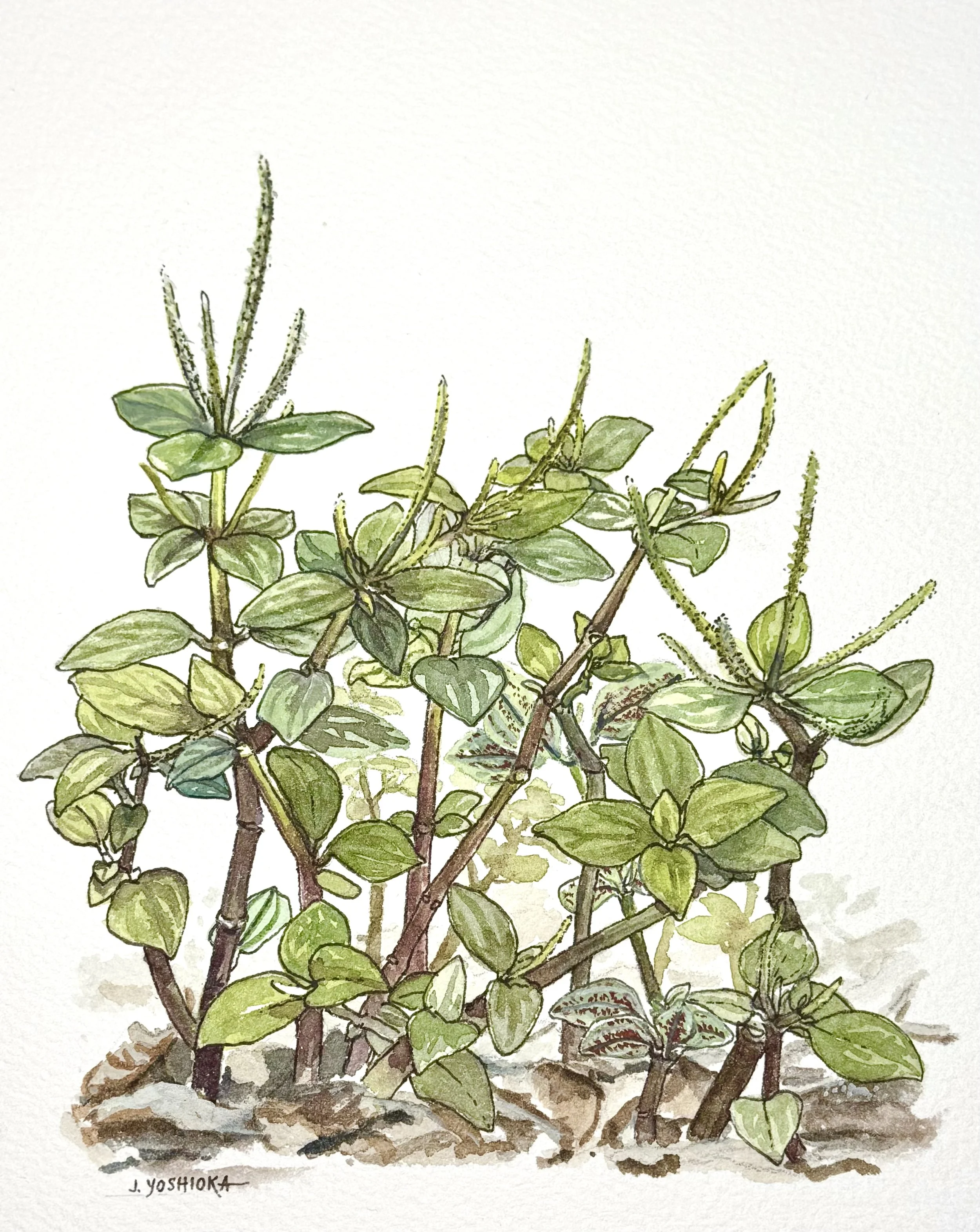
ʻAlaʻalawainui (Peperomia cookiana)
About: This month, I wanted to introduce you to a common forest friend that is all too often overlooked and underappreciated. But once you know what to look for, you will notice that they are relatively abundant in more intact mesic and wet forests and quite common in our forests here in Kaʻū. In June, we were exploring the canopy, watching ʻŌlapa dance in the breeze, but in July, I want to encourage you to move slowly and look down as you move through the forest. Often nestled around the bases of ʻŌhiʻa or even tucked into shady, moist pockets between the rocks lives a beautiful little succulent called ʻAlaʻalawainui. There are 25 species of Peperomia in Hawaiʻi, 23 of which are endemic, including P. cookiana. ʻAlaʻalawainui are small herbaceous plants in the Piperaceae or pepper family that can grow both terrestrially or epiphytically.
ʻAlaʻalawainui have thick, chunky stems that can easily be broken by a misplaced step of the unaware hiker, but if you do happen to accidentally break one, just place it in some wet moss and it will likely resprout. The leaves can be round or triangular, densely-packed together or sometimes spaced widely, depending on its habitat. This particular species has red markings on the underside of its leaves, which is one of my personal favorite characteristics. The flowers lack a perianth (petals and sepals) and instead are borne on a spike, or inflorescence, that is typically cream-colored and can grow several inches tall. It produces many teeny, black seeds that do have a slight peppery taste to them.
A healthy ʻAlaʻalawainui patch is an indicator of a healthy forest microclimate that receives plenty of rainfall. ʻAlaʻalawainui can be thought of as the path of big water, as they tend to grow where water collects in cracks, crevices, and caves. For me, seeing a batch of ʻAlaʻalawainui is comforting. It feels like you are in a magical sweet spot of the forest where all of the plant people are thriving.
Uses: Aside from being a key player in our native forests, ʻAlaʻalawainui are medicinal. In a Bishop Museum Bulletin written by Handy et al. in 1934, ʻAlaʻalawainui was ranked among some of the most commonly used plants in traditional Hawaiian medicine, though it is unclear which species of Peperomia was used. It does mention that ʻAlaʻalawainui was used to treat a variety of troubles related to female reproductive health, including uterine abnormalities and irregular menstrual periods. In the Kumulipo, ʻAlaʻalawainui is paired with ʻAʻalaʻula, a seaweed belonging to the genius Codium. If ʻAlaʻalawainui was the primary plant used for a treatment, ʻAʻalaʻula was used as the pani or closing treatment.
Growing: ʻAlaʻalawainui are very easy to grow and should be in everyone’s landscape if they are not already. First, find your favorite ʻAlaʻalawainui patch, and ask its permission to propagate. If you choose to grow from seeds (do-able but not as easy as cuttings), you want to gather spikes that have mature fruits on them. You will know they are mature if they stick to your hand. Those fruits can be gently removed (I have used a small squirt bottle to spray off) and scattered into a wet media, or you can place the entire spike in. Cuttings root very easily and are my preferred method of propagation. Just about any size cutting will do, so make your cuts clean and at the nodes. As always, when choosing the right media, you want to mimic its optimal natural conditions. Peat moss, soil, and cinder work great, but maybe a nearby tree trunk will loan you some moss for you to start your cuttings in. I have even had success placing cuttings in a cup of water and planting them out once they take root. When you choose a home for your new ʻAlaʻalawainui babies, consider the location very carefully, remembering that they are an indicator of places where rainwater collects, even at the micro scale. When your plant expands, you can divide it at the roots to create more ʻAlaʻalawainui to enjoy. So get out into the forest, take it slow, look down, and meet the beautiful ʻAlaʻalawainui this month!
As always, if you have any questions about what you read, feel free to ask me! jodie.rosam@gmail.com
About the artist: Joan Yoshioka is a conservationist at heart and has dedicated her life to preserving the native plants and animals of Hawaiʻi through her work with various federal, state, and private organizations over the past 30+ years. She describes herself as an outdoor-lovin' optimist, biologist/botanist, and habitual creator of art-stuff. She believes the key to our most fundamental and truest part of ourselves is found in nature and she constantly draws on it for inspiration.
About the author: Jodie Rosam has a deep love for native plants and a passion for exploration, with over 20 years of experience stewarding Hawaiʻi’s forests. She works for The Nature Conservancy and with Hawaiʻi Wildlife Fund, and serves on many non-profit boards. Jodie wears her love for Hawaiʻi’s native plants on her sleeve, and thrives on sparking a love for nature in her children, making new friends in the plant kingdom, and sharing her passion with others. When she is not in the forest, you can find Jodie rooting for her boys at baseball or keeping their fishing pole hooks baited! Feel free to send questions to her email: jodie.rosam@gmail.com.
