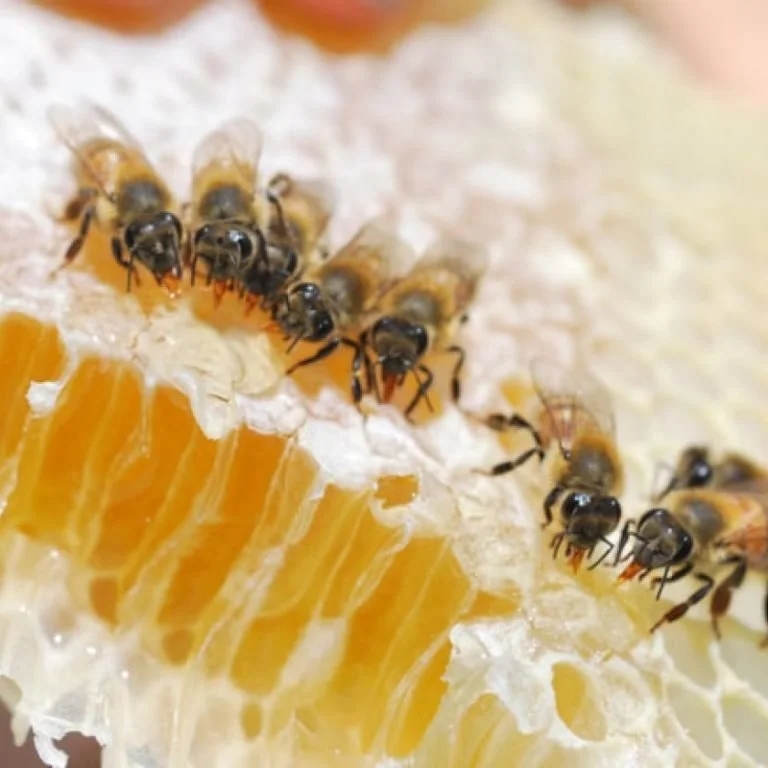
Lookout! It’s honey bee swarming season in Kaʻū

By Alison Yahna
The good news is that after more than a decade of declining bee populations, honey bee swarms are becoming common in Kaʻū again, and it is the season. The downside is that a swarm is a colony of bees looking for a home, and they might choose yours!
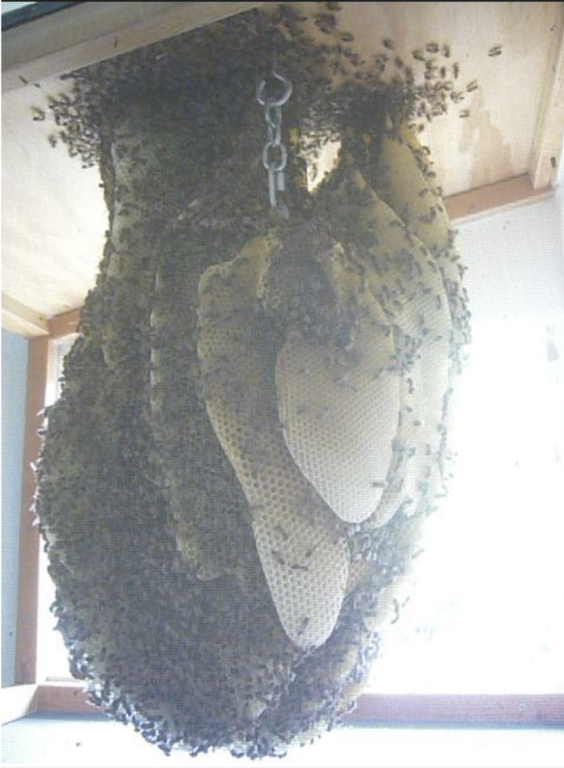
Honey bee colonies that take up residence on your property can be inconvenient and expensive to remove, and for some colonies, even dangerous. This article will explain what a swarm is, what a swarm is looking for, and how to prevent bees from moving into your walls, ceiling, electrical boxes, or some other problematic space. Swarms can come from both wild and domestic colonies, and will often travel miles from their “mother hive” in search of a new home. Once they move in and begin building new honey and brood combs (the ‘baby nursery’), the removal process can be destructive and expensive, as it requires the beekeeper to open up the space and remove the combs, as well as the bees. It is best to be informed and alert to prevent bees from moving in to begin with.
What is a honey bee swarm? Unlike solitary bees, honey bees are a super-organism and reproduce like an amoeba by splitting into two colonies. When there is plenty of nectar available, bees swarm. Nectar from ʻōhiʻa lehua or Christmas berry trees provides food to build new wax combs and stock them with honey.
When an existing hive has no more room to expand or when their reproductive instincts kick in, they will send the queen and about half of their population (30,000 bees) out of the hive. The separated bees and queen take to flight in a spectacular aerial dance. After some time in the air, the queen will settle on a nearby branch, and the whole colony will land and cluster around her. The original hive will raise a new queen, who will inherit its well-stocked larder and the 30,000 bees who stayed behind.
If you see a large cluster of bees hanging from a tree branch or other object, this is a swarm that has recently split from its home and is looking for a new one. This is the ideal time to gather the bees, and most beekeepers will welcome the opportunity to collect a new colony of bees. Swarms are generally very gentle and will not sting unless provoked. They can be easily gathered simply by cutting off the branch they are sitting on and shaking it into an empty beehive. Many beekeepers, including yours truly, are comfortable gathering a swarm without using smoke or even protective gear.
Once a swarm has landed and settled around their queen, they will send out many scout bees, who will search for their new home. The bees are drawn to spaces off the ground where they are protected from light and water. A hollow tree trunk is attractive, as is the hollow between a double wall, an attic, or the cabinet under a kitchen sink. As long as there is an opening from the outside just large enough for a honey bee to enter, the scout may decide this space is a potential new home. When a scout has found what she is looking for, she will mark it with her scent and fly back to the swarm and report her findings by performing a dance on the bodies of her fellow worker bees. Her dance will describe the location and quality of the site she found. A good dancer bee will recruit other bees who will visit the site and return back to the swarm and dance, and recruit even more scouts. On a single honey bee swarm cluster, there may be thousands of bees dancing for three or four different potential new home locations.
In the hours before the swarm makes a group decision and flies off to take up residence, you may prevent them from choosing your home by noticing the scout bees who are flying around, in and out of a small opening where a pipe goes into a wall, under the roof eaves, or a similar entrance. Unlike bees who are nested inside a wall already and zipping in and out with purpose, scout bees will be circling around, investigating nooks and crannies, and obviously exploring. There may be a few hundred scouts investigating the site. The difference between a few dozen scout bees and the roaring hum of 30,000 bees that marks the arrival of a swarm will be unmistakable. The key to preventing this is to make the site unattractive and/or inaccessible to the scouts.
If you notice scout bees, the first thing to do is block up the entrance to the cavity. Use what you have at hand. Rags, cork, tinfoil, caulking, and even newspaper can be used to block the opening. Do not worry (unless you are allergic) about getting stung by the scout bees. They are not likely to sting as they have no queen to die protecting; they are simply investigating. You can spray a little Raid or other chemical repellent or even stuff a few mothballs into the cavity. The scent of the pesticide will make the space unappealing.
You may provide the bees with an alternative home site by placing a “swarm trap” near the location where you notice scouts. A wooden or cardboard box with a sturdy top and bottom and a small hole cut into it can be tied or screwed onto the wall, under the eaves or in the branches of a nearby tree. It can be baited with lemongrass, orange oil, beeswax or honey. Place the swarm trap well off the ground. Cardboard coolers sold at Target or large peat or ceramic pots can be used, as long as there is a small opening for the bees to go in and out. Some beekeepers have swarm traps manufactured by bee supply companies, and may provide this service, especially if your location has attracted multiple swarms. Once the colony has moved into the swarm trap, you can call a beekeeper to remove it. If you are interested in keeping bees yourself, the beekeeper can help you set them up in a hive on your property. You will need to purchase a hive body and the tools (smoker, veil, etc.) to work with the bees, and it is a good idea to take a class or seek a mentor.
What if the bees move in? Many people here in Kaʻū share their homes with bees, and come to enjoy the sound of their humming, their pollination services, and the candy factory scent that wafts from the hive when they are making honey. If the bees move in, as long as their entrance is not near a door, they are not aggressive or causing too much of a nuisance by getting inside the house, it may not be worth the trouble and expense of removing them. Unlike termites, bees generally do not chew or cause structural damage to a building. My “kitchen hive” lived in my house for many years, surrounded by a screened box. They flew in and out the window. I have seen other folks cut and place a screen or glass on the inside wall over the colony to enjoy observing the hive!
If living with the bees is not possible, you may contact a local beekeeper to remove the colony. Depending on the location, size, and age of the colony and other factors, the removal can cost a few hundred dollars or more. Often, beekeepers will leave the honey they gather for the owner, a little sweet compensation for the trouble. After the bees are gone, you may need to hire a repairman to replace siding or drywall that has been removed in the process.
Many pest removal companies do not remove honey bees. For a comparable fee, they may be willing to kill them with poison, but that leaves the dead bees and comb to rot inside the cavity, attracting hive beetle maggots, rodents, and other problems. Honey from poison-killed hives should never be eaten.
An ounce of prevention is worth a pound of cure! Inspect your home for possible hive locations during swarming seasons. Seal and caulk cracks and openings where bees may enter. When building a new home or other building, make sure the gaps between siding and roof, the ventilation holes in the foundation or attic, and the openings around pipes are well sealed, caulked, or covered with a metal hardware cloth (1/8”). Swarms happen when there is a nectar flow, and although more common during late summer and fall, they can happen year-round here in Hawaii. Notice what plants are in bloom in your area. Pāhala, for example, will experience swarms during the macadamia nut bloom, while in Waiʻōhinu, swarms are most common from June to August as Christmas Berry trees provide an abundant nectar flow.
This author has recently been called to remove swarms and so-called nuisance colonies that have moved into house walls or other inconvenient places. For swarm or colony removal, contact a local beekeeper such as the author at ArtemisSmiles.com.