
Stars Over Kaʻū: July 2025
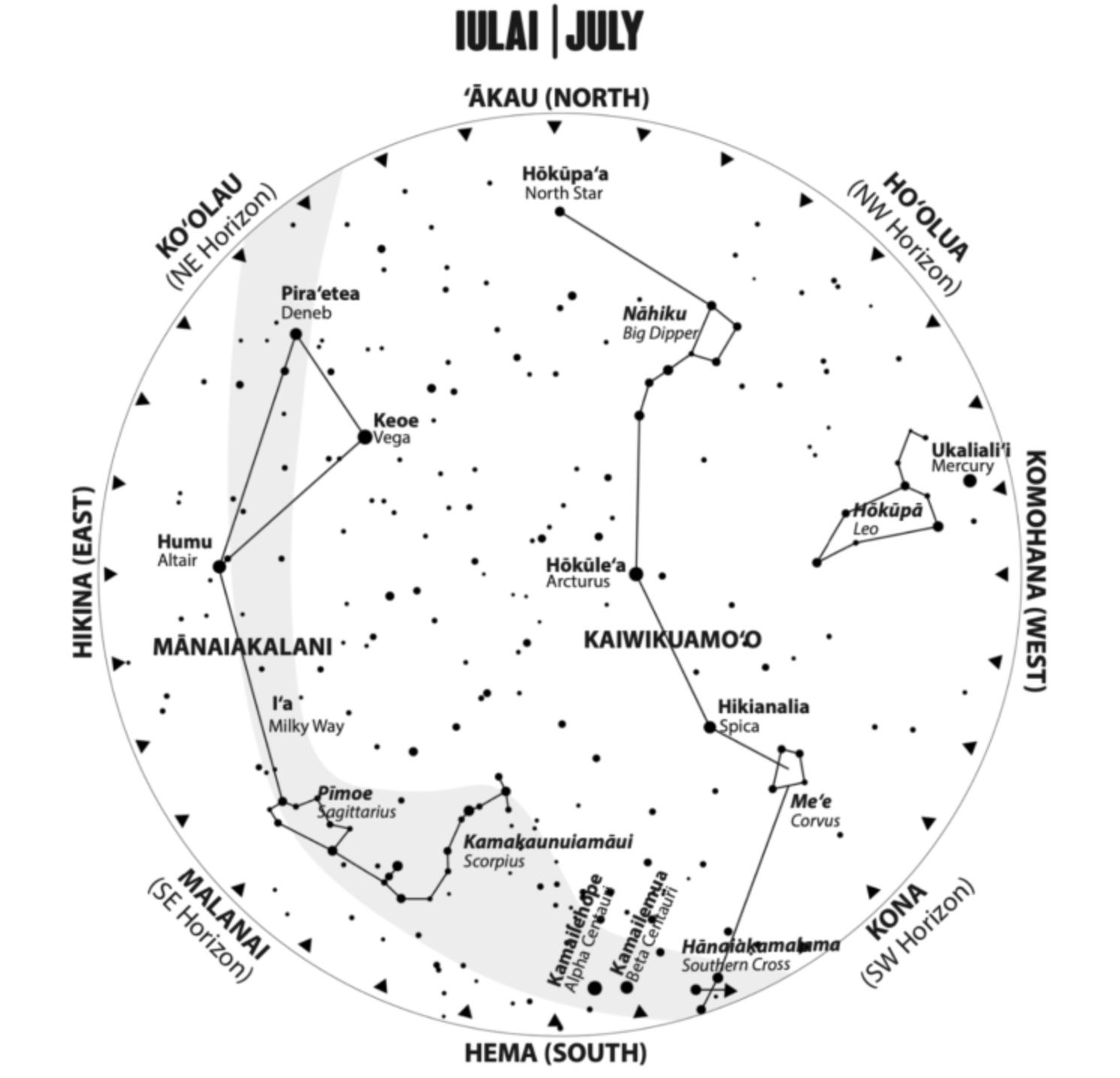
Image credit: ʻImiloa Astronomy Center of Hawaiʻi
By Christopher Phillips
Aloha Stargazers! July’s skies bring a dynamic mix of planetary sights, with gems visible both after sunset and in the quiet hours before sunrise. Early in the month, Mercury (ʻUkalialiʻi) makes a brief but charming appearance low in the western sky just after sunset. It sets quickly and disappears by July 6th, so catch it early with a clear view of the horizon. Mars (Holoholopinaʻau) shines steadily in the eastern sky after sunset all month long, its warm reddish light unmistakable to the keen-eyed observer. In the early morning hours, Venus (Hōkūloa) takes center stage in the east and southeast. Rising long before sunrise, this dazzling morning star is a reliable and radiant companion throughout July. As the month progresses, Jupiter (Ikaika) begins to climb back into view. Look for it low in the eastern sky just before sunrise by late July. Saturn (Naholoholo) follows suit, rising after midnight and standing high in the southeast before dawn during the final week of the month. Its soft golden hue makes it a quiet standout in the predawn stillness. Whether you’re stargazing in the evening or welcoming the new day under a dark sky, July’s heavens promise wonder for those who take the time to look up.
Image credit: ʻImiloa Astronomy Center of Hawaiʻi
Our Hawaiian Sky
This month the Hawaiian starline of Ka Iwikuamo‘o (The Backbone) continues to be prominent in our night sky. It is sometimes represented as the backbone of a great lizard or that of a genealogical backbone, with each star representing a generation. This magnificent starline begins in the North (ʻĀkau) and extends from Hōkūpaʻa (Fixed star) which in western tradition is known as the North star, Polaris. Our starline extends all the way South (Hema) to Hānaiakamalama (Cared for by the Moon), which is known as the Southern Cross. The line can be traced through the various constellations that make up Ka Iwikuamoʻo just as one can trace oneʻs own genealogy. A path from one’s self to one’s ancestors, back through time. Each set of stars is a unique entity with its own identity.
During this month we also see another starline rise to prominence, Mānaiakalani, which is known by several names depending on translation. It can be known as The Chiefʻs Fish Line, Come-From-Heaven, or Maui’s Fish Hook. The rise of this starline in our evening sky marks our transition to the stars of summer. The starline is composed of several notable asterisms, which are collections or patterns of stars. The largest of these is the fishing spool, made up of a great triangle of three bright stars. This trio is referred to as The Navigator’s Triangle (Huinakolu). Within it are the stars of Piraʻatea, Keoe, and Humu. You may also know these stars by their Arabic names, Deneb, Vega, and Altair, respectively. The fishing line extends to the constellation of Sagittarius, which in this context is Pimoe, the giant ulua fish. Next to this is the distinctive shape of the hook itself, Ka Makau Nui o Māui, also known as Scorpio, the scorpion.
The region dominated by Pimoe, and Ka Makau Nui o Māui also marks the center of our galaxy, the Milky Way. On a moonless night, the bright core of the galaxy, filled with the light of millions of stars, is a sight to behold. On either side, the great spiral arms of the Milky Way can be seen extending out from the bright core, with vast dark clouds of star forming material silhouetted against the light of countless stars.
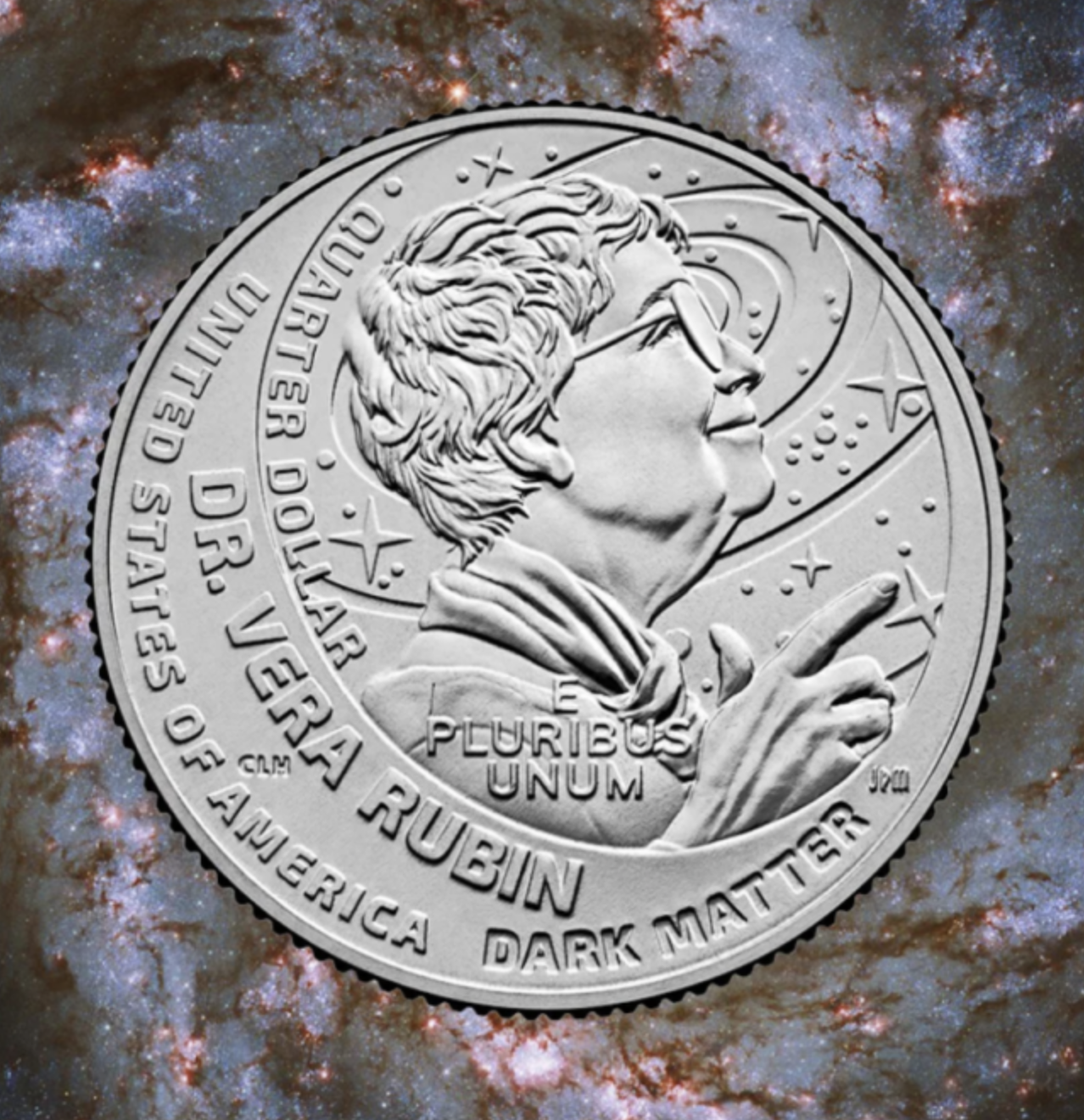
Image credit: US Mint
Vera C. Rubin Observatory Releases First Images as Commemorative U.S. Quarter Celebrates Her Legacy
A new chapter in astronomy has begun. On June 23rd, the Vera C. Rubin Observatory in Chile released its first-ever images of the night sky, marking a major milestone for one of the most ambitious sky surveys in history. At the same time, a new U.S. quarter featuring Rubin herself has entered circulation, honoring her groundbreaking contributions to our understanding of the universe. The Rubin Observatory, perched atop Cerro Pachón in northern Chile, is designed to capture the entire southern sky every three nights with its 3.2-gigapixel camera, which is the largest ever built for astronomy. These early images were revealed during a special livestream event, hosted by scientists from the Rubin team and viewed by audiences across the globe, including watch parties in planetariums, universities, and science museums.
With its ability to scan wide fields of view in extreme detail, the observatory will soon begin its 10-year Legacy Survey of Space and Time (LSST). This ambitious effort will catalog billions of stars and galaxies, and detect supernovae, asteroids, and perhaps most importantly the subtle gravitational effects of dark matter, a subject Rubin herself helped pioneer. Her work in the 1970s on galaxy rotation curves provided the first strong evidence that most of the matter in the universe is invisible.
Coinciding with this scientific milestone, the U.S. Mint has released a quarter featuring Vera Rubin as part of its American Women Quarters Program. The design shows Rubin looking skyward beside a swirling spiral galaxy, an homage to the very structures she studied in her dark matter research. The coin, released in 2025, ensures her legacy reaches far beyond the astronomy community, into classrooms, collections, and coin purses across the country.
Rubin’s long-overdue recognition serves as a reminder that astronomy is not only about looking up, it is also about honoring those who’ve led us there. The observatory that bears her name will provide an unprecedented view of the universe, night after night, year after year. And now, as her image orbits through circulation alongside our own daily journeys, we’re all invited to carry a piece of the cosmos with us.

Image credit: RubinObs/NOIRLab/NSF/AURA/H. Stockebrand
